Search
Invitrogen
Neurocan Polyclonal Antibody
{{$productOrderCtrl.translations['antibody.pdp.commerceCard.promotion.promotions']}}
{{$productOrderCtrl.translations['antibody.pdp.commerceCard.promotion.promocode']}}: {{promo.promoCode}} {{promo.promoTitle}} {{promo.promoDescription}}. {{$productOrderCtrl.translations['antibody.pdp.commerceCard.promotion.learnmore']}}
{{$ctrl.translations['antibody.pdp.skuNotes.additionalInformation']}}:
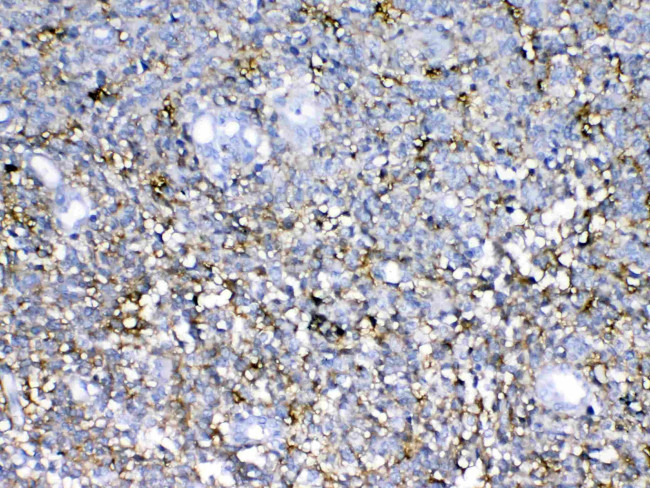
图: 1 / 5
Neurocan Antibody (PA5-79718) in IHC (P)
Immunohistochemistry analysis of Neurocan on paraffin-embedded human glioma tissue. Antigen retrieval was performed using citrate buffer (pH6, epitope retrieval solution) for 20 mins. Sample was blocked using 10% goat serum, incubated with Neurocan polyclonal antibody (Product# PA5-79718) with a dilution of 1 µg/mL (overnight at 4°C), and followed by biotinylated goat anti-rabbit IgG (30 minutes at 37°C). D... View More
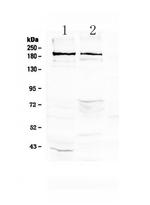
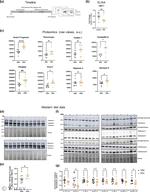
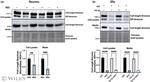
Please note: We are reviewing Western blot images included in the antibody testing data in our catalog, including those provided by third parties. Unless expressly labeled or annotated as “raw-unedited”, Western blot images included in the antibody testing data in our catalog may have been edited, optimized or otherwise adjusted for presentation.


产品信息
PA5-79718
产品规格
种属反应
Human,
Mouse,
Rat
已发表种属
Mouse
宿主/亚型
Rabbit
/ IgG
分类
Polyclonal
类型
Antibody
抗原
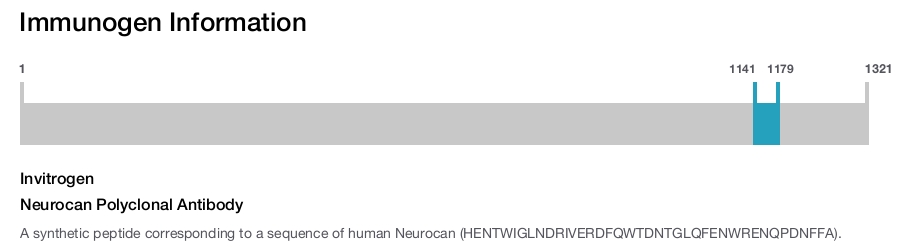
A synthetic peptide corresponding to a sequence of human Neurocan (HENTWIGLNDRIVERDFQWTDNTGLQFENWRENQPDNFFA).
偶联物
Unconjugated
Unconjugated
Unconjugated
形式
Lyophilized
浓度
500 µg/mL
规格
100 µg
纯化类型
Antigen affinity chromatography
保存液
PBS with 4mg trehalose
内含物
0.05mg sodium azide
保存条件
-20°C
运输条件
Ambient (domestic); Wet ice (international)
RRID
产品详细信息
Reconstitute with 0.2 mL of distilled water to yield a concentration of 500 µg/mL.
Positive Control - WB: rat brain tissue, rat testis tissue. IHC: human glioma tissue, mouse brain tissue.
靶标信息
Neurocan is a gene encoding a large chondroitin sulfate proteoglycan, predominantly expressed in the central nervous system. Located on chromosome 19 in humans, neurocan is part of the lectican family of proteoglycans, integral to the extracellular matrix where they modulate neuronal cell adhesion and migration. This proteoglycan is essential in the formation of the neural network during development and in maintaining the plasticity of the extracellular matrix in adult brains. Neurocan undergoes proteolytic processing, resulting in various fragments that influence neuronal growth and synapse stabilization. Altered neurocan expression has been linked to several neurological conditions such as schizophrenia, bipolar disorder, and Alzheimer's disease, likely due to its role in synaptic function and integrity of the neural matrix. Understanding neurocan's exact roles in neurological health and disease could illuminate pathways for potential therapeutic interventions targeting matrix remodeling and neuronal connectivity.
仅用于科研。不用于诊断过程。未经明确授权不得转售。
生物信息学
蛋白别名: 245 kDa early postnatal core glycoprotein; aggrecan proteoglycan family; chondroitin sulfate proteoglycan 3; chondroitin sulfate proteoglycan 3 (neurocan); chondroitin sulfate proteoglycan 3, related sequence; neurocan core protein-like; neurocan proteoglycan; proteoglycan; TGFbeta-induced transcript, brain; unnamed protein product
基因别名: C230035B04; CSPG3; Cspg3-rs; Tgfbit
UniProt ID: (Human) O14594, (Mouse) P55066
Entrez Gene ID: (Human) 1463, (Rat) 58982, (Mouse) 13004
Disclaimer

Clicking the images or links will redirect you to a website hosted by BenchSci that provides third-party scientific content. Neither the content nor the BenchSci technology and processes for selection have been evaluated by us; we are providing them as-is and without warranty of any kind, including for use or application of the Thermo Fisher Scientific products presented.

