Search
Agrisera
NodGS/Nodulin/glutamate-ammonia ligase-like protein Polyclonal Antibody
{{$productOrderCtrl.translations['antibody.pdp.commerceCard.promotion.promotions']}}
{{$productOrderCtrl.translations['antibody.pdp.commerceCard.promotion.viewpromo']}}
{{$productOrderCtrl.translations['antibody.pdp.commerceCard.promotion.promocode']}}: {{promo.promoCode}} {{promo.promoTitle}} {{promo.promoDescription}}. {{$productOrderCtrl.translations['antibody.pdp.commerceCard.promotion.learnmore']}}
Additional Information:
{{banner.description}}
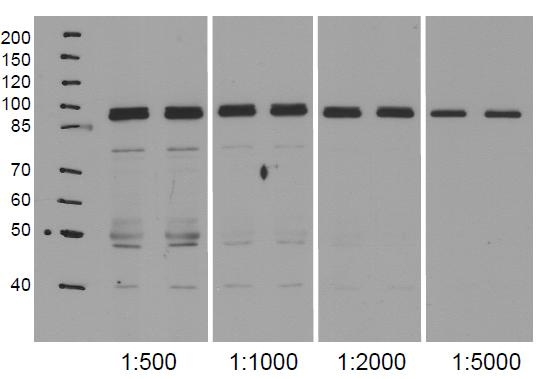
图: 1 / 1
NodGS/Nodulin/glutamate-ammonia ligase-like protein Antibody (AS15-3030) in WB
4,5 of total protein (supernatant after 1 h at 25.000 xg) from Arabidopsis thaliana suspension culture extracted with 50 m M HEPES p H 7,5/75 m M Na Cl/1 m M EGTA/1 m M Mg Cl 2/1 m M Na F in the presence of protease inhibitors were separated on 8% SDS-PAGE and blotted 1,5 h to a nitrocellulose membrane using tank transfer. Blots were blocked with 5% milk for 1 h at room temperature (RT) with agitation. Blot... View More

产品信息
AS15-3030
产品规格
种属反应
Plant
宿主/亚型
Rabbit
分类
Polyclonal
类型
Antibody
抗原
KLH-conjugated synthetic peptide derived from a C-terminal of Arabidopsis thaliana NodGS.
偶联物
Unconjugated
Unconjugated
Unconjugated
形式
Lyophilized
保存液
whole serum
内含物
no preservative
保存条件
-20°C, Avoid Freeze/Thaw Cycles
运输条件
Ambient (domestic); Wet ice (international)
产品详细信息
Store lyophilized/reconstituted at -20°C; once reconstituted make aliquots to avoid repeated freeze-thaw cycles. Please remember to spin the tubes briefly prior to opening them to avoid any losses that might occur from material adhering to the cap or sides of the tube.
For reconstitution add 50 µL of sterile water.
Specific Species Reactivity: Arabidopsis thaliana
靶标信息
NodGS encodes a plant-specific, cytoplasm-associated fusion protein found predominantly in the cytosol with additional association to endomembranes in the perinuclear region, and it can co-localize with microtubules and bind gamma-tubulin; structurally, it is a multi-exon, protein-coding locus whose product contains an N-terminal nodulin-like region with an amidohydrolase-like domain and a C-terminal glutamine synthetase type I-like module, consistent with a chimeric architecture that supports higher-order assembly. Biochemically, NodGS self-assembles into large oligomers (reported around ~700 kDa) and can be incorporated into even larger heterogeneous protein complexes, suggesting a scaffolding or regulatory role rather than acting solely as a soluble metabolic enzyme. Functionally, experimental perturbation (e.g., RNAi knockdown) implicates NodGS in root morphogenesis and root developmental processes, and its transcript abundance increases following flagellin exposure, linking the gene to innate immune signaling responses; together, these data support a model in which NodGS couples cytoskeletal/endomembrane organization with signaling pathways that influence root development and responses to bacterial elicitors.
仅用于科研。不用于诊断过程。未经明确授权不得转售。
篇参考文献 (0)
您是否在文献中引用过该产品?请点击下方按钮邮件告知我们。
生物信息学
蛋白别名: AT3G53180; F4J9A0; Nodulin/glutamine synthase-like protein; NP_190886
Disclaimer

Clicking the images or links will redirect you to a website hosted by BenchSci that provides third-party scientific content. Neither the content nor the BenchSci technology and processes for selection have been evaluated by us; we are providing them as-is and without warranty of any kind, including for use or application of the Thermo Fisher Scientific products presented.

