Search
Invitrogen
OPRL1 Polyclonal Antibody
{{$productOrderCtrl.translations['antibody.pdp.commerceCard.promotion.promotions']}}
{{$productOrderCtrl.translations['antibody.pdp.commerceCard.promotion.promocode']}}: {{promo.promoCode}} {{promo.promoTitle}} {{promo.promoDescription}}. {{$productOrderCtrl.translations['antibody.pdp.commerceCard.promotion.learnmore']}}
{{$ctrl.translations['antibody.pdp.skuNotes.additionalInformation']}}:
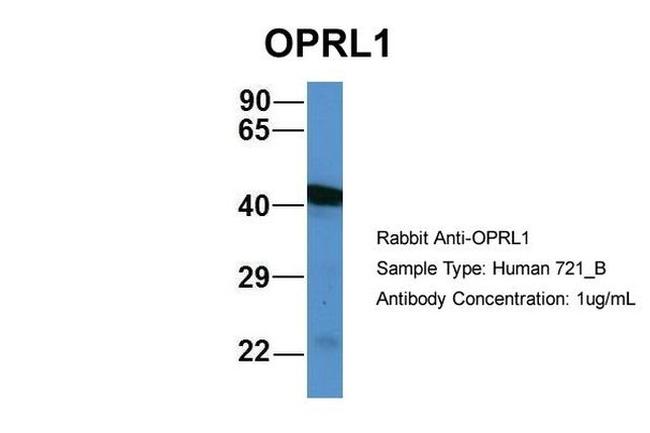
Please note: We are reviewing Western blot images included in the antibody testing data in our catalog, including those provided by third parties. Unless expressly labeled or annotated as “raw-unedited”, Western blot images included in the antibody testing data in our catalog may have been edited, optimized or otherwise adjusted for presentation.


产品信息
PA5-70443
应用
建议稀释比
已发表文章
产品规格
种属反应
Human
已发表种属
Mouse
宿主/亚型
Rabbit
/ IgG
分类
Polyclonal
类型
Antibody
抗原
synthetic peptide directed towards the middle region of human OPRL1
偶联物
Unconjugated
Unconjugated
Unconjugated
形式
Liquid
浓度
0.5 mg/mL
规格
50 µg
纯化类型
Affinity chromatography
保存液
PBS with 2% sucrose
内含物
0.09% sodium azide
保存条件
-20°C, Avoid Freeze/Thaw Cycles
运输条件
Ambient (domestic); Wet ice (international)
RRID
产品详细信息
This target displays homology in the following species: Cow: 100%; Dog: 100%; Goat: 100%; Guinea Pig: 100%; Horse: 100%; Human: 100%; Mouse: 100%; Rabbit: 100%; Rat: 100%; Sheep: 100%; Zebrafish: 100%
靶标信息
The G-protein-coupled receptor (GPCR) superfamily is comprised of an estimated 600-1,000 members and is the largest known class of molecular targets with proven therapeutic value. The nociceptin receptor is a G-protein coupled opioid receptor that functions as receptor for the endogenous neuropeptide nociceptin. Ligand binding causes a conformation change that triggers signaling via guanine nucleotide-binding proteins (G proteins) and modulates the activity of down-stream effectors. Signaling via G proteins mediates inhibition of adenylate cyclase activity and calcium channel activity. Arrestins modulate signaling via G proteins and mediate the activation of alternative signaling pathways that lead to the activation of MAP kinases. Plays a role in modulating nociception and the perception of pain. Plays a role in the regulation of locomotor activity by the neuropeptide nociceptin.
仅用于科研。不用于诊断过程。未经明确授权不得转售。
生物信息学
蛋白别名: G protein-coupled receptor; G-protein coupled receptor; kappa-type 3 opioid receptor; kappa3-related opioid receptor; LC132 Receptor-Like; nociceptin/orphanin FQ receptor; opiate receptor-like 1; opioid receptor; OPPRL1; OPRL1; ORL1; orphanin FQ receptor; splice variant of KOR-3 gene
基因别名: KOR-3; KOR3; NOCIR; NOP; NOPr; OOR; OPRL; ORL1; PNOCR
UniProt ID: (Human) P41146
Entrez Gene ID: (Human) 4987
G-protein coupled receptor signaling pathway
adenylate cyclase-inhibiting G-protein coupled receptor signaling pathway
phospholipase C-activating G-protein coupled receptor signaling pathway
neuropeptide signaling pathway
neuron-neuron synaptic transmission
sensory perception
sensory perception of pain
calcium-mediated signaling
opioid receptor signaling pathway
Disclaimer

Clicking the images or links will redirect you to a website hosted by BenchSci that provides third-party scientific content. Neither the content nor the BenchSci technology and processes for selection have been evaluated by us; we are providing them as-is and without warranty of any kind, including for use or application of the Thermo Fisher Scientific products presented.

