Search
NeoBiotechnologies
Occludin (Marker of Early Blood Brain Barrier Damage) Monoclonal Antibody (MSVA-415M)
{{$productOrderCtrl.translations['antibody.pdp.commerceCard.promotion.promotions']}}
{{$productOrderCtrl.translations['antibody.pdp.commerceCard.promotion.viewpromo']}}
{{$productOrderCtrl.translations['antibody.pdp.commerceCard.promotion.promocode']}}: {{promo.promoCode}} {{promo.promoTitle}} {{promo.promoDescription}}. {{$productOrderCtrl.translations['antibody.pdp.commerceCard.promotion.learnmore']}}
Additional Information:
{{banner.description}}

产品信息
100506658-MSM29-P1
产品规格
种属反应
Human
宿主/亚型
Mouse
/ IgG1, kappa
分类
Monoclonal
类型
Antibody
克隆号
MSVA-415M
抗原
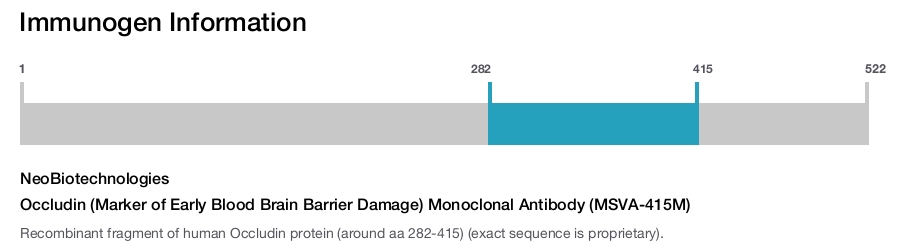
Recombinant fragment of human Occludin protein (around aa 282-415) (exact sequence is proprietary).
偶联物
Unconjugated
Unconjugated
Unconjugated
形式
Liquid
浓度
200 µg/mL
规格
100 µg
纯化类型
Protein G
保存液
PBS with 0.05% BSA
内含物
0.05% sodium azide
保存条件
4°C
运输条件
Ambient (domestic); Wet ice (international)
产品详细信息
Product cellular localization: Cell junction, Cell membrane, Tight junction.
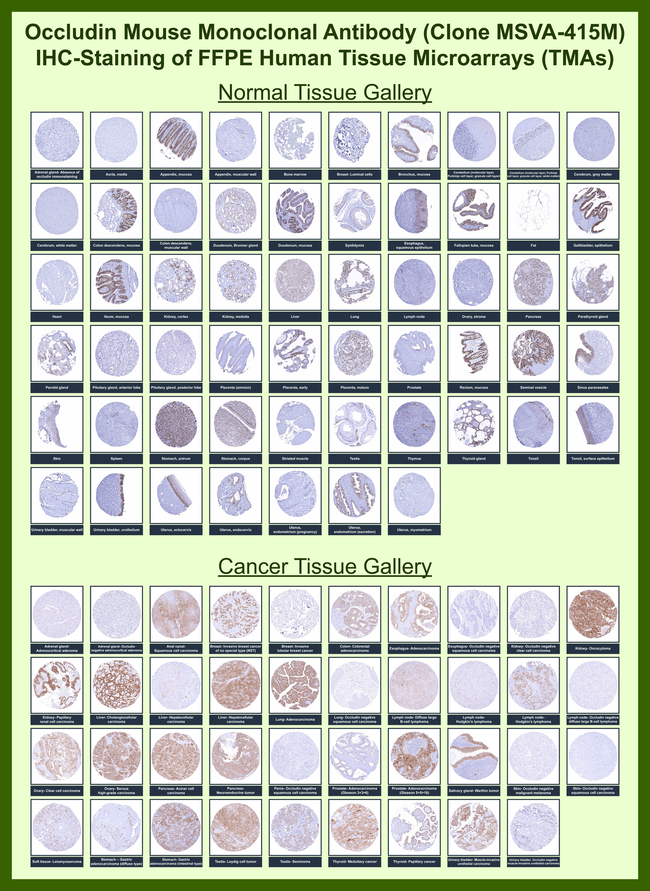
Positive control: Colon: A strong membranous occludin staining of epithelial cells should be seen with a particularly strong staining at the apical/luminal membranes.
Tissue specificity: Localized at tight junctions of both epithelial and endothelial cells. Highly expressed in kidney. Not detected in testis.
靶标信息
Occludin is a 65 kDa protein that can exist in a variety of phosphorylated forms, ranging up to approximately 82 kDa. Occludin is thought to be involved in regulating both the localization and the function of occludin. Polyunsaturated fatty acids are known to up-regulate occludin expression, increasing the transendothelial cell resistance and reducing the cellular permeability to large molecules. The level of occludin varies greatly depending on tissue; in brain tissue, occludin is highly and continuously expressed at cell-cell contact sites, whereas non-neural tissues show lower expression and discontinuous distribution. Overall structural features of the occludin protein are highly conserved in all the species examined. Under-expression of tight junction proteins, including occludin, is a key molecular abnormality responsible for the increased permeability of tumor endothelial tight junctions, which contributes to brain tumor edemas.
仅用于科研。不用于诊断过程。未经明确授权不得转售。
篇参考文献 (0)
您是否在文献中引用过该产品?请点击下方按钮邮件告知我们。
生物信息学
蛋白别名: Occludin; phosphatase 1, regulatory subunit 115; tight junction protein; unnamed protein product
基因别名: BLCPMG; OCLN; PPP1R115; PTORCH1
UniProt ID: (Human) Q16625
Entrez Gene ID: (Human) 100506658
positive regulation of lamellipodium assembly
positive regulation of gene expression
negative regulation of gene expression
epithelial cell migration
regulation of glucose transport
positive regulation of microtubule polymerization
maintenance of blood-brain barrier
cell-cell junction organization
positive regulation of glucose import
protein-containing complex assembly
bicellular tight junction assembly
positive regulation of wound healing
tight junction organization
protein localization to cell leading edge
positive regulation of maintenance of permeability of blood-brain barrier
Disclaimer

Clicking the images or links will redirect you to a website hosted by BenchSci that provides third-party scientific content. Neither the content nor the BenchSci technology and processes for selection have been evaluated by us; we are providing them as-is and without warranty of any kind, including for use or application of the Thermo Fisher Scientific products presented.

