Search
Invitrogen
PARP1 Recombinant Mouse Monoclonal Antibody (HC2R8)
{{$productOrderCtrl.translations['antibody.pdp.commerceCard.promotion.promotions']}}
{{$productOrderCtrl.translations['antibody.pdp.commerceCard.promotion.viewpromo']}}
{{$productOrderCtrl.translations['antibody.pdp.commerceCard.promotion.promocode']}}: {{promo.promoCode}} {{promo.promoTitle}} {{promo.promoDescription}}. {{$productOrderCtrl.translations['antibody.pdp.commerceCard.promotion.learnmore']}}
Additional Information:
{{banner.description}}
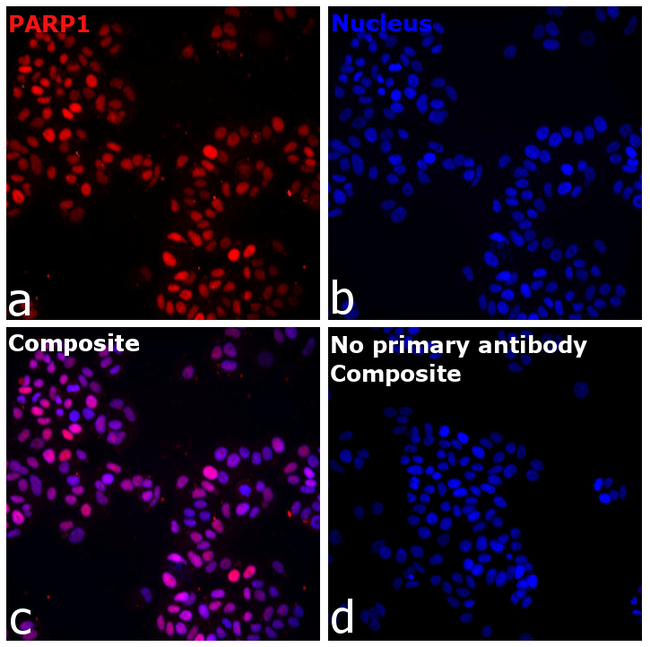
图: 1 / 4
PARP1 Antibody (740247M) in ICC/IF
Immunofluorescence analysis of PARP1 was performed using PARP1 Recombinant Mouse Monoclonal Antibody (HC2R8) (Product # 740247M) on MCF7 cells. The cells were fixed with 4% paraformaldehyde for 10 min and blocked with 2% BSA for 1 hr at RT. The cells were labeled with PARP1 Recombinant Mouse Monoclonal Antibody (HC2R8) (Product # 740247M, 1:200) in 0.1% BSA, incubated at 4°C overnight and then labeled with Goat anti-Mouse IgG (H+L) Highly Cross-Adsorbed Secondary Antibody, Alexa Fluor™ Plus 647 (Product #A32728, 1:2,000) for 60 min at RT. ... View More
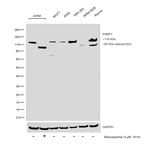
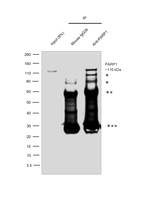
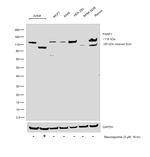
Please note: We are reviewing Western blot images included in the antibody testing data in our catalog, including those provided by third parties. Unless expressly labeled or annotated as “raw-unedited”, Western blot images included in the antibody testing data in our catalog may have been edited, optimized or otherwise adjusted for presentation.


产品信息
740247M
产品规格
种属反应
Human
宿主/亚型
Mouse
/ IgG2b, kappa
Expression System
Expi293
分类
Recombinant Monoclonal
类型
Antibody
克隆号
HC2R8
偶联物
Unconjugated
Unconjugated
Unconjugated
形式
Liquid
浓度
1 mg/mL
规格
100 µg
纯化类型
Protein A/G
保存液
PBS, pH 7.2-7.4
内含物
0.09% sodium azide
保存条件
Store at 4°C short term. For long term storage, store at -20°C, avoiding freeze/thaw cycles.
运输条件
Wet ice
产品详细信息
Recombinant mouse monoclonal antibodies are produced using in vitro expression systems. Recombinant antibodies are produced using specific genes that code for the desired antibodies. These genes are cloned into an expression vector and expressed in vitro. The advantages of recombinant antibodies include better specificity and lot-to-lot consistency.
It is recommended that the antibody be carefully titrated for optimal performance in the assay of interest.
靶标信息
Poly ADP-Ribose Polymerase (PARP) uses nicotinamide adenine dinucleotide (oxidized form) NAD as a substrate to catalyse the transfer of ADP-ribose to a variety of nuclear protein acceptors. Proteolysis of PARP to its stable 85kDa fragment is an early marker of programmed cell death (apoptosis) and is mediated by the caspase CPP32 protein. Cleavage occurs between Adp216 and Gly217, a site in PARP conserved across species.
仅用于科研。不用于诊断过程。未经明确授权不得转售。
篇参考文献 (0)
您是否在文献中引用过该产品?请点击下方按钮邮件告知我们。
生物信息学
蛋白别名: ADP-ribosyltransferase (NAD+; poly (ADP-ribose) polymerase); ADP-ribosyltransferase diphtheria toxin-like 1; ADP-ribosyltransferase NAD(+); DNA ADP-ribosyltransferase PARP1; NAD(+) ADP-ribosyltransferase 1; NAD(+) pADPRT-1; poly (ADP-ribose) polymerase family, member 1; poly(ADP-ribose) polymerase; poly(ADP-ribose) synthetase; poly(ADP-ribosyl)transferase; poly[ADP-ribose] synthase 1; protein poly-ADP-ribosyltransferase PARP1; unnamed protein product
基因别名: ADPRT; ADPRT 1; ADPRT1; ARTD1; pADPRT-1; PARP; PARP-1; PARS; Poly-PARP; PPOL
UniProt ID: (Human) P09874
Entrez Gene ID: (Human) 142
DNA binding
chromatin binding
damaged DNA binding
RNA binding
NAD+ ADP-ribosyltransferase activity
protein binding
enzyme activator activity
zinc ion binding
enzyme binding
protein kinase binding
estrogen receptor binding
nucleosome binding
ubiquitin protein ligase binding
identical protein binding
protein homodimerization activity
histone deacetylase binding
non-sequence-specific DNA binding, bending
NAD binding
RNA polymerase II sequence-specific DNA binding transcription factor binding
R-SMAD binding
NAD DNA ADP-ribosyltransferase activity
transcription regulator activator activity
NAD+-protein-serine ADP-ribosyltransferase activity
NAD+-protein-aspartate ADP-ribosyltransferase activity
NAD+-protein-glutamate ADP-ribosyltransferase activity
NAD+-protein-tyrosine ADP-ribosyltransferase activity
NAD+-protein-histidine ADP-ribosyltransferase activity
NAD+-histone H2BS6 serine ADP-ribosyltransferase activity
NAD+-histone H3S10 serine ADP-ribosyltransferase activity
NAD+-histone H2BE35 glutamate ADP-ribosyltransferase activity
single-strand break-containing DNA binding
protein ADP-ribosylase activity
single strand break repair
negative regulation of transcription from RNA polymerase II promoter
telomere maintenance
DNA repair
double-strand break repair
transcription from RNA polymerase II promoter
apoptotic process
cellular response to DNA damage stimulus
mitochondrion organization
transforming growth factor beta receptor signaling pathway
response to gamma radiation
positive regulation of cardiac muscle hypertrophy
carbohydrate biosynthetic process
protein autoprocessing
signal transduction involved in regulation of gene expression
macrophage differentiation
DNA ADP-ribosylation
mitochondrial DNA metabolic process
positive regulation of DNA-templated transcription, elongation
cellular response to insulin stimulus
regulation of protein localization
positive regulation of intracellular estrogen receptor signaling pathway
negative regulation of transcription elongation from RNA polymerase II promoter
cellular response to oxidative stress
cellular response to UV
protein modification process
positive regulation of I-kappaB kinase/NF-kappaB signaling
mitochondrial DNA repair
regulation of circadian sleep/wake cycle, non-REM sleep
response to ethanol
negative regulation of innate immune response
negative regulation of transcription, DNA-templated
positive regulation of transcription from RNA polymerase II promoter
decidualization
positive regulation of mitochondrial depolarization
positive regulation of SMAD protein import into nucleus
positive regulation of necroptotic process
protein poly-ADP-ribosylation
protein auto-ADP-ribosylation
protein localization to chromatin
establishment of protein localization to chromatin
cellular response to zinc ion
cellular response to transforming growth factor beta stimulus
replication fork reversal
negative regulation of cGAS/STING signaling pathway
positive regulation of protein localization to nucleus
cellular response to oxygen-containing compound
regulation of oxidative stress-induced neuron intrinsic apoptotic signaling pathway
response to aldosterone
negative regulation of adipose tissue development
negative regulation of telomere maintenance via telomere lengthening
cellular response to beta-amyloid
positive regulation of myofibroblast differentiation
regulation of base-excision repair
positive regulation of double-strand break repair via homologous recombination
cellular response to nerve growth factor stimulus
ATP generation from poly-ADP-D-ribose
negative regulation of ATP biosynthetic process
Disclaimer

Clicking the images or links will redirect you to a website hosted by BenchSci that provides third-party scientific content. Neither the content nor the BenchSci technology and processes for selection have been evaluated by us; we are providing them as-is and without warranty of any kind, including for use or application of the Thermo Fisher Scientific products presented.

