Search
Rockland
PCNA Polyclonal Antibody
{{$productOrderCtrl.translations['antibody.pdp.commerceCard.promotion.promotions']}}
{{$productOrderCtrl.translations['antibody.pdp.commerceCard.promotion.viewpromo']}}
{{$productOrderCtrl.translations['antibody.pdp.commerceCard.promotion.promocode']}}: {{promo.promoCode}} {{promo.promoTitle}} {{promo.promoDescription}}. {{$productOrderCtrl.translations['antibody.pdp.commerceCard.promotion.learnmore']}}
Additional Information:
{{banner.description}}
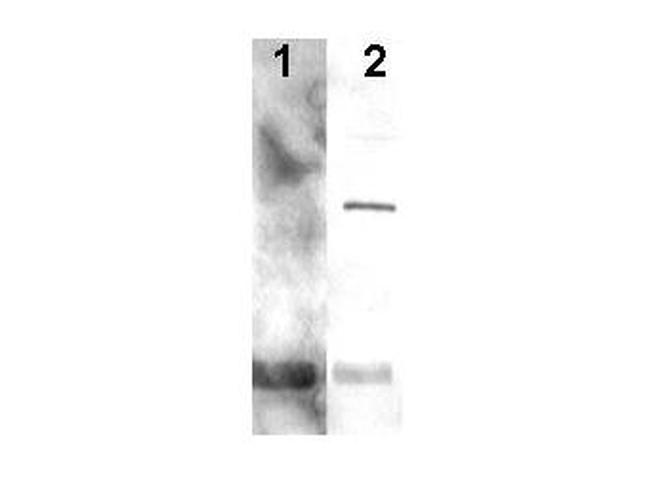
图: 1 / 1
PCNA Antibody (600-401-887) in WB
Western blot using Rocklands Affinity Purified anti-Alga PCNA antibody shows detection of a predominant band at ~29 kDa corresponding to PCNA (arrowhead lane 2). Peptide competition effectively eliminates specific band reactivity (lane 1). For peptide competition, the antibody was pre-incubated with 100 µg (excess) of the peptide for 2h at 37° C followed by overnight incubation at 4 °C with 100 µg (excess) of the peptide, followed by a brief centrifugation and then reaction with the membrane. Each lane contains a lysate from 105 cells from... View More

产品信息
600-401-887
应用
建议稀释比
已发表文章
产品规格
种属反应
Algae
宿主/亚型
Rabbit
/ IgG
分类
Polyclonal
类型
Antibody
抗原
This affinity-purified antibody was prepared from whole rabbit serum produced by repeated immunizations with a synthetic peptide corresponding to an internal region near amino acids 50-75 of Isochrysis galbana PCNA.
偶联物
形式
Liquid
浓度
1.42 mg/mL
规格
100 µg
纯化类型
Affinity chromatography
保存液
0.02M potassium phosphate, pH 7.2, with 0.15M NaCl
内含物
0.01% sodium azide
保存条件
-20°C, Avoid Freeze/Thaw Cycles
运输条件
Ambient (domestic); Wet ice (international)
产品详细信息
Store vial at -20° C prior to opening. Aliquot contents and freeze at -20° C or below for extended storage. Avoid cycles of freezing and thawing. Centrifuge product if not completely clear after standing at room temperature. This product is stable for several weeks at 4° C as an undiluted liquid. Dilute only prior to immediate use.
This affinity purified antibody is directed against algal PCNA. A BLAST analysis was used to suggest that this antibody would react with PCNA from the following alga sources: Prorocentrum minimum, Tetraselmis chui, Pleurochrysis carterae and Isochrysis galbana. Expect partial reactivity with PCNA from other alga sources as well as carrot, tobacco, peas, soybean and rice based on partial protein sequence homology. Species that have been tested but yielded no positive results are Pfiesteria piscicida, Emiliania huxleyi, Akashiwo sanguinea, Rhodomonas sp., Karlodinium micrum, and Skletonema costatum. Reactivity with PCNA from other sources has not been determined.
靶标信息
PCNA (polymerase delta auxiliary protein) is essential for DNA replication and is involved in DNA excision and mismatch repair pathways. PCNA binds to the CDK inhibitor p21, the structure-specific endonucleases Fen1 and XPG, and DNA cytosine 5-methyltransferase (MCMT). PCNA is a potentially useful marker of cells with proliferative potential and for identifying the proliferation status of tumor tissue (i.e. relevant to prognosis). PCNA is a marker for cells in early G1 phase and S phase of the cell cycle. PCNA is found in the nucleus and is a cofactor of DNA polymerase delta, and acts as a homotrimer and helps increase the processing of leading strand synthesis during DNA replication. In response to DNA damage, PCNA is ubiquitinated and is involved in the RAD6-dependent DNA repair pathway. Two transcript variants encoding the same protein have been found for PCNA. Pseudogenes of PCNA have been described on chromosome 4 and on the X chromosome.
仅用于科研。不用于诊断过程。未经明确授权不得转售。
篇参考文献 (0)
您是否在文献中引用过该产品?请点击下方按钮邮件告知我们。
生物信息学
蛋白别名: HGCN8729; MGC8367
Disclaimer

Clicking the images or links will redirect you to a website hosted by BenchSci that provides third-party scientific content. Neither the content nor the BenchSci technology and processes for selection have been evaluated by us; we are providing them as-is and without warranty of any kind, including for use or application of the Thermo Fisher Scientific products presented.

