Search
Agrisera
PFK1-7/Phosphofructokinase 1-7 Polyclonal Antibody
{{$productOrderCtrl.translations['antibody.pdp.commerceCard.promotion.promotions']}}
{{$productOrderCtrl.translations['antibody.pdp.commerceCard.promotion.viewpromo']}}
{{$productOrderCtrl.translations['antibody.pdp.commerceCard.promotion.promocode']}}: {{promo.promoCode}} {{promo.promoTitle}} {{promo.promoDescription}}. {{$productOrderCtrl.translations['antibody.pdp.commerceCard.promotion.learnmore']}}
Additional Information:
{{banner.description}}
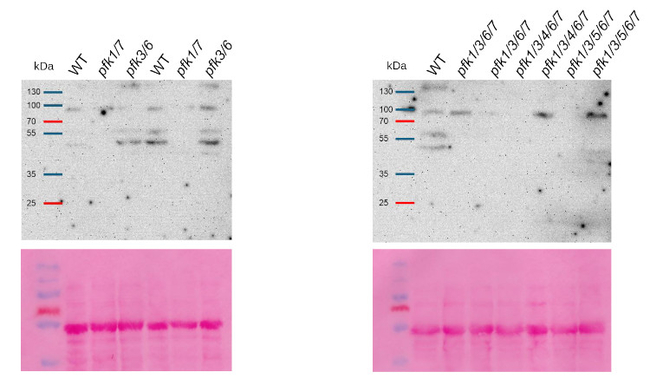
图: 1 / 1
PFK1-7/Phosphofructokinase 1-7 Antibody (AS23-4914) in WB
Samples: 20 µg of Arabidopsis thaliana whole leaf extract 20 µg of Arabidopsis thaliana mutant described above the picture MW markers are marked on the left side of each membrane 20 µg/well of total protein extracted freshly from leaf extracts of Arabidopsis thaliana wildtype and mutants. Exact buffer components were: 50 m M Hepes-KOH (p H 6.8), 5 m M Mg-acetate, 15% Glycerin, 1 m M EDTA, 1 m M EGTA, 5 m M ... View More
Please note: We are reviewing Western blot images included in the antibody testing data in our catalog, including those provided by third parties. Unless expressly labeled or annotated as “raw-unedited”, Western blot images included in the antibody testing data in our catalog may have been edited, optimized or otherwise adjusted for presentation.

产品信息
AS23-4914
产品规格
种属反应
Plant
宿主/亚型
Rabbit
分类
Polyclonal
类型
Antibody
抗原
KLH-conjugated peptide derived from Arabidopsis thaliana PFK1-7 protein sequences.
偶联物
Unconjugated
Unconjugated
Unconjugated
形式
Lyophilized
规格
50 µg
纯化类型
Antigen affinity chromatography
保存液
PBS, pH 7.4
内含物
no preservative
保存条件
-20°C, Avoid Freeze/Thaw Cycles
运输条件
Ambient (domestic); Wet ice (international)
产品详细信息
Store lyophilized/reconstituted at -20°C; once reconstituted make aliquots to avoid repeated freeze-thaw cycles. Please, remember to spin tubes briefly prior to opening them to avoid any losses that might occur from lyophilized material adhering to the cap or sides of the tubes.
For reconstitution add 50 µL of sterile water.
Specific Species Reactivity: Arabidopsis thaliana
靶标信息
In Arabidopsis thaliana, the cytosolic ATP-dependent phosphofructokinase gene set PFK1-7 encodes soluble enzymes that localize predominantly to the cytosol, supporting leaf and whole-plant carbohydrate metabolism. These proteins are ~444-537 amino acids in length and share the conserved phosphofructokinase catalytic architecture required for ATP-dependent phosphorylation of fructose-6-phosphate to fructose-1,6-bisphosphate, the major committed and highly regulated step of glycolysis. Genetic analyses indicate that multiple cytosolic isoforms (including PFK1, PFK3, PFK6, and PFK7) act redundantly yet are collectively important for maintaining sugar homeostasis and normal growth, consistent with a central role in balancing carbon flux between glycolysis and downstream biosynthetic and energy-producing pathways.
仅用于科研。不用于诊断过程。未经明确授权不得转售。
篇参考文献 (0)
您是否在文献中引用过该产品?请点击下方按钮邮件告知我们。
生物信息学
蛋白别名: AT5G56630; AtPFK7; MIK19.8; MIK19_8; PFK7
Disclaimer

Clicking the images or links will redirect you to a website hosted by BenchSci that provides third-party scientific content. Neither the content nor the BenchSci technology and processes for selection have been evaluated by us; we are providing them as-is and without warranty of any kind, including for use or application of the Thermo Fisher Scientific products presented.

