Search
Abnova
PI16 Polyclonal Antibody, MaxPab™
{{$productOrderCtrl.translations['antibody.pdp.commerceCard.promotion.promotions']}}
{{$productOrderCtrl.translations['antibody.pdp.commerceCard.promotion.viewpromo']}}
{{$productOrderCtrl.translations['antibody.pdp.commerceCard.promotion.promocode']}}: {{promo.promoCode}} {{promo.promoTitle}} {{promo.promoDescription}}. {{$productOrderCtrl.translations['antibody.pdp.commerceCard.promotion.learnmore']}}
Additional Information:
{{banner.description}}
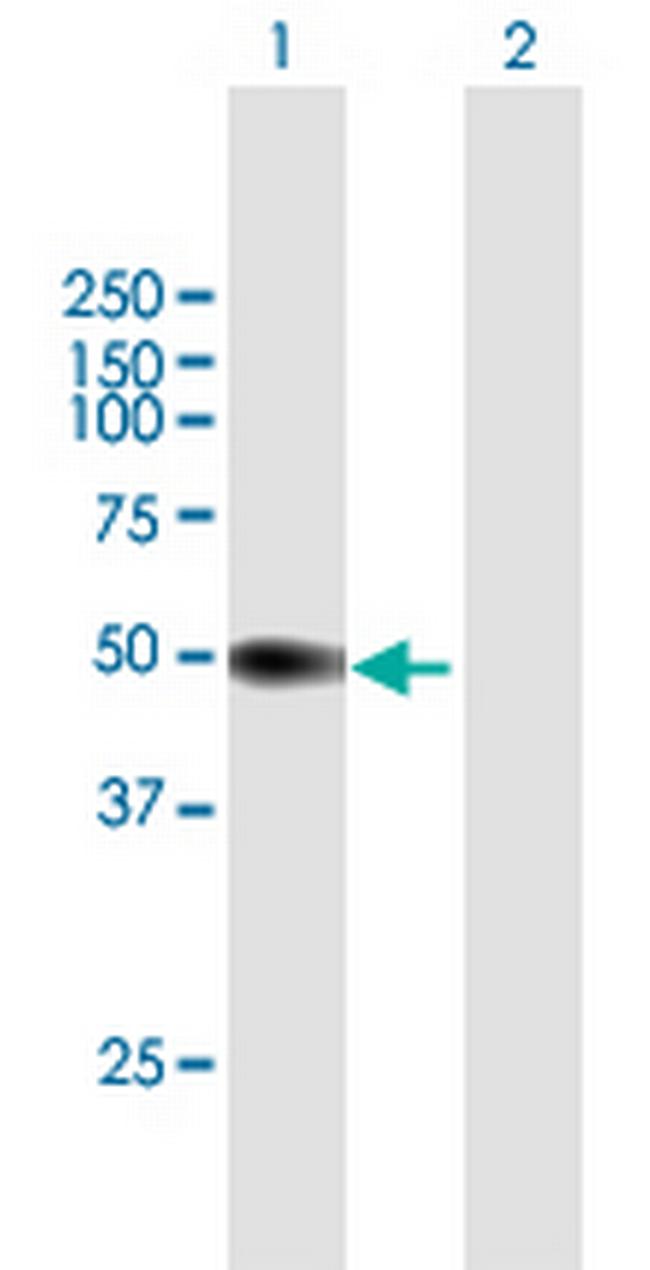
Please note: We are reviewing Western blot images included in the antibody testing data in our catalog, including those provided by third parties. Unless expressly labeled or annotated as “raw-unedited”, Western blot images included in the antibody testing data in our catalog may have been edited, optimized or otherwise adjusted for presentation.

产品信息
H00221476-B01P
产品规格
种属反应
Human
宿主/亚型
Mouse
/ IgG
分类
Polyclonal
类型
Antibody
抗原
PI16 (AAH22399.2, 1 a.a. approximately 408 a.a) full-length human protein.
偶联物
Unconjugated
Unconjugated
Unconjugated
形式
Liquid
浓度
0.5 mg/mL
规格
50 µg
纯化类型
Protein A
保存液
PBS, pH 7.4
内含物
no preservative
保存条件
-20°C, Avoid Freeze/Thaw Cycles
运输条件
Ambient (domestic); Wet ice (international)
产品详细信息
Product may be used with Western Blot (Transfected lysate).
The Isotype of this product is composed of an IgG Mixture.
Immunogen sequence: MHGSCSFLML LLPLLLLLVA TTGPVGALTD EEKRLMVELH NLYRAQVSPT ASDMLHMRWD EELAAFAKAY ARQCVWGHNK ERGRRGENLF AITDEGMDVP LAMEEWHHER EHYNLSAATC SPGQMCGHYT QVVWAKTERI GCGSHFCEKL QGVEETNIEL LVCNYEPPGN VKGKRPYQEG TPCSQCPSGY HCKNSLCEPI GSPEDAQDLP YLVTEAPSFR ATEASDSRKM GTPSSLATGI PAFLVTEVSG SLATKALPAV ETQAPTSLAT KDPPSMATEA PPCVTTEVPS ILAAHSLPSL DEEPVTFPKS THVPIPKSAD KVTDKTKVPS RSPENSLDPK MSLTGARELL PHAQEEAEAE AELPPSSEVL ASVFPAQDKP GELQATLDHT GHTSSKSLPK FPQYLCHR
靶标信息
Peptidase inhibitor 16 (PI16), also known as CRISP-9 or PSPBP, is a member of the cysteine-rich secretory protein (CRISP) family and plays a significant role in various biological processes. This protein consists of 436 amino acids and features three N-linked glycosylation motifs, suggesting its localization to the plasma membrane through a GPI anchor. PI16 has been implicated as a binding protein for prostate secretory protein of 94 amino acids (PSP94), which reflects its potential involvement in reproductive biology. Recent findings highlight PI16's expression in fibroblasts, particularly marking a precursor fibroblast cell state, which is critical in fibroblast lineage development. This expression is heightened in certain pathological conditions, such as neuropathic pain and inflammatory arthritis. In neuropathic pain models such as the spared nerve injury (SNI) model, elevated PI16 levels are noted in fibroblasts within the dorsal root ganglia (DRG) and sciatic nerve, but not in neurons or glia. Interestingly, mice lacking PI16 are protected against neuropathic pain, indicating its role in enhancing pain signaling. Conversely, in rheumatoid arthritis (RA), PI16's overexpression in peripheral blood and synovial fluid correlates with worsened arthritis severity, partly by suppressing the expression of the regulatory T cell marker Foxp3. This complex role of PI16, affecting various signaling pathways and cellular states, underscores its potential as a therapeutic target in pain and inflammatory diseases.
仅用于科研。不用于诊断过程。未经明确授权不得转售。
篇参考文献 (0)
您是否在文献中引用过该产品?请点击下方按钮邮件告知我们。
生物信息学
蛋白别名: cysteine-rich secretory protein 9; microseminoprotein, beta-binding protein; protease inhibitor 16; PSP94-binding protein; unnamed protein product
基因别名: CD364; CRISP9; MSMBBP; PSPBP
UniProt ID: (Human) Q6UXB8
Entrez Gene ID: (Human) 221476
Disclaimer

Clicking the images or links will redirect you to a website hosted by BenchSci that provides third-party scientific content. Neither the content nor the BenchSci technology and processes for selection have been evaluated by us; we are providing them as-is and without warranty of any kind, including for use or application of the Thermo Fisher Scientific products presented.

