Search
Invitrogen
PIAS1 Polyclonal Antibody
{{$productOrderCtrl.translations['antibody.pdp.commerceCard.promotion.promotions']}}
{{$productOrderCtrl.translations['antibody.pdp.commerceCard.promotion.viewpromo']}}
{{$productOrderCtrl.translations['antibody.pdp.commerceCard.promotion.promocode']}}: {{promo.promoCode}} {{promo.promoTitle}} {{promo.promoDescription}}. {{$productOrderCtrl.translations['antibody.pdp.commerceCard.promotion.learnmore']}}
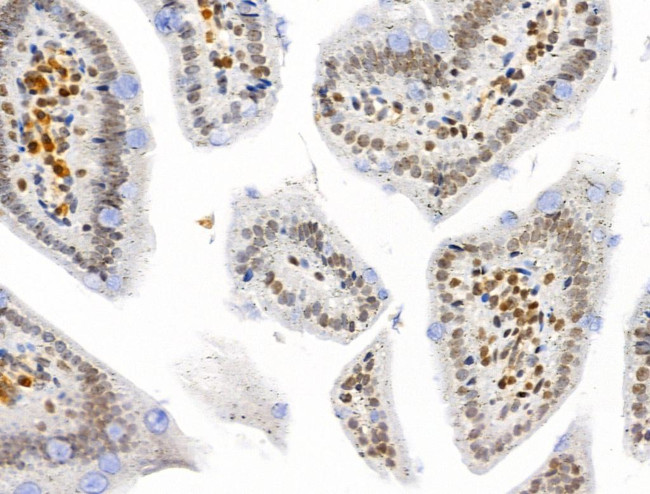
图: 1 / 8
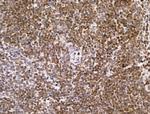
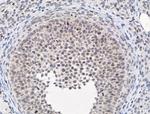
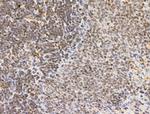
PIAS1 Antibody (PA5-99265) in IHC (P)
Immunohistochemistry analysis of PIAS1 in mouse colorectal tissue. The sample was formaldehyde fixed and a heat mediated antigen retrieval step in citrate buffer was performed. Samples were incubated with PIAS1 polyclonal antibody (Product # PA5-99265) using a dilution of 1:100 (4°C overnight) followed by HRP conjugated anti-Rabbit secondary antibody.
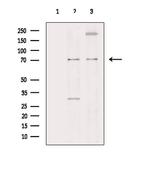
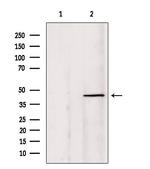
Please note: We are reviewing Western blot images included in the antibody testing data in our catalog, including those provided by third parties. Unless expressly labeled or annotated as “raw-unedited”, Western blot images included in the antibody testing data in our catalog may have been edited, optimized or otherwise adjusted for presentation.


产品信息
PA5-99265
应用
建议稀释比
已发表文章
产品规格
种属反应
Human,
Mouse,
Rat
宿主/亚型
Rabbit
/ IgG
分类
Polyclonal
类型
Antibody
抗原
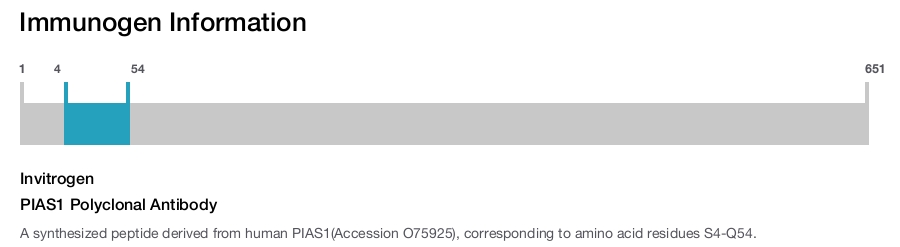
A synthesized peptide derived from human PIAS1(Accession O75925), corresponding to amino acid residues S4-Q54.
偶联物
Unconjugated
Unconjugated
Unconjugated
形式
Liquid
浓度
1 mg/mL
规格
100 µg
纯化类型
Affinity chromatography
保存液
PBS, pH 7.4, with 50% glycerol
内含物
0.02% sodium azide
保存条件
-20°C
运输条件
Ambient (domestic); Wet ice (international)
RRID
产品详细信息
Antibody detects endogenous levels of total PIAS1.
靶标信息
PIAS1 functions as an E3-type small ubiquitin-like modifier (SUMO) ligase, stabilizing the interaction between UBE2I and the substrate, and as a SUMO-tethering factor. This protein plays a crucial role in transcriptional coregulation of various cellular pathways, including the STAT pathway, the p53 pathway and the steroid hormone signaling pathway. It functions in testis as a nuclear receptor transcriptional coregulator and may have a role in androgen receptor initiation and maintenance of spermatogenesis. The effects of transcriptional coregulation, transactivation or silencing, may vary depending upon the biological context.
仅用于科研。不用于诊断过程。未经明确授权不得转售。
篇参考文献 (0)
您是否在文献中引用过该产品?请点击下方按钮邮件告知我们。
生物信息学
蛋白别名: AR interacting protein; DEAD/H (Asp-Glu-Ala-Asp/His) box binding protein 1; DEAD/H box-binding protein 1; E3 SUMO-protein transferase PIAS1; Gu binding protein; gu-binding protein; nuclear protein that binds to nucleolar RNA helicase Gu protein and to p53; PIAS1; PIAS1/GBP; PIG23; protein inhibitor of activated STAT protein 1; RING-type E3 ubiquitin transferase PIAS1; RNA helicase II-binding protein; unnamed protein product; zinc finger, MIZ-type containing 3
基因别名: 2900068C24Rik; DDXBP1; GBP; GU/RH-II; ZMIZ3
UniProt ID: (Human) O75925, (Mouse) O88907
Entrez Gene ID: (Human) 8554, (Mouse) 56469, (Rat) 300772
transcription regulatory region sequence-specific DNA binding
transcription cofactor activity
transcription corepressor activity
protein binding
zinc ion binding
SUMO transferase activity
enzyme binding
protein domain specific binding
ubiquitin protein ligase binding
SUMO ligase activity
DNA-binding transcription factor binding
transcription regulator inhibitor activity
ubiquitin protein ligase activity
G1/S transition of mitotic cell cycle
negative regulation of transcription from RNA polymerase II promoter
double-strand break repair via homologous recombination
DNA double-strand break processing
cellular response to DNA damage stimulus
JAK-STAT cascade
spermatogenesis
visual learning
protein sumoylation
positive regulation of proteasomal ubiquitin-dependent protein catabolic process
positive regulation of protein sumoylation
regulation of cell proliferation
negative regulation of apoptotic process
fat cell differentiation
positive regulation of transcription, DNA-templated
positive regulation of transcription from RNA polymerase II promoter
negative regulation of JAK-STAT cascade
positive regulation of smooth muscle cell differentiation
positive regulation of transcription initiation from RNA polymerase II promoter
protein-DNA complex assembly
positive regulation of protein localization to cell periphery
Disclaimer

Clicking the images or links will redirect you to a website hosted by BenchSci that provides third-party scientific content. Neither the content nor the BenchSci technology and processes for selection have been evaluated by us; we are providing them as-is and without warranty of any kind, including for use or application of the Thermo Fisher Scientific products presented.

