Search
Invitrogen
PKC alpha Polyclonal Antibody
{{$productOrderCtrl.translations['antibody.pdp.commerceCard.promotion.promotions']}}
{{$productOrderCtrl.translations['antibody.pdp.commerceCard.promotion.promocode']}}: {{promo.promoCode}} {{promo.promoTitle}} {{promo.promoDescription}}. {{$productOrderCtrl.translations['antibody.pdp.commerceCard.promotion.learnmore']}}
{{$ctrl.translations['antibody.pdp.skuNotes.additionalInformation']}}:
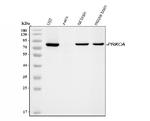
Please note: We are reviewing Western blot images included in the antibody testing data in our catalog, including those provided by third parties. Unless expressly labeled or annotated as “raw-unedited”, Western blot images included in the antibody testing data in our catalog may have been edited, optimized or otherwise adjusted for presentation.


产品信息
PA5-94941
产品规格
种属反应
Human,
Mouse,
Rat
宿主/亚型
Rabbit
/ IgG
分类
Polyclonal
类型
Antibody
抗原
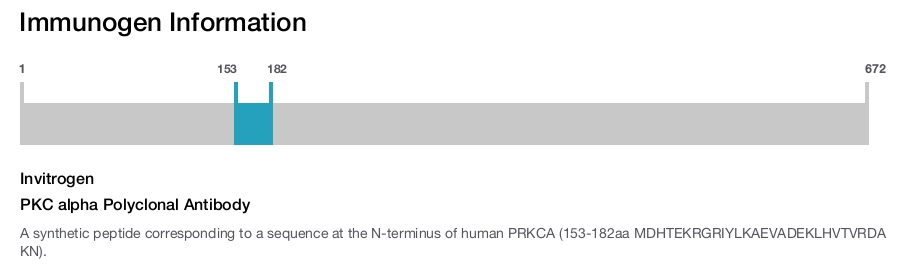
A synthetic peptide corresponding to a sequence at the N-terminus of human PRKCA (153-182aa MDHTEKRGRIYLKAEVADEKLHVTVRDAKN).
偶联物
Unconjugated
Unconjugated
Unconjugated
形式
Lyophilized
浓度
500 µg/mL once reconstituted
规格
100 µg
纯化类型
Affinity chromatography
保存液
PBS with 5mg BSA
内含物
0.05mg sodium azide, 0.05mg thimerosal
保存条件
-20°C
运输条件
Ambient (domestic); Wet ice (international)
RRID
产品详细信息
Reconstitute with 0.2 mL of distilled water to yield a concentration of 500 µg/mL.
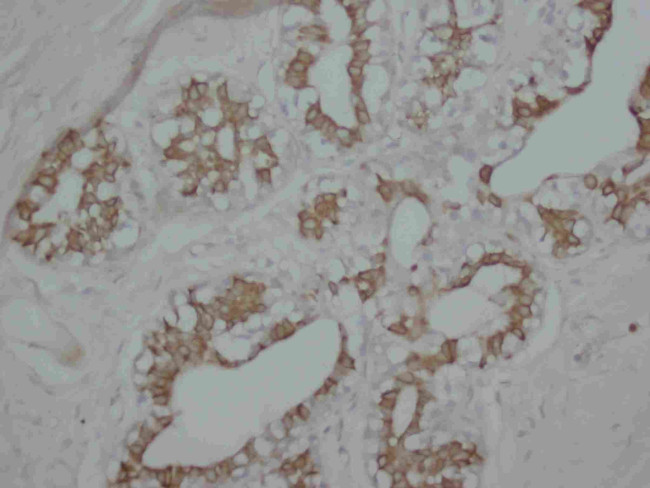
Positive Control - WB: human U87 whole cell, human HEL whole cell, rat brain tissue, mouse brain tissue. IHC: Human Mammary Cancer tissue.|Store at -20°C for one year from date of receipt. After reconstitution, at 4°C for one month. It can also be aliquotted and stored frozen at -20°C for six months. Avoid repeated freeze-thaw cycles.
靶标信息
The PKC family of serine/threonine kinases, including PRKCA (PKC alpha), is activated intracellularly by signal transduction pathways. In humans, at least 12 different PKC polypeptides have been identified. These isoforms differ in primary structure, tissue distribution, subcellular localization, mode of action in vitro, response to extracellular signals, and substrate specificity. PKC alpha, beta I, beta II, and gamma form the conventional family; their activities are Ca2+- and phospholipid-dependent. Protein kinase C (PKC) can be activated by calcium and the second messenger diacylglycerol. PKC family members phosphorylate a wide variety of protein targets and are known to be involved in diverse cellular signaling pathways. PKC family members also serve as major receptors for phorbol esters, a class of tumor promoters. Each member of the PKC family has a specific expression profile and is believed to play a distinct role in cells. The protein encoded by this gene is one of the PKC family members. This kinase has been reported to play roles in many different cellular processes, such as cell adhesion, cell transformation, cell cycle checkpoint, and cell volume control. Knockout studies in mice suggest that this kinase may be a fundamental regulator of cardiac contractility and Ca(2+) handling in myocytes.
⚠WARNING: This product can expose you to chemicals including mercury, which is known to the State of California to cause birth defects or other reproductive harm. For more information go to www.P65Warnings.ca.gov.
仅用于科研。不用于诊断过程。未经明确授权不得转售。
篇参考文献 (0)
您是否在文献中引用过该产品?请点击下方按钮邮件告知我们。
生物信息学
蛋白别名: AAG6; aging-associated gene 6; EC 2.7.11.13; FHC; FTH; FTHL6; kinase PKC-alpha; KPCA; MGC104426; PIG15; PKC III; PKC-A; PKC-alpha; PKC-III; PLIF; protein kinase C alpha-polypeptide; protein kinase c-alpha; unnamed protein product
基因别名: AAG6; PKC-alpha; PKCA; PKCalpha; PKCI+/-
UniProt ID: (Human) P17252, (Mouse) P20444, (Rat) P05696
Entrez Gene ID: (Human) 5578, (Mouse) 18750, (Rat) 24680
protein kinase activity
protein serine/threonine kinase activity
protein kinase C activity
calcium-dependent protein kinase C activity
receptor binding
integrin binding
protein binding
ATP binding
zinc ion binding
enzyme binding
diacylglycerol binding
histone kinase activity (H3-T6 specific)
protein serine kinase activity
lipid binding
response to reactive oxygen species
negative regulation of protein phosphorylation
positive regulation of protein phosphorylation
positive regulation of endothelial cell proliferation
regulation of the force of heart contraction
chondrocyte differentiation
desmosome assembly
chromatin remodeling
protein phosphorylation
negative regulation of protein kinase activity
cellular calcium ion homeostasis
regulation of muscle contraction
learning or memory
negative regulation of cell proliferation
positive regulation of signal transduction
positive regulation of endothelial cell migration
positive regulation of cardiac muscle hypertrophy
negative regulation of glucose transport
negative regulation of translation
central nervous system neuron axonogenesis
signal transduction involved in regulation of gene expression
positive regulation of cell migration
neutrophil chemotaxis
positive regulation of lipopolysaccharide-mediated signaling pathway
response to estradiol
negative regulation of glial cell apoptotic process
intracellular signal transduction
peptidyl-serine autophosphorylation
proteasome-mediated ubiquitin-dependent protein catabolic process
negative regulation of MAPK cascade
protein kinase B signaling
positive regulation of blood vessel endothelial cell migration
positive regulation of cellular component biogenesis
response to ethanol
positive regulation of macrophage differentiation
positive regulation of angiogenesis
positive regulation of bone resorption
positive regulation of cell adhesion
positive regulation of exocytosis
positive regulation of mitotic cell cycle
negative regulation of glucose import
negative regulation of insulin receptor signaling pathway
protein autophosphorylation
positive regulation of smooth muscle cell proliferation
positive regulation of inflammatory response
regulation of peptidyl-tyrosine phosphorylation
induction of positive chemotaxis
positive regulation of developmental process
positive regulation of multicellular organismal process
positive regulation of protein kinase B signaling
positive regulation of synapse assembly
renal sodium ion absorption
positive regulation of ERK1 and ERK2 cascade
protein kinase C signaling
response to interleukin-1
cellular response to carbohydrate stimulus
regulation of platelet aggregation
intrinsic apoptotic signaling pathway
positive regulation of angiotensin-activated signaling pathway
negative regulation of cytokine production involved in inflammatory response
response to phorbol 13-acetate 12-myristate
regulation of synaptic vesicle exocytosis
positive regulation of dense core granule biogenesis
mitotic nuclear envelope disassembly
response to mechanical stimulus
response to toxic substance
positive regulation of insulin secretion
response to peptide hormone
regulation of mRNA stability
regulation of transport
response to corticosterone
negative regulation of dopamine receptor signaling pathway
apoptotic signaling pathway
positive regulation of adenylate cyclase-activating G protein-coupled receptor signaling pathway
regulation of exocytosis
establishment of protein localization
Disclaimer

Clicking the images or links will redirect you to a website hosted by BenchSci that provides third-party scientific content. Neither the content nor the BenchSci technology and processes for selection have been evaluated by us; we are providing them as-is and without warranty of any kind, including for use or application of the Thermo Fisher Scientific products presented.

