Search
Abnova
PPP1R7 Polyclonal Antibody, MaxPab™
{{$productOrderCtrl.translations['antibody.pdp.commerceCard.promotion.promotions']}}
{{$productOrderCtrl.translations['antibody.pdp.commerceCard.promotion.viewpromo']}}
{{$productOrderCtrl.translations['antibody.pdp.commerceCard.promotion.promocode']}}: {{promo.promoCode}} {{promo.promoTitle}} {{promo.promoDescription}}. {{$productOrderCtrl.translations['antibody.pdp.commerceCard.promotion.learnmore']}}
Additional Information:
{{banner.description}}
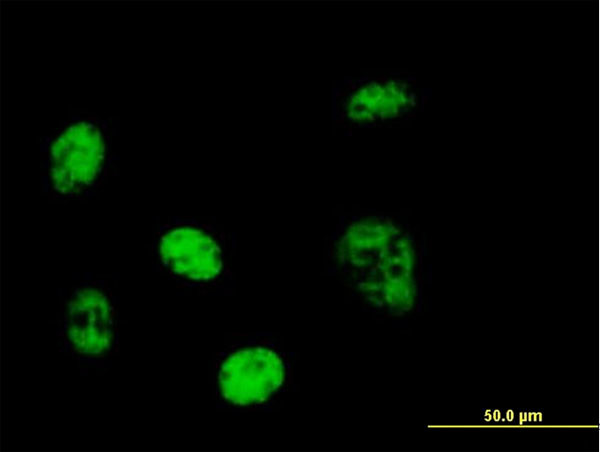
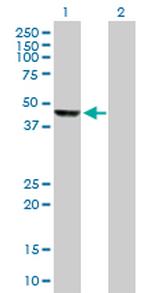


产品信息
H00005510-B01P
产品规格
宿主/亚型
Mouse
/ IgG
分类
Polyclonal
类型
Antibody
抗原
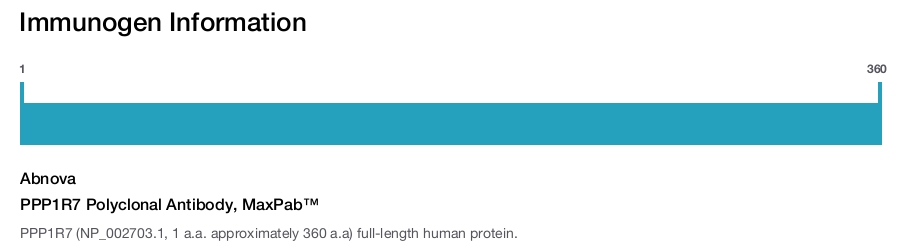
PPP1R7 (NP_002703.1, 1 a.a. approximately 360 a.a) full-length human protein.
偶联物
形式
Liquid
浓度
See Label
规格
50 µg
保存条件
-20°C, Avoid Freeze/Thaw Cycles
运输条件
Ambient (domestic); Wet ice (international)
产品详细信息
Sequence of this protein is as follows: MAAERGAGQQ QSQEMMEVDR RVESEESGDE EGKKHSSGIV ADLSEQSLKD GEERGEEDPE EEHELPVDME TINLDRDAED VDLNHYRIGK IEGFEVLKKV KTLCLRQNLI KCIENLEELQ SLRELDLYDN QIKKIENLEA LTELEILDIS FNLLRNIEGV DKLTRLKKLF LVNNKISKIE NLSNLHQLQM LELGSNRIRA IENIDTLTNL ESLFLGKNKI TKLQNLDALT NLTVLSMQSN RLTKIEGLQN LVNLRELYLS HNGIEVIEGL ENNNKLTMLD IASNRIKKIE NISHLTELQE FWMNDNLLES WSDLDELKGA RSLETVYLER NPLQKDPQYR RKVMLALPSV RQIDATFVRF
靶标信息
In eukaryotes, the phosphorylation and dephosphorylation of proteins on serine and threonine residues is an essential means of regulating a broad range of cellular functions, including division, homeostasis and apoptosis. A group of proteins that are intimately involved in this process are the protein phosphatases. In general, the protein phosphatase 1 (PP1) holoenzyme is a trimeric complex composed of a regulatory subunit, a variable subunit, and a catalytic subunit. Sds22, also known as PPP1R7 (protein phosphatase 1, regulatory (inhibitor) subunit 7), is a 360 amino acid protein that localizes to the nucleus and contains ten LRR (leucine rich) repeats. Expressed in a variety of tissues, Sds22 functions as a regulatory subunit of the PP1 complex, suggesting a role in protein regulation throughout the cell. Multiple isoforms of Sds22 exist due to alternative splicing events.
仅用于科研。不用于诊断过程。未经明确授权不得转售。
篇参考文献 (0)
您是否在文献中引用过该产品?请点击下方按钮邮件告知我们。
Disclaimer

Clicking the images or links will redirect you to a website hosted by BenchSci that provides third-party scientific content. Neither the content nor the BenchSci technology and processes for selection have been evaluated by us; we are providing them as-is and without warranty of any kind, including for use or application of the Thermo Fisher Scientific products presented.

