Search
Abnova
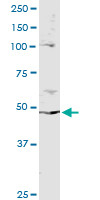
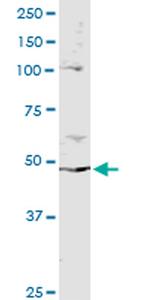
PPP2R2B Monoclonal Antibody (1F3)
{{$productOrderCtrl.translations['antibody.pdp.commerceCard.promotion.promotions']}}
{{$productOrderCtrl.translations['antibody.pdp.commerceCard.promotion.viewpromo']}}
{{$productOrderCtrl.translations['antibody.pdp.commerceCard.promotion.promocode']}}: {{promo.promoCode}} {{promo.promoTitle}} {{promo.promoDescription}}. {{$productOrderCtrl.translations['antibody.pdp.commerceCard.promotion.learnmore']}}
Additional Information:
{{banner.description}}

产品信息
H00005521-M02
产品规格
宿主/亚型
Mouse
/ IgG2a, kappa
分类
Monoclonal
类型
Antibody
克隆号
1F3
抗原
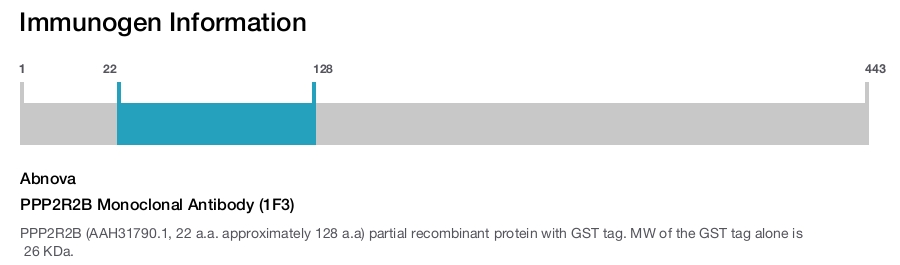
PPP2R2B (AAH31790.1, 22 a.a. approximately 128 a.a) partial recombinant protein with GST tag. MW of the GST tag alone is 26 KDa.
偶联物
Unconjugated
Unconjugated
Unconjugated
形式
Liquid
浓度
See Label
规格
100 µg
保存条件
-20°C, Avoid Freeze/Thaw Cycles
运输条件
Ambient (domestic); Wet ice (international)
产品详细信息
Sequence of this protein is as follows: TEADIISTVE FNHTGELLAT GDKGGRVVIF QREQESKNQV HRRGEYNVYS TFQSHEPEFD YLKSLEIEEK INKIRWLPQQ NAAYFLLSTN DKTVKLWKVS ERDKRPE
靶标信息
The product of this gene belongs to the phosphatase 2 regulatory subunit B family. Protein phosphatase 2 is one of the four major Ser/Thr phosphatases, and it is implicated in the negative control of cell growth and division. It consists of a common heteromeric core enzyme, which is composed of a catalytic subunit and a constant regulatory subunit, that associates with a variety of regulatory subunits. The B regulatory subunit might modulate substrate selectivity and catalytic activity. This gene encodes a beta isoform of the regulatory subunit B55 subfamily. Defects in this gene cause autosomal dominant spinocerebellar ataxia 12 (SCA12), a disease caused by degeneration of the cerebellum, sometimes involving the brainstem and spinal cord, and in resulting in poor coordination of speech and body movements. Multiple alternatively spliced variants, which encode different isoforms, have been identified for this gene. The 5' UTR of some of these variants includes a CAG trinucleotide repeat sequence (7-28 copies) that can be expanded to 66-78 copies in cases of SCA12.
仅用于科研。不用于诊断过程。未经明确授权不得转售。
篇参考文献 (0)
您是否在文献中引用过该产品?请点击下方按钮邮件告知我们。
Disclaimer

Clicking the images or links will redirect you to a website hosted by BenchSci that provides third-party scientific content. Neither the content nor the BenchSci technology and processes for selection have been evaluated by us; we are providing them as-is and without warranty of any kind, including for use or application of the Thermo Fisher Scientific products presented.

