Search
Abnova
PRKY Polyclonal Antibody, MaxPab™
{{$productOrderCtrl.translations['antibody.pdp.commerceCard.promotion.promotions']}}
{{$productOrderCtrl.translations['antibody.pdp.commerceCard.promotion.viewpromo']}}
{{$productOrderCtrl.translations['antibody.pdp.commerceCard.promotion.promocode']}}: {{promo.promoCode}} {{promo.promoTitle}} {{promo.promoDescription}}. {{$productOrderCtrl.translations['antibody.pdp.commerceCard.promotion.learnmore']}}
Additional Information:
{{banner.description}}
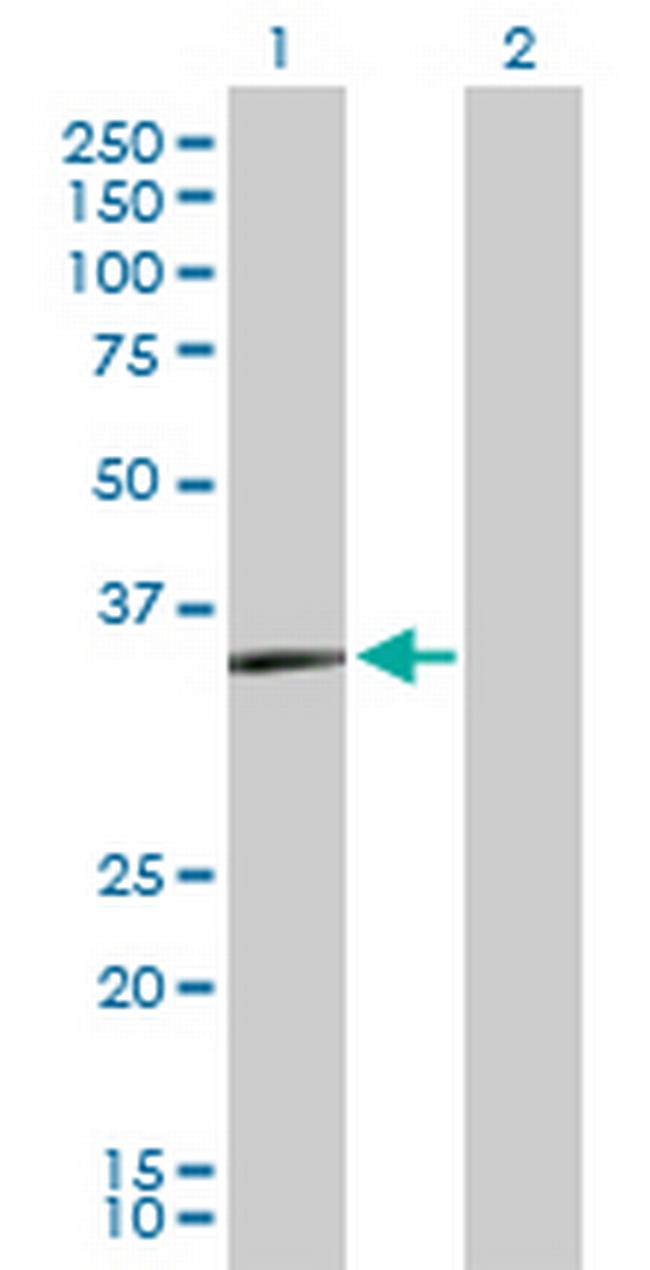
Please note: We are reviewing Western blot images included in the antibody testing data in our catalog, including those provided by third parties. Unless expressly labeled or annotated as “raw-unedited”, Western blot images included in the antibody testing data in our catalog may have been edited, optimized or otherwise adjusted for presentation.

产品信息
H00005616-D01P
产品规格
种属反应
Human
宿主/亚型
Rabbit
/ IgG
分类
Polyclonal
类型
Antibody
抗原
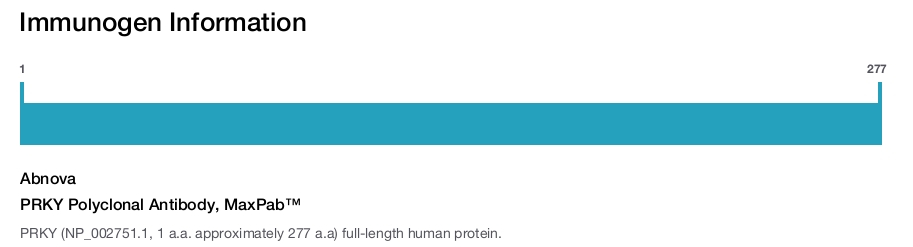
PRKY (NP_002751.1, 1 a.a. approximately 277 a.a) full-length human protein.
偶联物
Unconjugated
Unconjugated
Unconjugated
形式
Liquid
浓度
0.5-1 mg/mL
规格
100 µg
纯化类型
Protein A
保存液
PBS, pH 7.4
内含物
no preservative
保存条件
-20°C, Avoid Freeze/Thaw Cycles
运输条件
Ambient (domestic); Wet ice (international)
产品详细信息
Product may be used with Western Blot (Transfected lysate).
The Isotype of this product is composed of an IgG Mixture.
Immunogen sequence: MEAPGPAQAA AAESNSREVT EDAADWAPAL CPSPEARSPE APAYRLQDCD ALVTMGTGTF GRVHLVKEKT AKHFFALKVM SIPDVIRRKQ EQHVHNEKSV LKEVSHPFLI RLFWTWHEER FLYMLMEYVP GGELFSYLRN RGHFSSTTGL FYSAEIICAI EYLHSKEIVY RDLKPENILL DRDGHIKLTD FGFAKKLVDR TWTLCGTPEY LAPEVIQSKG HGRAVDWWAL GILIFEMLSG FPPFFDDNPF GIYQKILAGK LYFPRHLDFH VKTGRMM
靶标信息
A group of proteins that are intimately involved in this process are the serine/ threonine (Ser/Thr) protein kinases. PRKY (protein kinase, Y-linked) and PRKX (protein kinase, X-linked) are members of the Ser/Thr protein kinase family, both of which belong to the subfamily of cAMP-dependent kinases. Encoded by a gene that is located near the pseudoautosomal region on chromosome Y, PRKY contains one protein kinase domain through which it catalyzes the ATP-dependent phosphorylation of target proteins. Functioning in a similar manner to PRXY, PRKX contains one protein kinase domain and is essential for macrophage differentiation and renal epithelial cell migration. Defects in the genes encoding PRKY and PRXX are associated with sex reversal disorder, namely XX in males and XY in females.
仅用于科研。不用于诊断过程。未经明确授权不得转售。
篇参考文献 (0)
您是否在文献中引用过该产品?请点击下方按钮邮件告知我们。
生物信息学
Disclaimer

Clicking the images or links will redirect you to a website hosted by BenchSci that provides third-party scientific content. Neither the content nor the BenchSci technology and processes for selection have been evaluated by us; we are providing them as-is and without warranty of any kind, including for use or application of the Thermo Fisher Scientific products presented.

