Search
Invitrogen
PRPF39 Polyclonal Antibody
{{$productOrderCtrl.translations['antibody.pdp.commerceCard.promotion.promotions']}}
{{$productOrderCtrl.translations['antibody.pdp.commerceCard.promotion.promocode']}}: {{promo.promoCode}} {{promo.promoTitle}} {{promo.promoDescription}}. {{$productOrderCtrl.translations['antibody.pdp.commerceCard.promotion.learnmore']}}
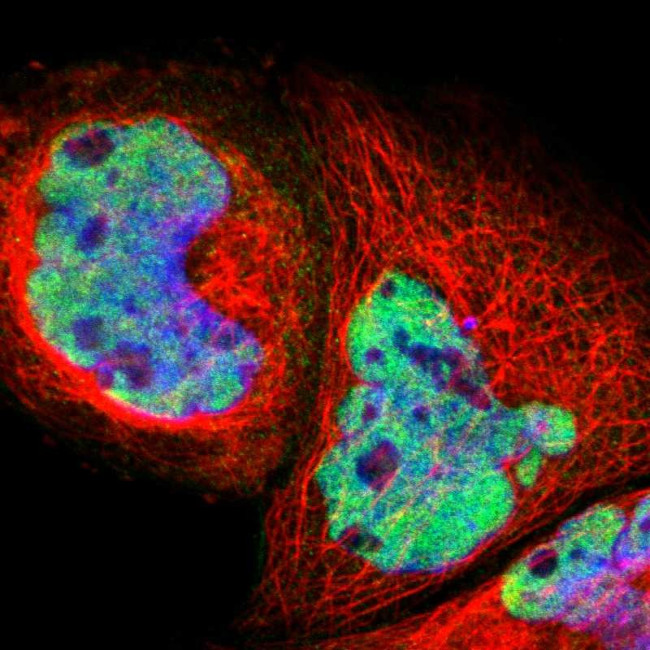
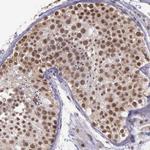
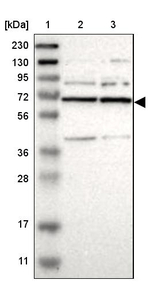
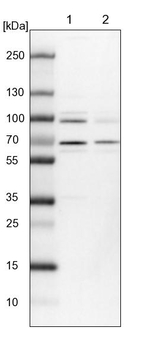
Please note: We are reviewing Western blot images included in the antibody testing data in our catalog, including those provided by third parties. Unless expressly labeled or annotated as “raw-unedited”, Western blot images included in the antibody testing data in our catalog may have been edited, optimized or otherwise adjusted for presentation.


产品信息
PA5-51528
应用
建议稀释比
已发表文章
产品规格
种属反应
Human,
Mouse,
Rat
宿主/亚型
Rabbit
/ IgG
分类
Polyclonal
类型
Antibody
抗原
偶联物
Unconjugated
Unconjugated
Unconjugated
形式
Liquid
浓度
0.1 mg/mL
规格
10 µg
纯化类型
Antigen affinity chromatography
保存液
PBS, pH 7.2, with 40% glycerol
内含物
0.02% sodium azide
保存条件
Store at 4°C short term. For long term storage, store at -20°C, avoiding freeze/thaw cycles.
运输条件
Ambient (domestic); Wet ice (international)
RRID
产品详细信息
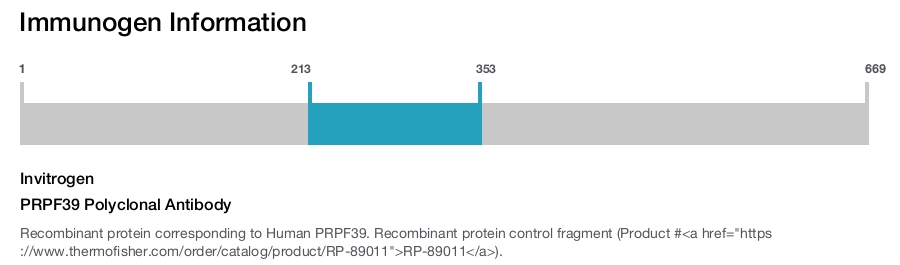
Immunogen sequence: DINWENEQGN LREVTAIYDR ILGIPTQLYS HHFQRFKEHV QNNLPRDLLT GEQFIQLRRE LASVNGHSGD DGPPGDDLPS GIEDITDPAK LITEIENMRH RIIEIHQEMF NYNEHEVSKR WTFEEGIKRP YFHVKPLEKA QL
Highest antigen sequence identity to the following orthologs: Mouse - 99%, Rat - 98%.
靶标信息
The PRPF39 gene plays a critical role as a splicing factor involved in alternative splicing regulation. In humans, it is homologous to the yeast Prp39 and Prp42 paralogs, forming a homodimer that interacts with the carboxy-terminal domain (CTD) of U1C, a parallel mechanism observed in the yeast Prp39/Prp42 heterodimer. Recent studies have highlighted its impact on splicing efficiency through knockdown experiments in HEK293 cells, which revealed significant changes in the expression of many genes, underscoring its importance in splicing adaptability according to cell type-specific needs. Additionally, PRPF39 is found to be highly expressed in Acute Lymphoblastic Leukemia (ALL), with research suggesting that targeting PRPF39 for degradation could contribute to the treatment of ALL. Phylogenetic analyses indicate a coevolution of PRPF39 expression with molecular components like shortened U1 snRNA, reflecting the splicing complexity across different species. The gene is also involved in the regulation of distant genes which are relevant to cellular responses, such as those involved in cisplatin response.
仅用于科研。不用于诊断过程。未经明确授权不得转售。
篇参考文献 (0)
您是否在文献中引用过该产品?请点击下方按钮邮件告知我们。
生物信息学
蛋白别名: flj11128; flj20666; flj45460; mgc149842; mgc149843; PRP39 homolog; PRP39 pre-mRNA processing factor 39 homolog; unnamed protein product; v-src suppressed transcript 1
基因别名: Srcs1
UniProt ID: (Human) Q86UA1
Entrez Gene ID: (Human) 55015, (Mouse) 328110, (Rat) 314171
Disclaimer

Clicking the images or links will redirect you to a website hosted by BenchSci that provides third-party scientific content. Neither the content nor the BenchSci technology and processes for selection have been evaluated by us; we are providing them as-is and without warranty of any kind, including for use or application of the Thermo Fisher Scientific products presented.

