Search
Invitrogen
PSD93 Recombinant Mouse Monoclonal Antibody (R35001_95B12)
{{$productOrderCtrl.translations['antibody.pdp.commerceCard.promotion.promotions']}}
{{$productOrderCtrl.translations['antibody.pdp.commerceCard.promotion.viewpromo']}}
{{$productOrderCtrl.translations['antibody.pdp.commerceCard.promotion.promocode']}}: {{promo.promoCode}} {{promo.promoTitle}} {{promo.promoDescription}}. {{$productOrderCtrl.translations['antibody.pdp.commerceCard.promotion.learnmore']}}
Additional Information:
{{banner.description}}
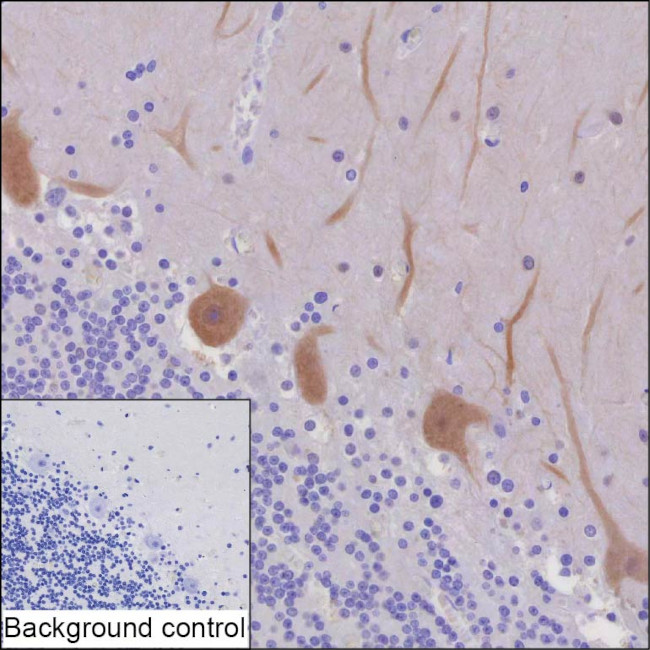
图: 1 / 1
PSD93 Antibody (MA563061) in IHC (P)
Immunohistochemistry (Paraffin) analysis of PSD93 in formalin-fixed paraffin-embedded brain tissue. Samples were incubated with PSD93 recombinant monoclonal (Product # MA563061) using a dilution of 5 µg/mL at room temperature for 1 hr followed by Poly-peroxidase conjugated goat anti-mouse IgG. Antigen was retrieved through addition of boiling Tris/EDTA buffer pH 9 in a pressure cooker for 3 min. Endogenous ... View More
Please note: We are reviewing Western blot images included in the antibody testing data in our catalog, including those provided by third parties. Unless expressly labeled or annotated as “raw-unedited”, Western blot images included in the antibody testing data in our catalog may have been edited, optimized or otherwise adjusted for presentation.

产品信息
MA563061
产品规格
种属反应
Human
宿主/亚型
Mouse
/ IgG2a
Expression System
CHO cells
分类
Recombinant Monoclonal
类型
Antibody
克隆号
R35001_95B12
偶联物
Unconjugated
Unconjugated
Unconjugated
形式
Liquid
浓度
1 mg/mL
规格
100 µg
纯化类型
Protein A
保存液
PBS with 0.5% BSA, 50% glycerol
内含物
0.09% sodium azide
保存条件
Maintain refrigerated at 2-8°C for up to 1 month. For long term storage store at -20°C
运输条件
Ambient (domestic); Wet ice (international)
RRID
靶标信息
PSD-93, also known as chapsyn-110, is one of a family of plasma membrane-associated proteins found in synaptic junctions. PSD-93 is unique among family members in its expression in Purkinje neuron cell bodies and dendrites. PSD-93 has three ~90 amino acid repeats called PDZ domains, a single interior SH3 domain, and a carboxyl-terminal guanylate kinase homology (GuK) domain that is enzymatically inactive. It is hypothesized that PDZ-domain interactions play a role in receptor and channel clustering which contributes to neuronal plasticiyt. PSD-93 is believed to participate in the clustering of certain proteins, including NMDA receptors and shaker-type potassium channels at the synaptic membrane. There are two principal modes of interaction between PSD-93 and other proteins. NMDA receptors and shaker-type potassium channels both share C-terminal sequence homology consisting of a threonine/serine-X-valine-COOH (T/SXV) motif. Other neuronal proteins that share this motif may interact with PSD-93 by binding to its PDZ domains. Neuronal nitric oxide synthase (nNOS), which lacks the T/SXV motif but which has its own PDZ domain, has been shown to associate with PSD-93 in vitro through a pseudo-homotypic PDZ-PDZ interaction.
仅用于科研。不用于诊断过程。未经明确授权不得转售。
篇参考文献 (0)
您是否在文献中引用过该产品?请点击下方按钮邮件告知我们。
生物信息学
蛋白别名: channel-associated protein of synapse-110; channel-associated protein of synapses, 110kDa; Chapsyn-1; discs, large homolog 2, chapsyn-110; postsynaptic density protein PSD-93; protein phosphatase 1, regulatory subunit 58; unnamed protein product
基因别名: chapsyn-110; PPP1R58; PSD-93; PSD93
UniProt ID: (Human) Q15700
Entrez Gene ID: (Human) 1740
chemical synaptic transmission
nervous system development
protein localization to synapse
cellular response to potassium ion
receptor clustering
clustering of voltage-gated potassium channels
establishment or maintenance of epithelial cell apical/basal polarity
GMP metabolic process
GDP metabolic process
receptor localization to synapse
cell-cell adhesion
regulation of postsynaptic membrane neurotransmitter receptor levels
maintenance of postsynaptic density structure
anterograde axonal protein transport
retrograde axonal protein transport
neurotransmitter receptor localization to postsynaptic specialization membrane
Disclaimer

Clicking the images or links will redirect you to a website hosted by BenchSci that provides third-party scientific content. Neither the content nor the BenchSci technology and processes for selection have been evaluated by us; we are providing them as-is and without warranty of any kind, including for use or application of the Thermo Fisher Scientific products presented.

