Search
Invitrogen
PSME2 Polyclonal Antibody
{{$productOrderCtrl.translations['antibody.pdp.commerceCard.promotion.promotions']}}
{{$productOrderCtrl.translations['antibody.pdp.commerceCard.promotion.promocode']}}: {{promo.promoCode}} {{promo.promoTitle}} {{promo.promoDescription}}. {{$productOrderCtrl.translations['antibody.pdp.commerceCard.promotion.learnmore']}}
{{$ctrl.translations['antibody.pdp.skuNotes.additionalInformation']}}:
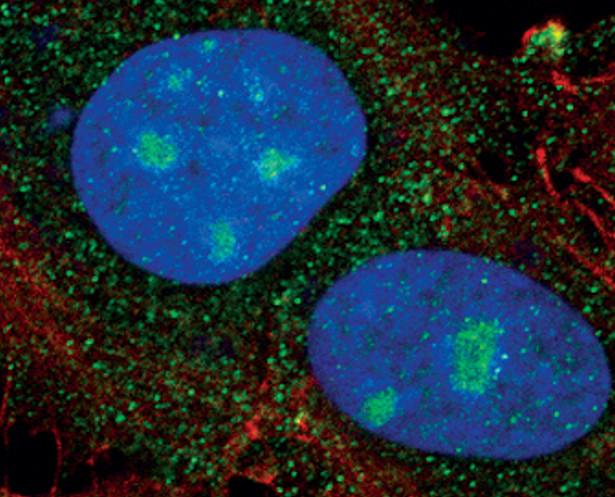
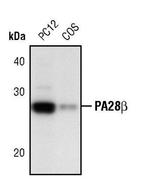
Please note: We are reviewing Western blot images included in the antibody testing data in our catalog, including those provided by third parties. Unless expressly labeled or annotated as “raw-unedited”, Western blot images included in the antibody testing data in our catalog may have been edited, optimized or otherwise adjusted for presentation.


产品信息
PA5-17332
产品规格
种属反应
Human,
Mouse,
Non-human primate,
Rat
已发表种属
Mouse
宿主/亚型
Rabbit
/ IgG
分类
Polyclonal
类型
Antibody
抗原
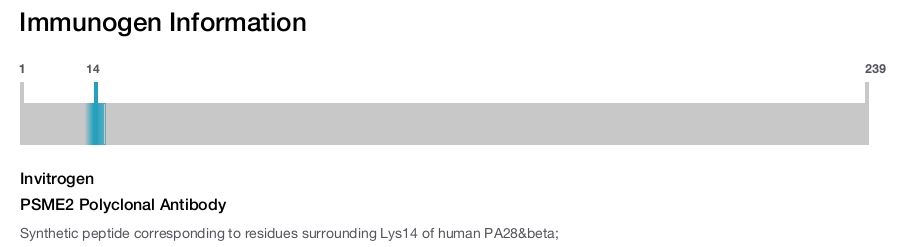
Synthetic peptide corresponding to residues surrounding Lys14 of human PA28β
偶联物
Unconjugated
Unconjugated
Unconjugated
形式
Liquid
纯化类型
Antigen affinity chromatography
保存液
0.01M HEPES, pH 7.5, with 0.15M NaCl, 100µg/mL BSA, 50% glycerol
内含物
no preservative
保存条件
-20°C
运输条件
Ambient (domestic); Wet ice (international)
RRID
产品详细信息
It is not recommended to aliquot this antibody.
靶标信息
Proteolytic degradation is critical to the maintenance of appropriate levels of short-lived and regulatory proteins as important and diverse as those involved in cellular metabolism, heat shock and stress response, antigen presentation, modulation of cell surface receptors and ion channels, cell cycle regulation, transcription, and signalling factors. The ubiquitin-proteasome pathway deconstructs most proteins in the eukaryotic cell cytosol and nucleus. Others are degraded via the vacuolar pathway which includes endosomes, lysosomes, and the endoplasmic reticulum. The 26S proteasome is an ATP-dependent, multisubunit (approximately 31), barrel-shaped molecular machine with an apparent molecular weight of approximately 2.5 MDa. It consists of a 20S proteolytic core complex which is crowned at one or both ends by 19S regulatory subunit complexes. The 19S regulatory subunits recognize ubiquitinated proteins and play an essential role in unfolding and translocating targets into the lumen of the 20S subunit. An enzymatic cascade is responsible for the attachment of multiple ubiquitin molecules to lysine residues of proteins targeted for degradation. Several genetic diseases are associated with defects in the ubiquitin-proteasome pathway. Some examples of affected proteins include those linked to cystic fibrosis, Angelman's syndrome, and Liddle syndrome.
仅用于科研。不用于诊断过程。未经明确授权不得转售。
生物信息学
蛋白别名: 11S regulator complex beta subunit; 11S regulator complex subunit beta; activator of multicatalytic protease subunit 2; cell migration-inducing protein 22; MCP activator, 31-kD subunit; MIG22; PA28b; PA28beta; protease (prosome, macropain) 28 subunit, beta; proteasome (prosome, macropain) 28 subunit, beta; proteasome (prosome, macropain) activator subunit 2; proteasome (prosome, macropain) activator subunit 2 (PA28 beta); proteasome activator 28 subunit beta; proteasome activator 28-beta; proteasome activator hPA28 subunit beta; PSME2; REG-beta; unnamed protein product
基因别名: PA28B; PA28beta; REGbeta
UniProt ID: (Human) Q9UL46, (Mouse) P97372, (Rat) Q63798
Entrez Gene ID: (Human) 5721, (Mouse) 19188, (Rat) 29614
Disclaimer

Clicking the images or links will redirect you to a website hosted by BenchSci that provides third-party scientific content. Neither the content nor the BenchSci technology and processes for selection have been evaluated by us; we are providing them as-is and without warranty of any kind, including for use or application of the Thermo Fisher Scientific products presented.

