Search
Invitrogen
Parvalbumin Polyclonal Antibody
{{$productOrderCtrl.translations['antibody.pdp.commerceCard.promotion.promotions']}}
{{$productOrderCtrl.translations['antibody.pdp.commerceCard.promotion.promocode']}}: {{promo.promoCode}} {{promo.promoTitle}} {{promo.promoDescription}}. {{$productOrderCtrl.translations['antibody.pdp.commerceCard.promotion.learnmore']}}
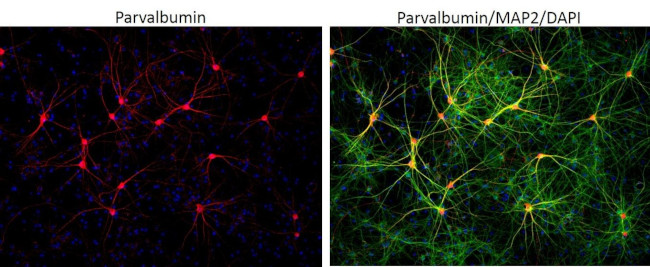
图: 1 / 40
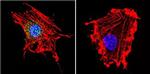
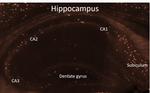
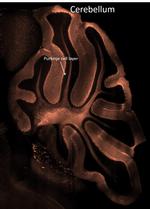
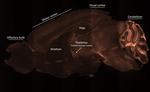
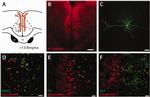
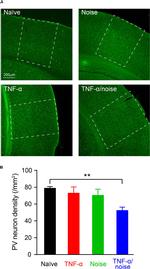
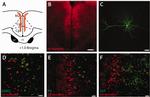
Parvalbumin Antibody (PA1-933) in ICC/IF
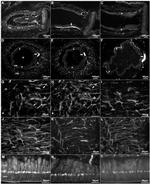
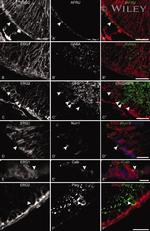
Immunofluorescent analysis of MAP2 (green) and parvalbumin (red) on rat primary Hippocampal neurons (E18) (Product # A15587) cultured for 28 days in the B-27 Plus Neuronal Culture System (Product # A3653401). At day 28 the cells were fixed with 4% paraformaldehyde for 15 min, permeabilized with 0.1% triton x-100 for 30min, and blocked with 1% BSA for 30 min at room temperature. Cells were stained with anti-... View More
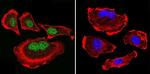
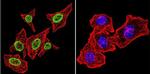



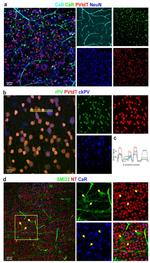
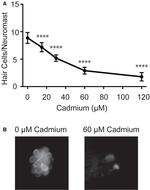

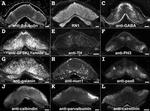
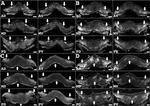

.jpg?time=20240507)
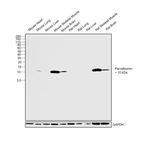
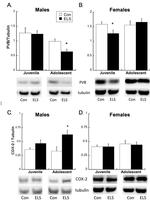
Please note: We are reviewing Western blot images included in the antibody testing data in our catalog, including those provided by third parties. Unless expressly labeled or annotated as “raw-unedited”, Western blot images included in the antibody testing data in our catalog may have been edited, optimized or otherwise adjusted for presentation.


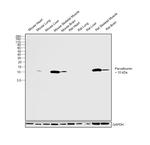
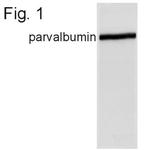
.jpg?time=20240507?time=20240507 "Parvalbumin Antibody (PA1-933) in WB")


产品信息
PA1-933
应用
建议稀释比
已发表文章
产品规格
种属反应
Human,
Rat
已发表种属
Human,
Mouse,
Rat,
Sea urchin,
Zebrafish
宿主/亚型
Rabbit
/ IgG
分类
Polyclonal
类型
Antibody
抗原
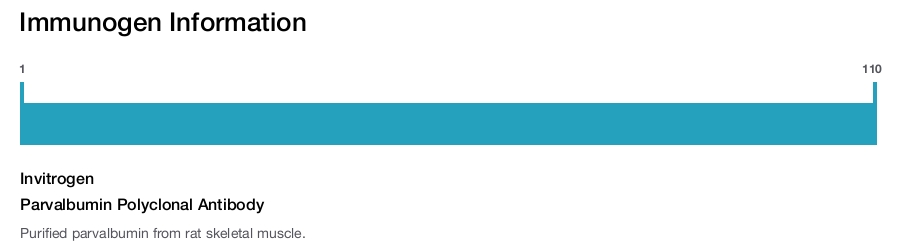
Purified parvalbumin from rat skeletal muscle.
偶联物
Unconjugated
Unconjugated
Unconjugated
形式
Lyophilized
浓度
1 mg/mL
规格
100 µg
纯化类型
Antigen affinity chromatography
保存液
0.1M sodium phosphate, pH 7.0, with 20mg/mL BSA
内含物
0.1% sodium azide
保存条件
-20°C, Avoid Freeze/Thaw Cycles
运输条件
Ambient (domestic); Wet ice (international)
RRID
产品详细信息
PA1-933 detects parvalbumin protein in human and rat samples.
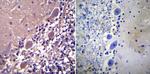
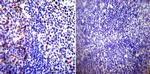
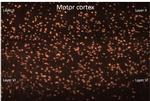
PA1-933 has successfully been used in Western blot, ELISA, immunoprecipitation and immunohistochemical procedures. By Western blot, this antibody detects a 12 kDa protein representing parvalbumin from rat cerebellum.
Parvalbumin protein is relatively small and, therefore, it is recommended that the electrophoresis be performed using tricine-SDS-PAGE gels and transferred to a nylon membrane.
The PA1-933 immunizing protein corresponds to purified parvalbumin from rat skeletal muscle.
Reconstitute in 100 µL PBS to create a stock of 1 mg/mL.
靶标信息
Parvalbumin (PV) is a calcium binding protein expressed in specific muscle fibers and fast-firing neurons. PV consists of a single, unbranched chain of linked amino acids and belongs to a larger group of EF hand proteins. Studies have demonstrated that parvalbumin acts in the decay of calcium in the contraction/ relaxation cycle of fast twitch muscles. This data has shown a positive correlation between the rate of relaxation and the concentration of parvalbumin. Parvalbumin is also expressed in a specific population of GABAergic interneurones which are thought to play a role in maintaining the balance between excitation and inhibition in the cortex as well as the hippocampus. In amyotrophic lateral sclerosis (ALS) patents, parvalbumin immunoreactivity is specifically absent from neuron populations lost early in ALS.
仅用于科研。不用于诊断过程。未经明确授权不得转售。
生物信息学
蛋白别名: alpha-parvalbumin; alpha-PV; HGNC:9704; MGC116759; parvalbumin; Parvalbumin (calcium binding protein); PVALB; unnamed protein product
基因别名: D22S749; PALB1; Pva
UniProt ID: (Human) P20472, (Rat) P02625
Entrez Gene ID: (Human) 5816, (Rat) 25269
Disclaimer

Clicking the images or links will redirect you to a website hosted by BenchSci that provides third-party scientific content. Neither the content nor the BenchSci technology and processes for selection have been evaluated by us; we are providing them as-is and without warranty of any kind, including for use or application of the Thermo Fisher Scientific products presented.

