Search
Invitrogen
Paxillin Polyclonal Antibody
{{$productOrderCtrl.translations['antibody.pdp.commerceCard.promotion.promotions']}}
{{$productOrderCtrl.translations['antibody.pdp.commerceCard.promotion.promocode']}}: {{promo.promoCode}} {{promo.promoTitle}} {{promo.promoDescription}}. {{$productOrderCtrl.translations['antibody.pdp.commerceCard.promotion.learnmore']}}
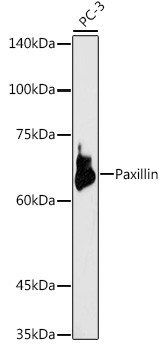
图: 1 / 1
Paxillin Antibody (PA5-120618) in WB
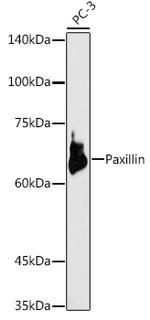
Western blot analysis of Paxillin in extracts of PC-3 cells. Samples were incubated with Paxillin Polyclonal antibody (Product # PA5-120618) using a dilution of 1:1,000, followed by HRP Goat Anti-Rabbit IgG (H+L) at a dilution of 1:10,000. Lysates/proteins: 25 µg per lane. Blocking buffer: 3% nonfat dry milk in TBST. Detection: ECL Basic Kit. Exposure time: 180s.
Please note: We are reviewing Western blot images included in the antibody testing data in our catalog, including those provided by third parties. Unless expressly labeled or annotated as “raw-unedited”, Western blot images included in the antibody testing data in our catalog may have been edited, optimized or otherwise adjusted for presentation.

产品信息
PA5-120618
产品规格
种属反应
Human,
Mouse
宿主/亚型
Rabbit
/ IgG
分类
Polyclonal
类型
Antibody
抗原
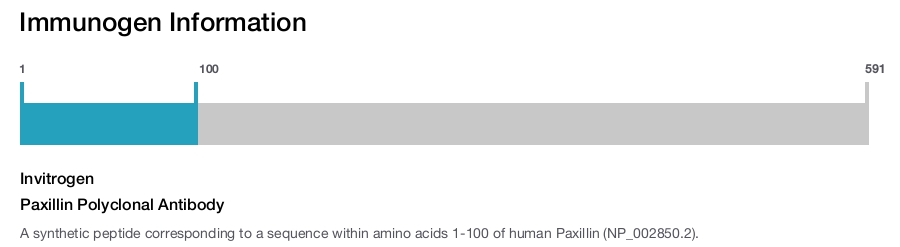
A synthetic peptide corresponding to a sequence within amino acids 1-100 of human Paxillin (NP_002850.2).
偶联物
Unconjugated
Unconjugated
Unconjugated
形式
Liquid
浓度
1.09 mg/mL
规格
109 µg
纯化类型
Affinity Chromatography
保存液
PBS, pH 7.3, with 50% glycerol
内含物
0.01% thimerosal
保存条件
-20°C, Avoid Freeze/Thaw Cycles
运输条件
Ambient (domestic); Wet ice (international)
RRID
产品详细信息
Positive test controls include: PC-3. The target is usually found in the following locations: Cell junction, Cytoplasm, cell cortex, cytoskeleton, focal adhesion.
Immunogen sequence: MDDLDALLAD LESTTSHISK RPVFLSEETP YSYPTGNHTY QEIAVPPPVP PPPSSEALNG TILDPLDQWQ PSSSRFIHQQ PQSSSPVYGS SAKTSSVSNP
靶标信息
Paxillin is a focal adhesion protein and a substrate for several tyrosine kinases such as src, FAK, and p210BRC/ABL. The tyrosine phosphorylation of paxillin is affected by conditions that change cell-cell adhesion. Paxillin associates tightly with FAK and Crk through its SH2 domain. This interaction is independent of the extracellular matrix. Although paxillin was initially discovered in fibroblasts, its phosphorylation may also be important during neurite extension during differentiation.
⚠WARNING: This product can expose you to chemicals including mercury, which is known to the State of California to cause birth defects or other reproductive harm. For more information go to www.P65Warnings.ca.gov.
仅用于科研。不用于诊断过程。未经明确授权不得转售。
篇参考文献 (0)
您是否在文献中引用过该产品?请点击下方按钮邮件告知我们。
生物信息学
蛋白别名: FLJ16691; hCG_1778014; PAX-1; PAXI; paxillin alpha; testicular tissue protein Li 134; unnamed protein product
基因别名: Pax
UniProt ID: (Human) P49023, (Mouse) Q8VI36
Entrez Gene ID: (Human) 5829, (Mouse) 19303
cell adhesion
signal transduction
signal complex assembly
transforming growth factor beta receptor signaling pathway
cell migration
substrate adhesion-dependent cell spreading
cellular response to reactive oxygen species
endothelial cell migration
positive regulation of stress fiber assembly
growth hormone receptor signaling pathway
MAPK cascade
cytoskeleton organization
integrin-mediated signaling pathway
regulation of cell shape
peptidyl-tyrosine phosphorylation
lamellipodium assembly
lipopolysaccharide-mediated signaling pathway
positive regulation of angiogenesis
positive regulation of protein kinase activity
focal adhesion assembly
branching morphogenesis of an epithelial tube
positive regulation of substrate adhesion-dependent cell spreading
response to peptide
Disclaimer

Clicking the images or links will redirect you to a website hosted by BenchSci that provides third-party scientific content. Neither the content nor the BenchSci technology and processes for selection have been evaluated by us; we are providing them as-is and without warranty of any kind, including for use or application of the Thermo Fisher Scientific products presented.

