Search
Invitrogen
Pentachlorophenol Recombinant Mouse Monoclonal Antibody (2F11)
{{$productOrderCtrl.translations['antibody.pdp.commerceCard.promotion.promotions']}}
{{$productOrderCtrl.translations['antibody.pdp.commerceCard.promotion.promocode']}}: {{promo.promoCode}} {{promo.promoTitle}} {{promo.promoDescription}}. {{$productOrderCtrl.translations['antibody.pdp.commerceCard.promotion.learnmore']}}
{{$ctrl.translations['antibody.pdp.skuNotes.additionalInformation']}}:
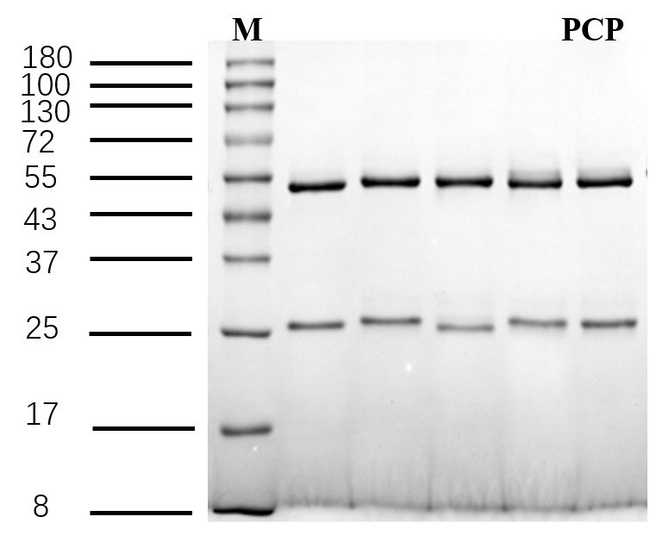
FIGURE: 1 / 1
Pentachlorophenol Antibody (MA566372) in SDS-PAGE
SDS-PAGE characterization of Pentachlorophenol under reducing conditions. Lane M: Protein marker (kDa); Lane PCP: Purified Pentachlorophenol Recombinant Monoclonal (Product # MA566372). Pentachlorophenol showing heavy chain (~50 kDa) and light chain (~25 kDa). Gels were stained with Coomassie Brilliant Blue R-614.
Please note: We are reviewing Western blot images included in the antibody testing data in our catalog, including those provided by third parties. Unless expressly labeled or annotated as “raw-unedited”, Western blot images included in the antibody testing data in our catalog may have been edited, optimized or otherwise adjusted for presentation.

Product Details
MA566372
Product Specifications
Species Reactivity
Chemical
Host/Isotype
Mouse
/ IgG
Expression System
CHO cells
Class
Recombinant Monoclonal
Type
Antibody
Clone
2F11
Immunogen
Conjugate of PCP hapten and KLH.
Conjugate
Unconjugated
Unconjugated
Unconjugated
Form
Liquid
Concentration
4.8 mg/mL
Amount
200 µg
Purification
Protein G
Storage buffer
PBS
Contains
0.09% sodium azide
Storage conditions
-20°C
Shipping conditions
Ambient (domestic); Wet ice (international)
RRID
Target Information
Pentachlorophenol (PCP) is a chlorinated aromatic compound primarily used as a wood preservative and fungicide. Its biodegradation is facilitated by specific bacterial strains such as Arthrobacter sp., Pseudomonas sp., and Flavobacterium sp., which possess genes enabling the breakdown of PCP. The gene sequences involved in PCP degradation have been analyzed through 16S rRNA comparisons and PCR fingerprinting, revealing a close genetic relationship among these strains. Structurally, PCP is a white to cream-colored powder with a melting point of 174 C, insoluble in water but soluble in organic solvents. Functionally, PCP acts as an inhibitor of chlorophyll and 5-aminolevulinic acid biosynthesis in certain algae, indicating its potential impact on photosynthetic organisms. The biodegradation process of PCP has been optimized in two-phase bioreactors, demonstrating the feasibility of this approach for environmental remediation.
For Research Use Only. Not for use in diagnostic procedures. Not for resale without express authorization.
References (0)
Have you cited this product in a publication?
Let us know so we can reference it here.
Disclaimer

Clicking the images or links will redirect you to a website hosted by BenchSci that provides third-party scientific content. Neither the content nor the BenchSci technology and processes for selection have been evaluated by us; we are providing them as-is and without warranty of any kind, including for use or application of the Thermo Fisher Scientific products presented.

Performance Guarantee
If an Invitrogen™ antibody doesn't perform as described on our website or datasheet,we'll replace the product at no cost to you, or provide you with a credit for a future purchase.*
Learn more
We're here to help
Get expert recommendations for common problems or connect directly with an on staff expert for technical assistance related to applications, equipment and general product use.
Contact tech support