Search
Agrisera
PetL/Cytochrome b6-f complex subunit 6 Polyclonal Antibody
{{$productOrderCtrl.translations['antibody.pdp.commerceCard.promotion.promotions']}}
{{$productOrderCtrl.translations['antibody.pdp.commerceCard.promotion.viewpromo']}}
{{$productOrderCtrl.translations['antibody.pdp.commerceCard.promotion.promocode']}}: {{promo.promoCode}} {{promo.promoTitle}} {{promo.promoDescription}}. {{$productOrderCtrl.translations['antibody.pdp.commerceCard.promotion.learnmore']}}
Additional Information:
{{banner.description}}
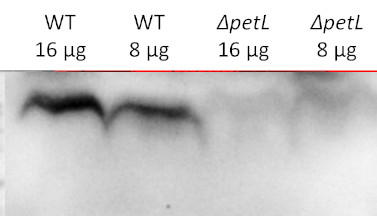
图: 1 / 1
PetL/Cytochrome b6-f complex subunit 6 Antibody (AS22-4883) in WB
8-16 µg/well of thylakoids extracted from Nicotiana tabacum. Exact buffer components were: 50 m M Hepes-KOH p H 7.5,100 m M sorbitol, 10 m M Mg Cl 2 and denatured with 0.1 M Tris/HCl p H 6.8,0.24% glycerol, 8% SDS, 2% b-mercaptoethanol, 0.2 mg/mL Coomassie Blue G 250 at 95 °C 10 min. Samples were separated in the cold on 10% SDS-tricine and blotted for overnight to PVDF, using wet transfer in the cold. Blot... View More

产品信息
AS22-4883
产品规格
种属反应
Plant
宿主/亚型
Rabbit
分类
Polyclonal
类型
Antibody
抗原
KLH-conjugated peptide derived from Nicotiana tabacum PetL protein sequence.
偶联物
形式
Lyophilized
规格
50 µg
纯化类型
Antigen affinity chromatography
保存液
PBS, pH 7.4
内含物
no preservative
保存条件
-20°C, Avoid Freeze/Thaw Cycles
运输条件
Ambient (domestic); Wet ice (international)
产品详细信息
Store lyophilized/reconstituted at -20°C; once reconstituted make aliquots to avoid repeated freeze-thaw cycles. Please, remember to spin tubes briefly prior to opening them to avoid any losses that might occur from lyophilized material adhering to the cap or sides of the tubes.
For reconstitution add 50 µL of sterile water.
Specific Species Reactivity: Nicotiana tabacum
靶标信息
PetL is a plastid-encoded gene in photosynthetic organisms whose product is a very small, highly hydrophobic membrane protein that localizes to the chloroplast thylakoid membrane as an accessory component of the cytochrome b6f complex. In higher plants, PetL is an approximately 31-amino-acid polypeptide predicted to form a single transmembrane helix, with evidence suggesting its N-terminus faces the thylakoid lumen, consistent with its role as one of the "small subunits" embedded in the b6f dimer. Functionally, PetL is not strictly required for initial cytochrome b6f accumulation or photosynthetic electron transport capacity in young tissue; however, genetic disruption studies show that loss of PetL compromises cytochrome b6f complex stability, leading to accelerated, leaf age-dependent depletion of the complex and reduced photosynthetic performance in mature/older leaves, indicating a specific role in maintaining long-term structural integrity and/or resistance to destabilizing conditions rather than serving as a catalytic electron-transfer subunit.
仅用于科研。不用于诊断过程。未经明确授权不得转售。
篇参考文献 (0)
您是否在文献中引用过该产品?请点击下方按钮邮件告知我们。
生物信息学
蛋白别名: cytochrome b6/f complex subunit 6; cytochrome b6/f complex subunit VI; petL
Disclaimer

Clicking the images or links will redirect you to a website hosted by BenchSci that provides third-party scientific content. Neither the content nor the BenchSci technology and processes for selection have been evaluated by us; we are providing them as-is and without warranty of any kind, including for use or application of the Thermo Fisher Scientific products presented.

