Search
Invitrogen
Phospho-14-3-3 beta/gamma/eta/zeta (Ser58, Ser59, Ser60) Recombinant Rabbit Monoclonal Antibody (10T1L0)
{{$productOrderCtrl.translations['antibody.pdp.commerceCard.promotion.promotions']}}
{{$productOrderCtrl.translations['antibody.pdp.commerceCard.promotion.promocode']}}: {{promo.promoCode}} {{promo.promoTitle}} {{promo.promoDescription}}. {{$productOrderCtrl.translations['antibody.pdp.commerceCard.promotion.learnmore']}}
{{$ctrl.translations['antibody.pdp.skuNotes.additionalInformation']}}:
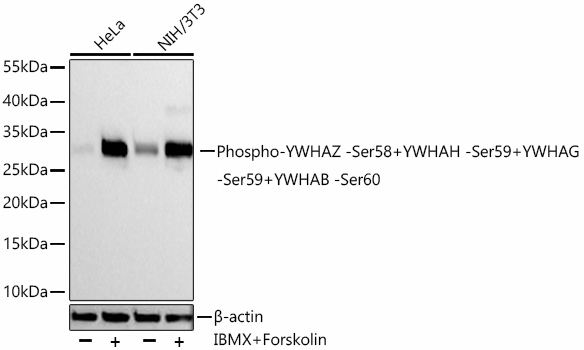
图: 1 / 1
Phospho-14-3-3 beta/gamma/eta/zeta (Ser58, Ser59, Ser60) Antibody (MA569924) in WB
Western blot analysis of Phospho-14-3-3 beta/gamma/eta/zeta (Ser58, Ser59, Ser60) in HeLa and NIH/3T3 cells. Samples were probed with Phospho-14-3-3 beta/gamma/eta/zeta (Ser58, Ser59, Ser60) recombinant monoclonal antibody (Product # MA569924) at 1:13,000 dilution incubated overnight at 4°C. Secondary antibody: HRP Goat Anti-Rabbit IgG (H+L) at 1:10,000 dilution. Lysates/proteins: 30 µg per lane. Blocking b... View More
Please note: We are reviewing Western blot images included in the antibody testing data in our catalog, including those provided by third parties. Unless expressly labeled or annotated as “raw-unedited”, Western blot images included in the antibody testing data in our catalog may have been edited, optimized or otherwise adjusted for presentation.

产品信息
MA569924
产品规格
种属反应
Human,
Mouse
宿主/亚型
Rabbit
/ IgG
Expression System
HEK293 cells
分类
Recombinant Monoclonal
类型
Antibody
克隆号
10T1L0
抗原
Synthetic peptide.
偶联物
Unconjugated
Unconjugated
Unconjugated
形式
Liquid
浓度
1.34 mg/mL
规格
134 µg
纯化类型
Affinity chromatography
保存液
PBS, pH 7.3., with 50% glycerol, 0.05% BSA
内含物
0.09% sodium azide
保存条件
-20°C, Avoid Freeze/Thaw Cycles
运输条件
Ambient (domestic); Wet ice (international)
靶标信息
The 14-3-3 protein family consists of highly conserved regulatory molecules expressed across all eukaryotic cells, serving as a critical hub for diverse cellular processes such as signal transduction, metabolism, apoptosis, and cell cycle control. Structurally, these proteins function by forming dimeric complexes that bind to specific phosphoserine or phosphothreonine motifs on a wide array of target proteins, effectively modulating their stability, activity, or subcellular localization. The family is composed of multiple isoforms that possess both unique and overlapping roles: 14-3-3 Beta and Zeta are heavily involved in cell proliferation and survival, with Zeta specifically aiding in DNA damage responses; 14-3-3 Gamma is essential for neuronal development and stress management; and 14-3-3 Eta acts as a key regulator of the immune response, with its dysregulation serving as a known marker for rheumatoid arthritis. Because these isoforms work in concert to maintain homeostasis, their dysregulation is a significant factor in the development of complex diseases, including various cancers, metabolic conditions, and neurological disorders.
仅用于科研。不用于诊断过程。未经明确授权不得转售。
篇参考文献 (0)
您是否在文献中引用过该产品?请点击下方按钮邮件告知我们。
生物信息学
蛋白别名: 14-3-3 alpha; 14-3-3 delta; 14-3-3 eta; 14-3-3 gamma; 14-3-3 protein beta; 14-3-3 protein gamma subtype; 14-3-3 protein/cytosolic phospholipase A2; 14-3-3 zeta; 14-3-3n; 3-monooxgenase/tryptophan 5-monooxgenase activation protein, gamma polypeptide; 3-monooxgenase/tryptophan 5-monooxygenase activation protein, gamma polypeptide; 3-monooxygenase/tryptophan 5-monooxygenase activation protein, gamma polypeptide; AS1; brain-specific tyrosine and tryptophan hydroxylase activator; epididymis luminal protein 4; epididymis secretory protein Li 1; epididymis secretory protein Li 3; epididymis secretory protein Li 93; HS1; KCIP-1; phospholipase A2; protein 1054; protein kinase C inhibitor protein 1; protein kinase C inhibitor protein-1; protein phosphatase 1, regulatory subunit 170; SEZ-2; signal transduction phosphoprotein; similar to Homo sapiens DNA for 14-3-3 protein eta chain, exon 2 with GenBank Accession Number D78577.1; tyrosine 3-monooxygenase/tryptophan 5-monooxygenase activation protein, alpha polypeptide; tyrosine 3-monooxygenase/tryptophan 5-monooxygenase activation protein, beta polypeptide; tyrosine 3-monooxygenase/tryptophan 5-monooxygenase activation protein, delta polypeptide; tyrosine 3-monooxygenase/tryptophan 5-monooxygenase activation protein, eta polypeptide; tyrosine 3-monooxygenase/tryptophan 5-monooxygenase activation protein, gamma polypeptide; tyrosine 3-monooxygenase/tryptophan 5-monooxygenase activation protein, zeta polypeptide; tyrosine 3/tryptophan 5 -monooxygenase activation protein, beta polypeptide; tyrosine 3/tryptophan 5 -monooxygenase activation protein, zeta polypeptide; unnamed protein product; YWHAG; YWHAH
基因别名: 1110013I11Rik; 1300003C17Rik; 14-3-3-zeta; 14-3-3b; 14-3-3GAMMA; 14-3-3zeta; D7Bwg1348e; DEE56; EIEE56; GW128; HEL-S-1; HEL-S-3; HEL-S-93; HEL4; HS1; KCIP-1; POPCHAS; PPP1R170; YWHA1; YWHAA; YWHAD
UniProt ID: (Human) P31946, (Human) P61981, (Human) Q04917, (Human) P63104, (Mouse) Q9CQV8, (Mouse) P61982, (Mouse) P68510, (Mouse) P63101
Entrez Gene ID: (Human) 7529, (Human) 7532, (Human) 7533, (Human) 7534, (Mouse) 54401, (Mouse) 22628, (Mouse) 22629, (Mouse) 22631
protein kinase inhibitor activity
protein phosphatase inhibitor activity
protein binding
enzyme binding
protein domain specific binding
identical protein binding
histone deacetylase binding
macromolecular complex binding
cadherin binding
phosphoserine binding
phosphoprotein binding
protein sequestering activity
RNA binding
protein kinase C binding
insulin-like growth factor receptor binding
protein kinase C inhibitor activity
receptor tyrosine kinase binding
phosphorylation-dependent protein binding
actin binding
sodium channel regulator activity
glucocorticoid receptor binding
ion channel binding
protein heterodimerization activity
protein kinase binding
protein phosphatase binding
ubiquitin protein ligase binding
DNA-binding transcription factor binding
regulation of sodium ion transport
glucocorticoid catabolic process
intracellular protein transport
cytoskeleton organization
regulation of mitotic nuclear division
signal transduction
protein localization
glucocorticoid receptor signaling pathway
negative regulation of apoptotic process
establishment of protein localization
positive regulation of transcription, DNA-templated
negative regulation of dendrite morphogenesis
membrane depolarization during action potential
presynaptic modulation of chemical synaptic transmission
cytoplasmic translation
negative regulation of T cell mediated immune response to tumor cell
positive regulation of T cell mediated immune response to tumor cell
protein targeting
positive regulation of cell-cell adhesion
SCF-dependent proteasomal ubiquitin-dependent protein catabolic process
cellular response to nutrient levels
cellular response to insulin stimulus
regulation of protein localization
cellular response to amino acid starvation
TORC1 signaling
cellular response to glucose starvation
proteasome-mediated ubiquitin-dependent protein catabolic process
regulation of neuron differentiation
negative regulation of translational initiation
positive regulation of translational initiation
regulation of synaptic plasticity
protein stabilization
negative regulation of T cell activation
positive regulation of T cell activation
protein localization to lysosome
protein K6-linked ubiquitination
negative regulation of TORC1 signaling
positive regulation of TORC1 signaling
substantia nigra development
positive regulation of hippo signaling
negative regulation of protein import into nucleus
negative regulation of G-protein coupled receptor protein signaling pathway
negative regulation of transcription, DNA-templated
positive regulation of transcription from RNA polymerase II promoter
negative regulation of cell growth involved in contact inhibition
negative regulation of transcription from RNA polymerase II promoter
angiogenesis
respiratory system process
protein phosphorylation
synaptic target recognition
lung development
regulation of protein stability
tube formation
negative regulation of innate immune response
establishment of Golgi localization
regulation of ERK1 and ERK2 cascade
regulation of synapse maturation
Golgi reassembly
negative regulation of protein localization to nucleus
histamine secretion by mast cell
lysosome organization
response to xenobiotic stimulus
regulation of programmed cell death
ERK1 and ERK2 cascade
protein localization to mitochondrion
antibacterial innate immune response
regulation of lysosome organization
negative regulation of protein kinase activity
regulation of signal transduction
Disclaimer

Clicking the images or links will redirect you to a website hosted by BenchSci that provides third-party scientific content. Neither the content nor the BenchSci technology and processes for selection have been evaluated by us; we are providing them as-is and without warranty of any kind, including for use or application of the Thermo Fisher Scientific products presented.

