Search
Invitrogen
Phospho-DAXX (Ser213) Polyclonal Antibody
{{$productOrderCtrl.translations['antibody.pdp.commerceCard.promotion.promotions']}}
{{$productOrderCtrl.translations['antibody.pdp.commerceCard.promotion.promocode']}}: {{promo.promoCode}} {{promo.promoTitle}} {{promo.promoDescription}}. {{$productOrderCtrl.translations['antibody.pdp.commerceCard.promotion.learnmore']}}
{{$ctrl.translations['antibody.pdp.skuNotes.additionalInformation']}}:
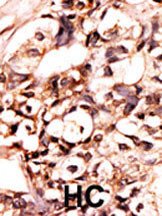
图: 1 / 2
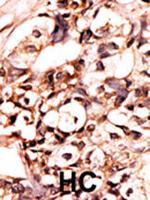
Phospho-DAXX (Ser213) Antibody (PA5-12582) in IHC (P)
Immunohistochemistry analysis of Phospho-DAXX (Ser213) in formalin-fixed and paraffin-embedded human cancer tissue. Samples were incubated with Phospho-DAXX (Ser213) polyclonal antibody (Product # PA5-12582) which was peroxidase-conjugated to the secondary antibody, followed by AEC staining. This data demonstrates the use of this antibody for immunohistochemistry; clinical relevance has not been evaluated. ... View More
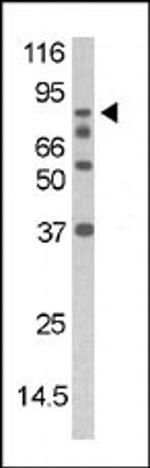
Please note: We are reviewing Western blot images included in the antibody testing data in our catalog, including those provided by third parties. Unless expressly labeled or annotated as “raw-unedited”, Western blot images included in the antibody testing data in our catalog may have been edited, optimized or otherwise adjusted for presentation.


产品信息
PA5-12582
产品规格
种属反应
Human,
Mouse
宿主/亚型
Rabbit
/ IgG
分类
Polyclonal
类型
Antibody
抗原
KLH conjugated synthetic phosphopeptide corresponding to amino acid residues surrounding S213 of human DAXX
偶联物
Unconjugated
Unconjugated
Unconjugated
形式
Liquid
浓度
0.4 mg/mL
规格
160 µg
纯化类型
Protein A, Antigen affinity chromatography
保存液
PBS, pH 7.4
内含物
0.09% sodium azide
保存条件
Store at 4°C short term. For long term storage, store at -20°C, avoiding freeze/thaw cycles.
运输条件
Ambient (domestic); Wet ice (international)
RRID
产品详细信息
This antibody is predicted to react with mouse and rat based on sequence homology.
靶标信息
This gene encodes a multifunctional protein that resides in multiple locations in the nucleus and in the cytoplasm. It interacts with a wide variety of proteins, such as apoptosis antigen Fas, centromere protein C, and transcription factor erythroblastosis virus E26 oncogene homolog 1. In the nucleus, the encoded protein functions as a potent transcription repressor that binds to sumoylated transcription factors. Its repression can be relieved by the sequestration of this protein into promyelocytic leukemia nuclear bodies or nucleoli. This protein also associates with centromeres in G2 phase. In the cytoplasm, the encoded protein may function to regulate apoptosis. The subcellular localization and function of this protein are modulated by post-translational modifications, including sumoylation, phosphorylation and polyubiquitination. Alternative splicing results in multiple transcript variants.
仅用于科研。不用于诊断过程。未经明确授权不得转售。
篇参考文献 (0)
您是否在文献中引用过该产品?请点击下方按钮邮件告知我们。
生物信息学
蛋白别名: CENP-C binding protein; DADB-159G18.9; DAXX; death domain-binding protein; HDaxx; death-associated protein 6; death-domain associated protein; ETS1-associated protein 1; fas death domain-associated protein; Fas-binding protein; MGC126245; MGC126246; SMIM40; unnamed protein product
基因别名: BING2; DAP6; EAP1
UniProt ID: (Human) Q9UER7, (Mouse) O35613
Entrez Gene ID: (Human) 1616, (Mouse) 13163
p53 binding
transcription coactivator activity
transcription corepressor activity
protein binding
enzyme binding
protein kinase binding
protein kinase activator activity
heat shock protein binding
ubiquitin protein ligase binding
histone binding
protein homodimerization activity
androgen receptor binding
RNA polymerase II sequence-specific DNA binding transcription factor binding
transcription regulator inhibitor activity
ATP-dependent H3-H4 histone complex chaperone activity
molecular condensate scaffold activity
JUN kinase binding
kinesin binding
nucleosome assembly
chromatin remodeling
regulation of transcription, DNA-templated
JNK cascade
extrinsic apoptotic signaling pathway via death domain receptors
regulation of gene expression
negative regulation of gene expression
androgen receptor signaling pathway
regulation of protein ubiquitination
telomeric heterochromatin assembly
cellular response to heat
cellular response to unfolded protein
neuron intrinsic apoptotic signaling pathway in response to oxidative stress
regulation of apoptotic process
negative regulation of transcription, DNA-templated
positive regulation of transcription, DNA-templated
cellular response to cadmium ion
cellular response to copper ion
cellular response to diamide
DNA replication-dependent chromatin disassembly
cellular response to sodium arsenite
negative regulation of transcription from RNA polymerase II promoter
mitotic cytokinesis
negative regulation of protein kinase activity
cell proliferation
negative regulation of myotube differentiation
PML body organization
regulation of multicellular organism growth
positive regulation of apoptotic process
negative regulation of apoptotic process
positive regulation of protein kinase activity
positive regulation of transcription from RNA polymerase II promoter
protein localization to chromatin
cellular response to interferon-gamma
apoptotic signaling pathway
negative regulation of cellular response to hypoxia
positive regulation of apoptotic signaling pathway
Disclaimer

Clicking the images or links will redirect you to a website hosted by BenchSci that provides third-party scientific content. Neither the content nor the BenchSci technology and processes for selection have been evaluated by us; we are providing them as-is and without warranty of any kind, including for use or application of the Thermo Fisher Scientific products presented.

