Search
Invitrogen
Phospho-EphB Pan (Tyr600, Tyr602, Tyr614, Tyr596) Polyclonal Antibody
{{$productOrderCtrl.translations['antibody.pdp.commerceCard.promotion.promotions']}}
{{$productOrderCtrl.translations['antibody.pdp.commerceCard.promotion.promocode']}}: {{promo.promoCode}} {{promo.promoTitle}} {{promo.promoDescription}}. {{$productOrderCtrl.translations['antibody.pdp.commerceCard.promotion.learnmore']}}
产品信息
PA5-64578
产品规格
种属反应
Human,
Mouse,
Rat
宿主/亚型
Rabbit
/ IgG
分类
Polyclonal
类型
Antibody
抗原
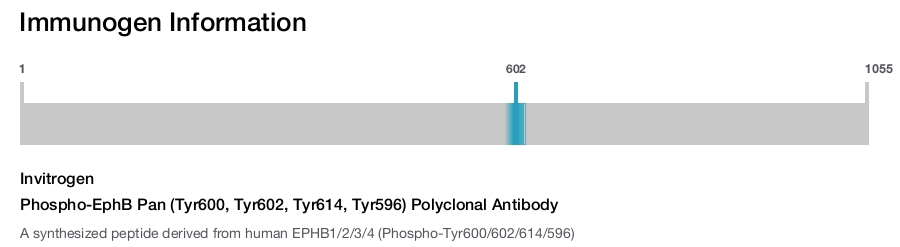
A synthesized peptide derived from human EPHB1/2/3/4 (Phospho-Tyr600/602/614/596)
偶联物
Unconjugated
Unconjugated
Unconjugated
形式
Liquid
浓度
1 mg/mL
规格
100 µg
纯化类型
Antigen affinity chromatography
保存液
PBS, pH 7.4, with 50% glycerol, 0.5% BSA
内含物
0.02% sodium azide
保存条件
-20°C
运输条件
Ambient (domestic); Wet ice (international)
RRID
产品详细信息
Phospho-EphB Pan (Tyr600, Tyr602, Tyr614, Tyr596) Polyclonal Antibody detects endogenous levels of EphB Pan only when phosphorylated at Tyr600, Tyr602, Tyr614, Tyr596.
靶标信息
Ephrin receptors and their ligands, the ephrins, mediate numerous developmental processes, particularly in the nervous system. Based on their structures and sequence relationships, ephrins are divided into the ephrin-A (EFNA) class, which are anchored to the membrane by a glycosylphosphatidylinositol linkage, and the ephrin-B (EFNB) class, which are transmembrane proteins. The Eph family of receptors are divided into 2 groups based on the similarity of their extracellular domain sequences and their affinities for binding ephrin-A and ephrin-B ligands. Ephrin receptors make up the largest subgroup of the receptor tyrosine kinase (RTK) family. EphB4 binds to ephrin-B2 and plays an essential role in vascular development.
仅用于科研。不用于诊断过程。未经明确授权不得转售。
篇参考文献 (0)
您是否在文献中引用过该产品?请点击下方按钮邮件告知我们。
生物信息学
蛋白别名: developmental kinase 2; developmental kinase 5; developmentally-regulated Eph-related tyrosine kinase; EK6; ELK-related protein tyrosine kinase; elk-related tyrosine kinase; embryonic kinase 2; Eph receptor B2 (ELK-related protein tyrosine kinase); eph tyrosine kinase 2; eph tyrosine kinase 3; EPH-like kinase 5; EPH-like kinase 6; EPH-like tyrosine kinase 2; EPH-like tyrosine kinase-2; Ephrin B1; Ephrin B2; Ephrin B3; Ephrin B4; ephrin receptor EphB4; ephrin type-B receptor 2-like; EphrinB1; EphrinB2; EphrinB3; EphrinB4; HEK-6; hepatoma transmembrane kinase; human embryo kinase 2; mDK-2; membrane protein; MGC87492; neural kinase; neuronally-expressed EPH-related tyrosine kinase; nuk receptor tyrosine kinase; protein-tyrosine kinase HEK5; renal carcinoma antigen NY-REN-47; Sek-3; Sek-4; tyrosine kinase MYK-1; tyrosine-protein kinase receptor EPH-2; tyrosine-protein kinase receptor EPH-3; tyrosine-protein kinase receptor HTK; tyrosine-protein kinase receptor SEK-3; tyrosine-protein kinase receptor SEK-4; tyrosine-protein kinase TYRO11; tyrosine-protein kinase TYRO5; tyrosine-protein kinase TYRO6; unnamed protein product
基因别名: 9330129L11; b2b2412Clo; BDPLT22; C130099E04Rik; CAPB; Cek10; Cek5; Cek6; CMAVM2; DRT; EK2; EK5; ELK; Elkh; Ephb2; EPHT2; EPHT3; ERK; ETECK; ETK2; HEK2; Hek5; Hek6; HFASD; HTK; LMPHM7; mDK-5; MDK2; MDK5; MYK1; NET; Nuk; PCBC; Prkm5; Qek5; RGD1564232; Sek3; Sek4; TYRO11; Tyro5; TYRO6
UniProt ID: (Human) P54762, (Human) P29323, (Human) P54753, (Human) P54760, (Mouse) Q8CBF3, (Rat) P09759, (Mouse) P54763, (Mouse) P54754, (Mouse) P54761
Entrez Gene ID: (Human) 2047, (Human) 2048, (Human) 2049, (Human) 2050, (Mouse) 270190, (Rat) 24338, (Mouse) 13844, (Rat) 313633, (Rat) 287989, (Mouse) 13845, (Mouse) 13846, (Rat) 686310
protein kinase activity
protein tyrosine kinase activity
transmembrane receptor protein tyrosine kinase activity
ephrin receptor activity
transmembrane-ephrin receptor activity
protein binding
ATP binding
axon guidance receptor activity
macromolecular complex binding
beta-amyloid binding
receptor binding
signaling receptor activity
identical protein binding
nucleotide binding
angiogenesis
urogenital system development
positive regulation of immunoglobulin production
negative regulation of cell adhesion
transmembrane receptor protein tyrosine kinase signaling pathway
nervous system development
axon guidance
axonal fasciculation
learning or memory
learning
positive regulation of gene expression
phosphorylation
peptidyl-tyrosine phosphorylation
hindbrain tangential cell migration
corpus callosum development
regulation of blood coagulation
positive regulation of cell migration
positive regulation of B cell proliferation
positive regulation of synaptic plasticity
positive regulation of tumor necrosis factor production
B cell activation
inner ear morphogenesis
regulation of JAK-STAT cascade
negative regulation of Ras protein signal transduction
ephrin receptor signaling pathway
regulation of neuronal synaptic plasticity
regulation of body fluid levels
positive regulation of multicellular organismal process
regulation of filopodium assembly
regulation of synapse assembly
positive regulation of synapse assembly
palate development
dendritic spine development
dendritic spine morphogenesis
positive regulation of dendritic spine morphogenesis
negative regulation of ERK1 and ERK2 cascade
cellular response to lipopolysaccharide
commissural neuron axon guidance
postsynaptic membrane assembly
neuron projection retraction
vesicle-mediated intercellular transport
tight junction assembly
negative regulation of cytokine production involved in inflammatory response
positive regulation of long-term synaptic potentiation
negative regulation of glutamate receptor signaling pathway
positive regulation of glutamate receptor signaling pathway
positive regulation of protein localization to plasma membrane
cellular response to beta-amyloid
neuron projection maintenance
positive regulation of protein localization to cell surface
regulation of T-helper 17 type immune response
regulation of behavioral fear response
cell migration involved in sprouting angiogenesis
heart morphogenesis
cell adhesion
animal organ development
venous blood vessel morphogenesis
regulation of developmental process
positive regulation of aorta morphogenesis
positive regulation of T cell costimulation
immunological synapse formation
cell activation
skeletal muscle satellite cell activation
cell migration
cranial nerve development
optic nerve morphogenesis
central nervous system projection neuron axonogenesis
neurogenesis
establishment of cell polarity
retinal ganglion cell axon guidance
cell-substrate adhesion
regulation of JNK cascade
protein autophosphorylation
camera-type eye morphogenesis
modulation of synaptic transmission
detection of temperature stimulus involved in sensory perception of pain
cell chemotaxis
neural precursor cell proliferation
regulation of ERK1 and ERK2 cascade
negative regulation of skeletal muscle satellite cell proliferation
negative regulation of satellite cell differentiation
central nervous system development
regulation of cell-cell adhesion
neuron projection development
substrate adhesion-dependent cell spreading
thymus development
digestive tract morphogenesis
regulation of axonogenesis
cell morphogenesis
protein phosphorylation
organ morphogenesis
positive regulation of long-term neuronal synaptic plasticity
negative regulation of axonogenesis
regulation of autophagosome assembly
system development
Disclaimer

Clicking the images or links will redirect you to a website hosted by BenchSci that provides third-party scientific content. Neither the content nor the BenchSci technology and processes for selection have been evaluated by us; we are providing them as-is and without warranty of any kind, including for use or application of the Thermo Fisher Scientific products presented.

