Search
Invitrogen
Phospho-IkB alpha (Ser32, Ser36) Recombinant Rabbit Monoclonal Antibody (PSH06-76)
{{$productOrderCtrl.translations['antibody.pdp.commerceCard.promotion.promotions']}}
{{$productOrderCtrl.translations['antibody.pdp.commerceCard.promotion.promocode']}}: {{promo.promoCode}} {{promo.promoTitle}} {{promo.promoDescription}}. {{$productOrderCtrl.translations['antibody.pdp.commerceCard.promotion.learnmore']}}
{{$ctrl.translations['antibody.pdp.skuNotes.additionalInformation']}}:
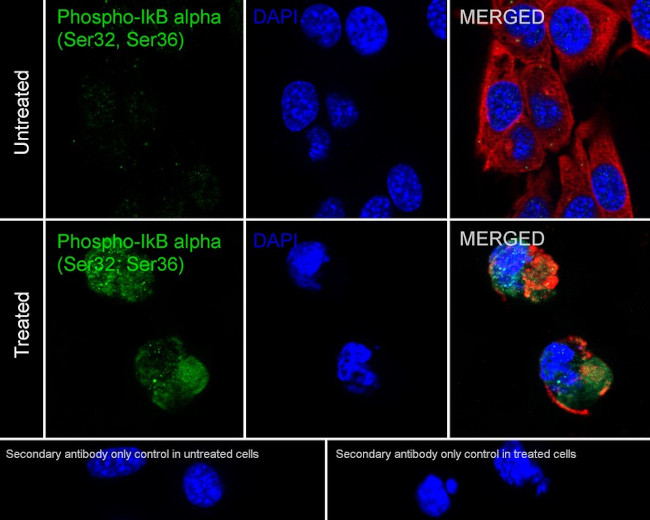
图: 1 / 5
Phospho-IkB alpha (Ser32, Ser36) Antibody (MA5-60179) in ICC/IF
Immunofluorescence analysis of Phospho-IkB alpha (Ser32/Ser36) using NIH/3T3 cells untreated (top) or treated with 20 ng/mL TNF-α and 100 nM Calyculin A for 10 minutes (bottom). The cells were fixed in 4% paraformaldehyde for 20 minutes at room temperature, permeabilized with 0.1% Triton X-100 in PBS for 5 minutes at room temperature, then blocked with 1% BSA in 10% negative goat serum for 1 hour at room te... View More
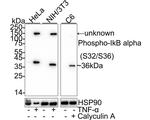
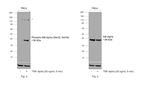
Please note: We are reviewing Western blot images included in the antibody testing data in our catalog, including those provided by third parties. Unless expressly labeled or annotated as “raw-unedited”, Western blot images included in the antibody testing data in our catalog may have been edited, optimized or otherwise adjusted for presentation.


产品信息
MA5-60179
产品规格
种属反应
Human,
Mouse,
Rat
宿主/亚型
Rabbit
/ IgG
Expression System
HEK293 cells
分类
Recombinant Monoclonal
类型
Antibody
克隆号
PSH06-76
抗原
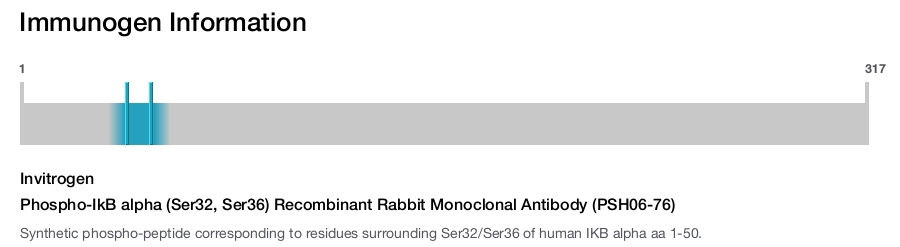
Synthetic phospho-peptide corresponding to residues surrounding Ser32/Ser36 of human IKB alpha aa 1-50.
偶联物
Unconjugated
Unconjugated
Unconjugated
形式
Liquid
浓度
1 mg/mL
规格
100 µg
纯化类型
Protein A
保存液
PBS, pH 7.4, with 0.1% BSA, 40% glycerol
内含物
0.05% sodium azide
保存条件
Store at 4°C short term. For long term storage, store at -20°C, avoiding freeze/thaw cycles.
运输条件
Ambient (domestic); Dry ice (international)
RRID
产品详细信息
Positive Control: HeLa treated with 20 ng/mL TNF-alpha and 100nM Calyculin A for 10 minutes cell lysate, NIH/3T3 treated with 20 ng/mL TNF-alpha and 100nM Calyculin A for 10 minutes cell lysate, C6 treated with 100 ng/mL Calyculin A for 1 hours cell lysate, human breast cancer tissue, HeLa cells treated with 20 ng/mL TNF-alpha and 100nM Calyculin A for 10 minutes, NIH/3T3 cells treated with 20 ng/mL TNF-alpha and 100nM Calyculin A for 10 minutes.
Tissue Specificity: Tissue enhanced (bone).
Subcellular Location: Cytoplasm, Nucleus.
Sequence Similarities: 100% Mouse/Rat.
Predicted band size: 36 kDa.
靶标信息
IkB-alpha is a 40 kDa protein that functions to inhibit NF- kappaB activity. The inhibition occurs via protein-protein interaction between I kappaB proteins and NF- kappaB dimers in the cytosol. The interaction of I kappa B-alpha with NF- kappaB masks the nuclear localization sequence of NF- kappaB, preventing NF- kappaB translocation to the nucleus. A variety of stimuli can activate gene expression by liberating NF- kappaB through the degradation of I kappaB alpha. These stimuli include the proinflammatory cytokines TNF- alpha and IL-1 beta, chemokines, PMA, growth factors, LPS, UV irradiation, viral infection, as well as various chemical and physical stresses. In humans, the gene is located on the q arm of chromosome 14. Activation of NFkB requires that IkB be phosphorylated on specific serine residues, which results in targeted degradation of IkB. IkB kinase alpha (IKK alpha), previously designated CHUK, interacts with IkB-alpha and specifically phosphorylates IkB-alpha on the sites that trigger its degradation Serines 32 and 36. IKK alpha appears to be critical for NFkB activation in response to proinflammatory cytokines. Phosphorylation of IkB by IKK alpha is stimulated by the NFkB inducing kinase (NIK), which itself is a central regulator for NFkB activation in response to TNF and IL-1. The functional IKK complex contains three subunits, IKK alpha, IKK beta and IKK gamma, and each appear to make essential contributions to IkB phosphorylation.
仅用于科研。不用于诊断过程。未经明确授权不得转售。
篇参考文献 (0)
您是否在文献中引用过该产品?请点击下方按钮邮件告知我们。
生物信息学
蛋白别名: I(Kappa)B(alpha); I-kappa-B-alpha; I-kappaBalpha; IkappaBalpha; ikB-alpha; IkBa; IKBalpha; Inhibitor of nuclear factor of kappa light chain gene enhancer in B-cells, alpha; MAD3; major histocompatibility complex enhancer-binding protein MAD3; Mutations: 945:OK; nuclear factor of kappa light chain gene enhancer in B-cells; nuclear factor of kappa light chain gene enhancer in B-cells inhibitor, alpha; nuclear factor of kappa light polyp gene enhancer in B-cell 1; nuclear factor of kappa light polypeptide gene enhancer in B-cells inhibitor, alpha; unnamed protein product
基因别名: EDAID2; IKBA; MAD-3; NFKBI; RL/IF-1
UniProt ID: (Human) P25963, (Mouse) Q9Z1E3, (Rat) Q63746
Entrez Gene ID: (Human) 4792, (Mouse) 18035, (Rat) 25493
protein binding
nuclear localization sequence binding
enzyme binding
ubiquitin protein ligase binding
identical protein binding
NF-kappaB binding
protein sequestering activity
molecular sequestering activity
transcription regulator inhibitor activity
heat shock protein binding
macromolecular complex binding
negative regulation of transcription from RNA polymerase II promoter
regulation of transcription from RNA polymerase II promoter
protein import into nucleus
inflammatory response
I-kappaB kinase/NF-kappaB signaling
regulation of gene expression
negative regulation of macrophage derived foam cell differentiation
negative regulation of lipid storage
signal transduction involved in regulation of gene expression
lipopolysaccharide-mediated signaling pathway
negative regulation of cholesterol transport
response to muramyl dipeptide
response to lipopolysaccharide
tumor necrosis factor-mediated signaling pathway
toll-like receptor 4 signaling pathway
response to muscle stretch
NIK/NF-kappaB signaling
regulation of cell proliferation
negative regulation of protein import into nucleus
negative regulation of I-kappaB kinase/NF-kappaB signaling
response to exogenous dsRNA
negative regulation of myeloid cell differentiation
negative regulation of Notch signaling pathway
positive regulation of transcription, DNA-templated
positive regulation of transcription from RNA polymerase II promoter
positive regulation of inflammatory response
B cell receptor signaling pathway
positive regulation of transcription initiation from RNA polymerase II promoter
nucleotide-binding oligomerization domain containing 1 signaling pathway
nucleotide-binding oligomerization domain containing 2 signaling pathway
interleukin-1-mediated signaling pathway
cellular response to cytokine stimulus
cellular response to tumor necrosis factor
negative regulation of cytokine production involved in inflammatory response
cellular response to cold
response to stress
response to ethanol
liver regeneration
Disclaimer

Clicking the images or links will redirect you to a website hosted by BenchSci that provides third-party scientific content. Neither the content nor the BenchSci technology and processes for selection have been evaluated by us; we are providing them as-is and without warranty of any kind, including for use or application of the Thermo Fisher Scientific products presented.

