Search
Invitrogen
Phospho-LDHA (Tyr10) Polyclonal Antibody
{{$productOrderCtrl.translations['antibody.pdp.commerceCard.promotion.promotions']}}
{{$productOrderCtrl.translations['antibody.pdp.commerceCard.promotion.viewpromo']}}
{{$productOrderCtrl.translations['antibody.pdp.commerceCard.promotion.promocode']}}: {{promo.promoCode}} {{promo.promoTitle}} {{promo.promoDescription}}. {{$productOrderCtrl.translations['antibody.pdp.commerceCard.promotion.learnmore']}}
Additional Information:
{{banner.description}}
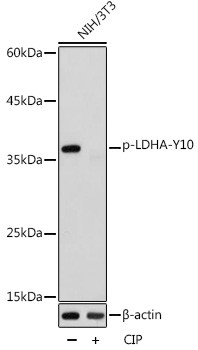
图: 1 / 1
Phospho-LDHA (Tyr10) Antibody (PA5-117223) in WB
Western blot analysis of Phospho-LDHA (Tyr10) in extracts of NIH/3T3 cells. Samples were incubated with Phospho-LDHA (Tyr10) Polyclonal antibody (Product # PA5-117223) using a dilution of 1:1,000, followed by HRP Goat Anti-Rabbit IgG (H+L) secondary antibody at a dilution of 1:10,000. NIH/3T3 cells were treated by CIP (20 µL/400 µL) at 37°C for 1 hour. Lysates/proteins: 25 µg per lane. Blocking buffer: 3% n... View More
Please note: We are reviewing Western blot images included in the antibody testing data in our catalog, including those provided by third parties. Unless expressly labeled or annotated as “raw-unedited”, Western blot images included in the antibody testing data in our catalog may have been edited, optimized or otherwise adjusted for presentation.


产品信息
PA5-117223
产品规格
种属反应
Human,
Mouse
宿主/亚型
Rabbit
/ IgG
分类
Polyclonal
类型
Antibody
抗原
Synthetic peptide
偶联物
Unconjugated
Unconjugated
Unconjugated
形式
Liquid
浓度
1.74 mg/mL
规格
174 µg
纯化类型
Affinity chromatography
保存液
PBS, pH 7.3, with 50% glycerol
内含物
0.09% sodium azide
保存条件
-20°C, Avoid Freeze/Thaw Cycles
运输条件
Ambient (domestic); Wet ice (international)
RRID
产品详细信息
Positive Samples: NIH/3T3
Immunogen sequence: LIYNL
靶标信息
Lactate dehydrogenase (LDH) is the enzyme in the glycolytic pathway that converts pyruvate to lactate with concomitant interconversion of NADH and NAD+. In mammals, the enzyme is encoded by three genes: LDHA (M or muscle form), LDHB (H or heart form), and LDHC (X or testis form). The three human LDHs have 84-89% sequence similarities and 69-75% amino acid identities. There are five different LDH isoenzymes based on the proportion of M and H chains existing in the LDH tetrameric structure. The LDHA is hypoxia inducible and its expression is directly controlled by the transcriptional activity of the hypoxia inducible factor 1a (HIF1a). LDHB is also known to be upregulated in many cancers. Mutations in the LDHA gene can lead to Glycogen storage disease 11 (GSD11).
仅用于科研。不用于诊断过程。未经明确授权不得转售。
篇参考文献 (0)
您是否在文献中引用过该产品?请点击下方按钮邮件告知我们。
生物信息学
蛋白别名: Cell proliferation-inducing gene 19 protein; L-lactate dehydrogenase; L-lactate dehydrogenase A chain; Lactate Dehydrogenase; lactate dehydrogenase 1, A chain; lactate dehydrogenase A4; lactate dehydrogenase-A; Lactic Dehydrogenase; LDH; LDH muscle subunit; LDH-A; LDH-M; M-LDH; OTTHUMP00000165206; Renal carcinoma antigen NY-REN-59
基因别名: l7R2; Ldh-1; Ldh1; LDHA; Ldhm; PIG19
UniProt ID: (Mouse) P06151
Entrez Gene ID: (Mouse) 16828
Disclaimer

Clicking the images or links will redirect you to a website hosted by BenchSci that provides third-party scientific content. Neither the content nor the BenchSci technology and processes for selection have been evaluated by us; we are providing them as-is and without warranty of any kind, including for use or application of the Thermo Fisher Scientific products presented.

