Search
Invitrogen
Phospho-PAK1/2/3 (Thr423, Thr402, Thr421) Polyclonal Antibody
{{$productOrderCtrl.translations['antibody.pdp.commerceCard.promotion.promotions']}}
{{$productOrderCtrl.translations['antibody.pdp.commerceCard.promotion.viewpromo']}}
{{$productOrderCtrl.translations['antibody.pdp.commerceCard.promotion.promocode']}}: {{promo.promoCode}} {{promo.promoTitle}} {{promo.promoDescription}}. {{$productOrderCtrl.translations['antibody.pdp.commerceCard.promotion.learnmore']}}
Additional Information:
{{banner.description}}
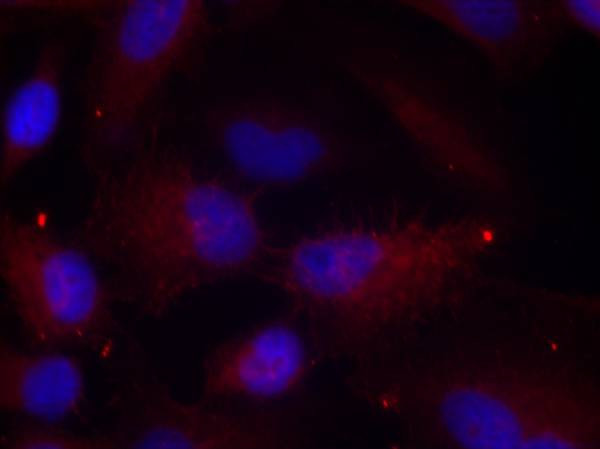
Please note: We are reviewing Western blot images included in the antibody testing data in our catalog, including those provided by third parties. Unless expressly labeled or annotated as “raw-unedited”, Western blot images included in the antibody testing data in our catalog may have been edited, optimized or otherwise adjusted for presentation.


产品信息
PA5-37819
产品规格
种属反应
Human,
Mouse,
Rat
宿主/亚型
Rabbit
/ IgG
分类
Polyclonal
类型
Antibody
抗原
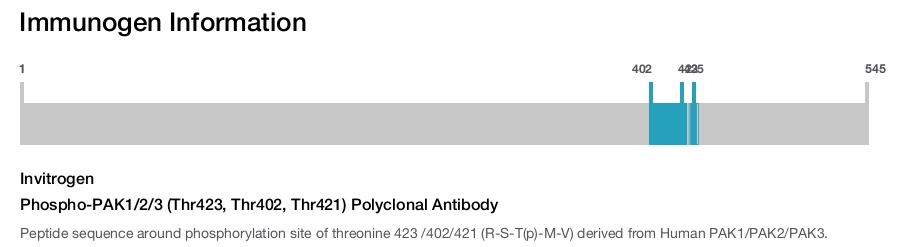
Peptide sequence around phosphorylation site of threonine 423 /402/421 (R-S-T(p)-M-V) derived from Human PAK1/PAK2/PAK3.
偶联物
Unconjugated
Unconjugated
Unconjugated
形式
Liquid
浓度
1 mg/mL
规格
100 µg
纯化类型
Antigen affinity chromatography
保存液
PBS, pH 7.4, with 50% glycerol
内含物
0.02% sodium azide
保存条件
Store at 4°C short term. For long term storage, store at -20°C, avoiding freeze/thaw cycles.
运输条件
Ambient (domestic); Wet ice (international)
RRID
产品详细信息
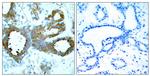
A suggested positive control for IHC is human breast carcinoma; suggested positive control for ICC/IF is Hela cells.
靶标信息
In mammals, there are several identified isoforms of p21-Activated Protein Kinases or PAKs: alpha-PAK (also known as PAK-1) and beta-PAK (also known as PAK-3) are mostly brain-specific, while gamma-PAK (also known as PAK-2) is expressed ubiquitously (Jakobi et al., 2003). Mutations of the gene coding for PAK-3 are associated wit X-linked mental retardation and recent work indicates that PAK-3 is a key regulator of synapse formation and plasticity in the hippocampus (Boda et al., 2004). PAK-3 is thought to play a key role in regulation of cell shape and motility as well as cell death (Jakobi et al., 2003; Walter et al., 1998). Autophosphorylation of Thr402 in the protein has been found to be essential for activation of PAK (Jakobi et al., 2000).
仅用于科研。不用于诊断过程。未经明确授权不得转售。
篇参考文献 (0)
您是否在文献中引用过该产品?请点击下方按钮邮件告知我们。
生物信息学
蛋白别名: activated protein kinase alpha; ADRB2; adriamycin resistance-associated; alpha-PAK; aPAK; beta-PAK; BPAK; CDC42/RAC effector kinase PAK-A; CDC42/RAC effector kinase PAK-B; CDKN1A; CLAP; EC 2.7.11.1; gamma pak; gamma-PAK; hPAK3; kinase PAK1; oligophrenin-3; p21 (CDKN1A)-activated kinase 1; p21 (CDKN1A)-activated kinase 2; p21 (CDKN1A)-activated kinase 3; P21 CDKN1A-activated kinase 1; p21 protein (Cdc42/Rac)-activated kinase 1; p21 protein (Cdc42/Rac)-activated kinase 2; p21 protein (Cdc42/Rac)-activated kinase 3; p21-activated kinase 1; p21-activated kinase 2; p21-activated kinase 3; p21/Cdc42/Rac1-activated kinase 1 (STE20 homolog, yeast); p21/Cdc42/Rac1-activated kinase 1 (yeast Ste20-related); p21/Cdc42/Rac1-activated kinase 3 (yeast Ste20-related); p21cdc42/rac1-activated serine/threonine kinase; p58; p65-PAK; p68-PAK; PAK 1; PAK alpha; PAK beta; PAK gamma; PAK-1; PAK-2; PAK-3; PAK-a; PAK-B; PAK-y; protein kinase; protein kinase MUK2; S6/H4 kinase; serine/threonine-protein kinase PAK 2-like; STE20 homolog, yeast; unnamed protein product; yPAK
基因别名: 5330420P17Rik; A130002K10Rik; alpha-PAK; ARA; beta-PAK; bPAK; D16Ertd269e; gamma-PAK; IDDMSSD; KNO2; mKIAA4182; MRX30; MRX47; OPHN3; p65-PAK; PAK-1; PAK-2; PAK-3; PAK3beta; PAK65; Pak65alpha; Pak65beta; Paka; PAKalpha; PAKgamma; Stk4; XLID30
UniProt ID: (Human) Q13153, (Human) Q13177, (Human) O75914, (Rat) P35465, (Rat) Q64303, (Mouse) Q8CIN4, (Rat) Q62829, (Mouse) Q61036
Entrez Gene ID: (Human) 5058, (Human) 5062, (Human) 5063, (Mouse) 18479, (Rat) 29431, (Rat) 29432, (Mouse) 224105, (Rat) 29433, (Mouse) 18481
protein kinase activity
protein serine/threonine kinase activity
protein binding
collagen binding
ATP binding
protein kinase binding
small GTPase binding
identical protein binding
gamma-tubulin binding
protein serine kinase activity
protein tyrosine kinase activator activity
cadherin binding
MAP kinase kinase activity
MAP kinase kinase kinase activity
GTPase binding
response to hypoxia
chromatin remodeling
protein phosphorylation
cellular response to DNA damage stimulus
neuromuscular junction development
positive regulation of cell proliferation
cellular response to starvation
regulation of gene expression
positive regulation of fibroblast migration
dendrite development
cell migration
transmission of nerve impulse
amygdala development
establishment of cell polarity
actin cytoskeleton organization
positive regulation of cell migration
positive regulation of microtubule polymerization
cellular response to insulin stimulus
regulation of actin cytoskeleton organization
positive regulation of peptidyl-serine phosphorylation
positive regulation of intracellular estrogen receptor signaling pathway
intracellular signal transduction
wound healing
receptor clustering
regulation of MAPK cascade
positive regulation of axon extension
positive regulation of insulin receptor signaling pathway
protein autophosphorylation
hepatocyte growth factor receptor signaling pathway
branching morphogenesis of an epithelial tube
neuron projection morphogenesis
regulation of axonogenesis
positive regulation of stress fiber assembly
negative regulation of cell proliferation involved in contact inhibition
dendritic spine development
negative regulation of cell growth involved in cardiac muscle cell development
gamma-aminobutyric acid secretion, neurotransmission
glutamate secretion, neurotransmission
positive regulation of microtubule nucleation
positive regulation of protein targeting to membrane
observational learning
regulation of trans-synaptic signaling by endocannabinoid, modulating synaptic transmission
regulation of long-term synaptic potentiation
protein localization to cytoplasmic stress granule
positive regulation of vascular smooth muscle cell proliferation
positive regulation of vascular associated smooth muscle cell migration
cardiac muscle hypertrophy
adherens junction assembly
negative regulation of apoptotic process
regulation of cytoskeleton organization
negative regulation of stress fiber assembly
bicellular tight junction assembly
cellular response to transforming growth factor beta stimulus
protein localization to cell-cell junction
positive regulation of extrinsic apoptotic signaling pathway
MAPK cascade
stimulatory C-type lectin receptor signaling pathway
transmembrane receptor protein tyrosine kinase signaling pathway
axonogenesis
regulation of actin filament polymerization
ephrin receptor signaling pathway
synapse organization
dendritic spine morphogenesis
regulation of actin filament organization
small GTPase mediated signal transduction
cerebellum development
regulation of neuron projection development
positive regulation of neuron apoptotic process
positive regulation of dendritic spine morphogenesis
regulation of postsynapse organization
positive regulation of DNA biosynthetic process
signal transduction
vascular endothelial growth factor receptor signaling pathway
protein maturation
execution phase of apoptosis
positive regulation of execution phase of apoptosis
Fc-gamma receptor signaling pathway involved in phagocytosis
Disclaimer

Clicking the images or links will redirect you to a website hosted by BenchSci that provides third-party scientific content. Neither the content nor the BenchSci technology and processes for selection have been evaluated by us; we are providing them as-is and without warranty of any kind, including for use or application of the Thermo Fisher Scientific products presented.

