Search
Agrisera
PntA (Slr1239)/Pyridine nucleotide transhydrogenase alpha-subunit Polyclonal Antibody
{{$productOrderCtrl.translations['antibody.pdp.commerceCard.promotion.promotions']}}
{{$productOrderCtrl.translations['antibody.pdp.commerceCard.promotion.viewpromo']}}
{{$productOrderCtrl.translations['antibody.pdp.commerceCard.promotion.promocode']}}: {{promo.promoCode}} {{promo.promoTitle}} {{promo.promoDescription}}. {{$productOrderCtrl.translations['antibody.pdp.commerceCard.promotion.learnmore']}}
Additional Information:
{{banner.description}}
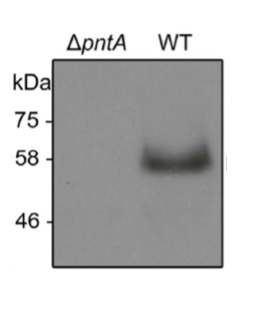
图: 1 / 1
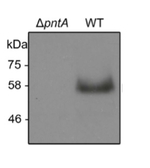
PntA (Slr1239)/Pyridine nucleotide transhydrogenase alpha-subunit Antibody (AS15-2910) in WB
25 µg of total proteins from Synechocystis sp. PCC 6,803 (WT) and the Δpnt A mutant extracted with buffer containing 50 m M HEPES-Na OH, p H 7.5,30 m M Ca Cl 2,800 m M sorbitol and 1 m M 6-aminohexanoid acid and denatured with 2 x LaemLi buffer at +4 °C for O/N. Proteins were separated on 12% SDS-PAGE containing 6 M urea and blotted 1 h to PVDF using semi-dry transfer. Blot was blocked with 5% milk for 1 h ... View More

产品信息
AS15-2910
产品规格
种属反应
Bacteria
宿主/亚型
Rabbit
分类
Polyclonal
类型
Antibody
抗原
KLH-conjugated peptide derived from Synechocystis NAD(P) transhydrogenase alpha subunit sequence.
偶联物
形式
Lyophilized
规格
50 µg
纯化类型
Antigen affinity chromatography
保存液
PBS, pH 7.4
内含物
no preservative
保存条件
-20°C, Avoid Freeze/Thaw Cycles
运输条件
Ambient (domestic); Wet ice (international)
产品详细信息
Store lyophilized/reconstituted at -20°C; once reconstituted make aliquots to avoid repeated freeze-thaw cycles. Please remember to spin the tubes briefly prior to opening them to avoid any losses that might occur from material adhering to the cap or sides of the tube.
For reconstitution add 50 µL of sterile water.
Specific Species Reactivity: Synechocystis sp. PCC6803
靶标信息
PntA encodes the alpha subunit of the proton-translocating nicotinamide nucleotide transhydrogenase (PntAB), an integral cytoplasmic-membrane enzyme complex in bacteria that couples hydride transfer between NAD(H) and NADP(H) to proton translocation across the membrane, thereby helping maintain cellular NADPH supply for reductive biosynthesis and redox homeostasis. In Escherichia coli, PntA is produced as a ~50-55 kDa protein that forms a stable complex with the beta subunit (PntB) and contributes both a large cytosolic NAD(H)-binding peripheral domain (often termed domain I) and a membrane-embedded segment comprising multiple transmembrane helices that are part of the shared proton-coupling membrane domain. Structural studies of the isolated NAD(H)-binding portion show it forms dimers and binds NAD(H) with conformational flexibility consistent with alternating-access/coupling models, while physiological genetics and flux analyses indicate PntAB can provide a substantial fraction of the NADPH required during aerobic growth on glucose, underscoring its central role in balancing NADH/NADPH pools in vivo.
仅用于科研。不用于诊断过程。未经明确授权不得转售。
篇参考文献 (0)
您是否在文献中引用过该产品?请点击下方按钮邮件告知我们。
生物信息学
蛋白别名: b1603; ECK1598; JW1595
Disclaimer

Clicking the images or links will redirect you to a website hosted by BenchSci that provides third-party scientific content. Neither the content nor the BenchSci technology and processes for selection have been evaluated by us; we are providing them as-is and without warranty of any kind, including for use or application of the Thermo Fisher Scientific products presented.

