Search
NeoBiotechnologies
Progesterone Receptor (Marker of Progestin Dependence) Recombinant Rabbit Monoclonal Antibody (MSVA-570R)
{{$productOrderCtrl.translations['antibody.pdp.commerceCard.promotion.promotions']}}
{{$productOrderCtrl.translations['antibody.pdp.commerceCard.promotion.promocode']}}: {{promo.promoCode}} {{promo.promoTitle}} {{promo.promoDescription}}. {{$productOrderCtrl.translations['antibody.pdp.commerceCard.promotion.learnmore']}}
{{$ctrl.translations['antibody.pdp.skuNotes.additionalInformation']}}:
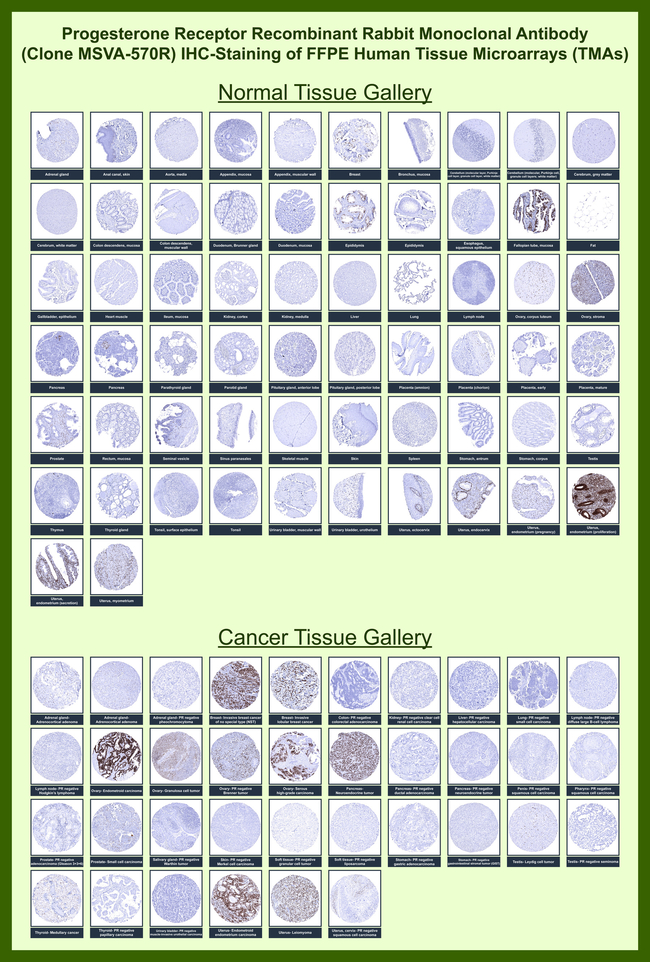
图: 1 / 1
Progesterone Receptor (Marker of Progestin Dependence) Antibody (5241-RBM20-P1) in IHC (P)
Progesterone receptor Rabbit Recombinant Monoclonal Antibody (MSVA-570R) tested on many normal and cancer tissues. The immunohistochemistry staining in these tissues aligns with the expression data in Human Protein Atlas.
Please note: We are reviewing Western blot images included in the antibody testing data in our catalog, including those provided by third parties. Unless expressly labeled or annotated as “raw-unedited”, Western blot images included in the antibody testing data in our catalog may have been edited, optimized or otherwise adjusted for presentation.

产品信息
5241-RBM20-P1
产品规格
种属反应
Human
宿主/亚型
Rabbit
/ IgG, kappa
Expression System
HEK293 cells
分类
Recombinant Monoclonal
类型
Antibody
克隆号
MSVA-570R
抗原
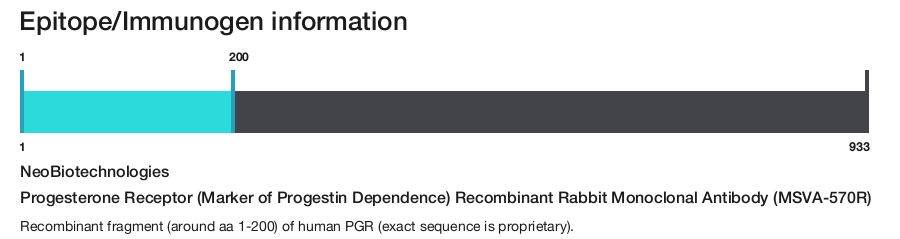
Recombinant fragment (around aa 1-200) of human PGR (exact sequence is proprietary).
偶联物
Unconjugated
Unconjugated
Unconjugated
形式
Liquid
浓度
200 µg/mL
规格
100 µg
纯化类型
Protein A
保存液
PBS with 0.05% BSA
内含物
0.05% sodium azide
保存条件
4°C
运输条件
Ambient (domestic); Wet ice (international)
产品详细信息
Product cellular localization: Cell junction, Cell membrane, Membrane raft.
Positive control: Jurkat cells. Tonsil or Angiosarcoma., THP-1.
Tissue specificity: Expressed on platelets and leukocytes and is primarily concentrated at the borders between endothelial cells (PubMed:18388311, PubMed:21464369). Expressed in human umbilical vein endothelial cells (HUVECs) (at protein level) (PubMed:19342684, PubMed:17580308). Expressed on neutrophils (at protein level) (PubMed:17580308). Isoform Long predominates in all tissues examined (PubMed:12433657). Isoform Delta12 is detected only in trachea (PubMed:12433657). Isoform Delta14-15 is only detected in lung (PubMed:12433657). Isoform Delta14 is detected in all tissues examined with the strongest expression in heart (PubMed:12433657). Isoform Delta15 is expressed in brain, testis, ovary, cell surface of platelets, human umbilical vein endothelial cells (HUVECs), Jurkat T-cell leukemia, human erythroleukemia (HEL) and U-937 histiocytic lymphoma cell lines (at protein level) (PubMed:12433657, PubMed:18388311).
靶标信息
The progesterone receptor (PR) is a member of the steroid family of nuclear receptors. The PR mediates the physiological effects of progesterone, which plays a central role in reproductive events associated with the establishment and maintenance of pregnancy. PR is found as a 94 kDa protein (Form A) or a 120 kDa protein (Form B) due to the use of alternative translation initiation sites. PR-B is the transcriptionally active form and is responsible for activating genes for the maintenance of the endometrium, maintenance of pregnancy, and inhibition of ovulation. PR-A is identical to PR-B except for a 165 amino acid deletion at the N-terminus. This deletion exposes a 140 amino acid inhibitory domain (ID) that acts as a repressor of steroid hormone transcriptional activity. In its inactive state, PgR forms a multiprotein complex which includes heat shock proteins and immunophins. Upon binding of progesterone hormone to its receptor, there is a conformational change that allows dimerization and binding of the receptor to progesterone response elements (PRE) sequences, resulting in activated transcription. A Null mutation in the PGR gene leads to pleiotrophic reproductive abnormalities.
仅用于科研。不用于诊断过程。未经明确授权不得转售。
篇参考文献 (0)
您是否在文献中引用过该产品?请点击下方按钮邮件告知我们。
生物信息学
蛋白别名: nuclear receptor subfamily 3 group C member 3; unnamed protein product
基因别名: NR3C3; PR
UniProt ID: (Human) P06401
Entrez Gene ID: (Human) 5241
RNA polymerase II core promoter proximal region sequence-specific DNA binding
RNA polymerase II transcription factor activity, sequence-specific DNA binding
transcription coactivator binding
transcriptional activator activity, RNA polymerase II transcription regulatory region sequence-specific binding
DNA binding
transcription factor activity, sequence-specific DNA binding
steroid hormone receptor activity
RNA polymerase II transcription factor activity, ligand-activated sequence-specific DNA binding
receptor binding
steroid binding
protein binding
zinc ion binding
enzyme binding
estrogen response element binding
identical protein binding
sequence-specific DNA binding
ATPase binding
sequence-specific double-stranded DNA binding
regulation of transcription, DNA-templated
regulation of transcription from RNA polymerase II promoter
signal transduction
cell-cell signaling
positive regulation of gene expression
negative regulation of gene expression
intracellular steroid hormone receptor signaling pathway
negative regulation of phosphorylation
steroid hormone mediated signaling pathway
positive regulation of transcription from RNA polymerase II promoter
progesterone receptor signaling pathway
maintenance of protein location in nucleus
Disclaimer

Clicking the images or links will redirect you to a website hosted by BenchSci that provides third-party scientific content. Neither the content nor the BenchSci technology and processes for selection have been evaluated by us; we are providing them as-is and without warranty of any kind, including for use or application of the Thermo Fisher Scientific products presented.

