Search
NeoBiotechnologies
Prostate Specific Antigen (PSA) Recombinant Rabbit Monoclonal Antibody (KLK3/4602R)
{{$productOrderCtrl.translations['antibody.pdp.commerceCard.promotion.promotions']}}
{{$productOrderCtrl.translations['antibody.pdp.commerceCard.promotion.promocode']}}: {{promo.promoCode}} {{promo.promoTitle}} {{promo.promoDescription}}. {{$productOrderCtrl.translations['antibody.pdp.commerceCard.promotion.learnmore']}}
{{$ctrl.translations['antibody.pdp.skuNotes.additionalInformation']}}:
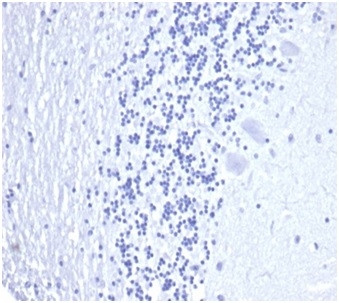
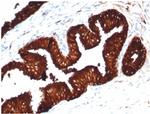
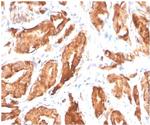
Please note: We are reviewing Western blot images included in the antibody testing data in our catalog, including those provided by third parties. Unless expressly labeled or annotated as “raw-unedited”, Western blot images included in the antibody testing data in our catalog may have been edited, optimized or otherwise adjusted for presentation.


产品信息
354-RBM12-P1
产品规格
种属反应
Human
宿主/亚型
Rabbit
/ IgG
Expression System
HEK293 cells
分类
Recombinant Monoclonal
类型
Antibody
克隆号
KLK3/4602R
抗原
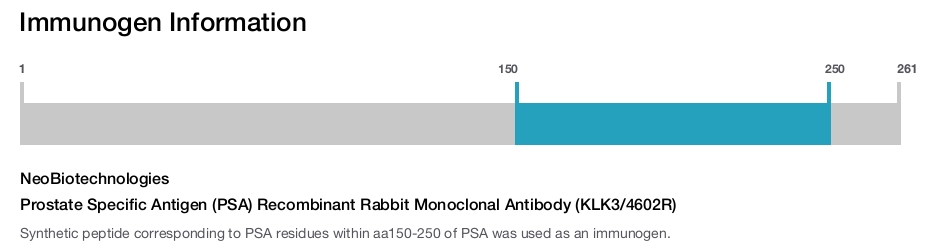
Synthetic peptide corresponding to PSA residues within aa150-250 of PSA was used as an immunogen.
偶联物
Unconjugated
Unconjugated
Unconjugated
形式
Liquid
浓度
200 µg/mL
规格
100 µg
纯化类型
Protein A/G
保存液
PBS with 0.05% BSA
内含物
0.05% sodium azide
保存条件
4°C
运输条件
Ambient (domestic); Wet ice (international)
产品详细信息
Antibody is stable for 24 months.
Positive Control: PC12 cells.Normal prostate or prostate carcinoma tissues. Cellular Localization: Secreted
Specificity Comments: Prostate-specific antigen (PSA) is a single-chain glycoprotein of 237 amino acids containing approximately 8% carbohydrate. It is a serine protease produced almost exclusively by prostatic epithelial cells. Immunohistochemically PSA is expressed in the highly specialized apically-superficial layer of female and male secretory cells of the prostate gland, and is readily demonstrated in adeno carcinomas of the prostate in about 99% of the cases. There is a correlation between malignancy grade and intensity of staining, high grade carcinomas displaying weaker expression. About 1% of poorly differentiated carcinomas have been negative for PSA. Due to the high specificity of PSA for prostatic glandular epithelium, it is very useful in identifying prostatic carcinoma in the prostate and in the adjacent organs often affected by epithelial malignancies, i.e. rectum and urinary bladder. PSA may be used in a panel together with NKX3.1 and Prostein, which are at least as sensitive and slightly more specific than PSA.
靶标信息
PSA is a chymotrypsin-like serine protease (kallikrein family) produced by the prostate epithelium, and is abundant in seminal fluid. PSA can be detected in the sera of patients with prostatic carcinoma. It is predominantly complexed to a liver-derived serine protease inhibitor, alpha-1-antichymotrypsin (ACT). A higher proportion of serum PSA is complexed to ACT in prostate cancer than in benign prostate hyperplasia. PSA is used to confirm prostatic acinar cell origin in primary and metastatic carcinoma and to rule out non-prostatic carcinoma mimics.
仅用于科研。不用于诊断过程。未经明确授权不得转售。
篇参考文献 (0)
您是否在文献中引用过该产品?请点击下方按钮邮件告知我们。
生物信息学
蛋白别名: Antigen; gamma-seminoprotein; Kallikrein 3; kallikrein-3; Kallikrein-3 (KLK3); KLK-3; P-30 antigen; prostate specific antigen precursor; prostate-specific (APS); prostate-specific antigen; PSA; KLK3; semenogelase; seminin; unnamed protein product
基因别名: APS; hK3; KLK2A1; PSA
UniProt ID: (Human) P07288
Entrez Gene ID: (Human) 354
Disclaimer

Clicking the images or links will redirect you to a website hosted by BenchSci that provides third-party scientific content. Neither the content nor the BenchSci technology and processes for selection have been evaluated by us; we are providing them as-is and without warranty of any kind, including for use or application of the Thermo Fisher Scientific products presented.

