Search
Invitrogen
RAP Chimeric Recombinant Rabbit Monoclonal Antibody (7F1)
{{$productOrderCtrl.translations['antibody.pdp.commerceCard.promotion.promotions']}}
{{$productOrderCtrl.translations['antibody.pdp.commerceCard.promotion.promocode']}}: {{promo.promoCode}} {{promo.promoTitle}} {{promo.promoDescription}}. {{$productOrderCtrl.translations['antibody.pdp.commerceCard.promotion.learnmore']}}
{{$ctrl.translations['antibody.pdp.skuNotes.additionalInformation']}}:
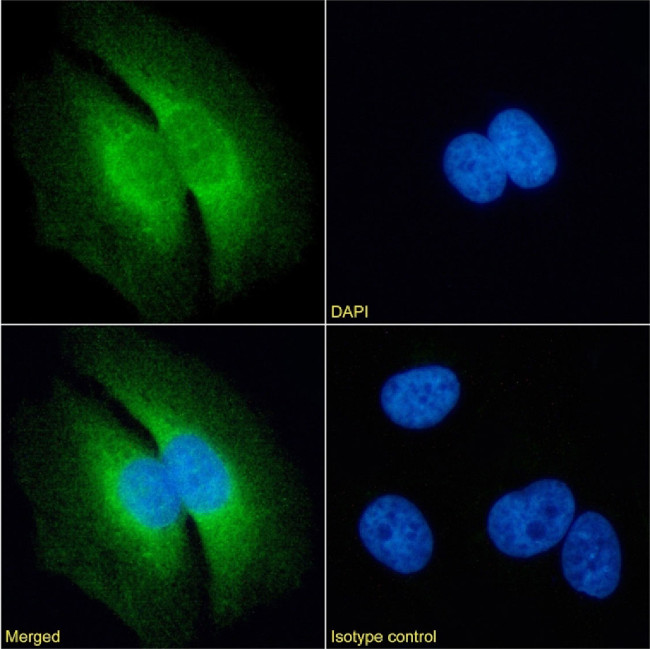
FIGURE: 1 / 3
RAP Chimeric Antibody (MA5-48227) in ICC/IF
Immunocytochemistry/Immunofluorescence analysis of RAP in HeLa cells using RAP Chimeric Monoclonal Antibody (Product # MA5-48227). Paraformaldehyde-fixed cells were immobilized on cover slips and stained with RAP Chimeric Monoclonal Antibody at 10 µg/mL for 1h followed by Alexa Fluor 488 secondary antibody (2 µg/mL), showing membrane staining. The nuclear stain is DAPI (blue). Panels show from left-right, t... View More
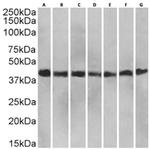
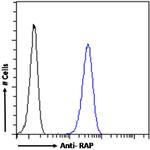
Please note: We are reviewing Western blot images included in the antibody testing data in our catalog, including those provided by third parties. Unless expressly labeled or annotated as “raw-unedited”, Western blot images included in the antibody testing data in our catalog may have been edited, optimized or otherwise adjusted for presentation.


Product Details
MA5-48227
Applications
Tested Dilution
Publications
Product Specifications
Species Reactivity
Human
Host/Isotype
Rabbit
/ IgG, kappa
Expression System
HEK293 cells
Class
Recombinant Monoclonal
Type
Antibody
Clone
7F1
Immunogen
This antibody was raised by immunising mice with human placental RAP.
Conjugate
Unconjugated
Unconjugated
Unconjugated
Form
Liquid
Concentration
1 mg/mL
Amount
200 µg
Purification
Protein A
Storage buffer
PBS
Contains
0.02% ProClin 300
Storage conditions
Store at 4°C short term. For long term storage, store at -20°C, avoiding freeze/thaw cycles.
Shipping conditions
Ambient (domestic); Wet ice (international)
RRID
Product Specific Information
Specificity: This antibody is specific for human RAP. It does not cross-react with rabbit or murine RAP.
Target Information
The term RAP typically refers to receptor-associated protein, encoded by the LRPAP1 gene, which plays a significant role in the trafficking and function of certain receptors within cells. RAP is primarily involved in the regulation of low-density lipoprotein receptor-related proteins (LRPs) by acting as a chaperone during protein transport within the endoplasmic reticulum (ER). It prevents premature ligand binding and assists in the proper folding and assembly of receptor complexes, ensuring efficient receptor function and trafficking to the cell surface. RAP also influences cellular processes related to cholesterol metabolism and cell signaling through its interactions with these receptors. Its function is crucial for transporting and recycling receptors involved in various pathways, including lipid metabolism, endocytosis, and cellular homeostasis. Dysregulation of RAP or related receptor functions can impact metabolic health and are implicated in conditions such as atherosclerosis, neurodegenerative disorders, and cancer.
For Research Use Only. Not for use in diagnostic procedures. Not for resale without express authorization.
References (0)
Have you cited this product in a publication?
Let us know so we can reference it here.
Bioinformatics
Protein Aliases: 39 kDa receptor-associated protein; low density lipoprotein receptor-related protein associated protein 1; low density lipoprotein-related protein-associated protein 1 (alpha-2-macroglobulin receptor-associated protein 1); unnamed protein product
Gene Aliases: A2MRAP; A2RAP; alpha-2-MRAP; HBP44; MYP23; RAP
UniProt ID: (Human) P30533
Entrez Gene ID: (Human) 4043
negative regulation of receptor internalization
signal transduction
negative regulation of very-low-density lipoprotein particle clearance
regulation of receptor-mediated endocytosis
amyloid-beta clearance by transcytosis
extracellular negative regulation of signal transduction
negative regulation of beta-amyloid clearance
positive regulation of beta-amyloid clearance
Disclaimer

Clicking the images or links will redirect you to a website hosted by BenchSci that provides third-party scientific content. Neither the content nor the BenchSci technology and processes for selection have been evaluated by us; we are providing them as-is and without warranty of any kind, including for use or application of the Thermo Fisher Scientific products presented.

Performance Guarantee
If an Invitrogen™ antibody doesn't perform as described on our website or datasheet,we'll replace the product at no cost to you, or provide you with a credit for a future purchase.*
Learn more
We're here to help
Get expert recommendations for common problems or connect directly with an on staff expert for technical assistance related to applications, equipment and general product use.
Contact tech support