Search
Invitrogen
RCAN2 Monoclonal Antibody (1A9)
{{$productOrderCtrl.translations['antibody.pdp.commerceCard.promotion.promotions']}}
{{$productOrderCtrl.translations['antibody.pdp.commerceCard.promotion.promocode']}}: {{promo.promoCode}} {{promo.promoTitle}} {{promo.promoDescription}}. {{$productOrderCtrl.translations['antibody.pdp.commerceCard.promotion.learnmore']}}
{{$ctrl.translations['antibody.pdp.skuNotes.additionalInformation']}}:
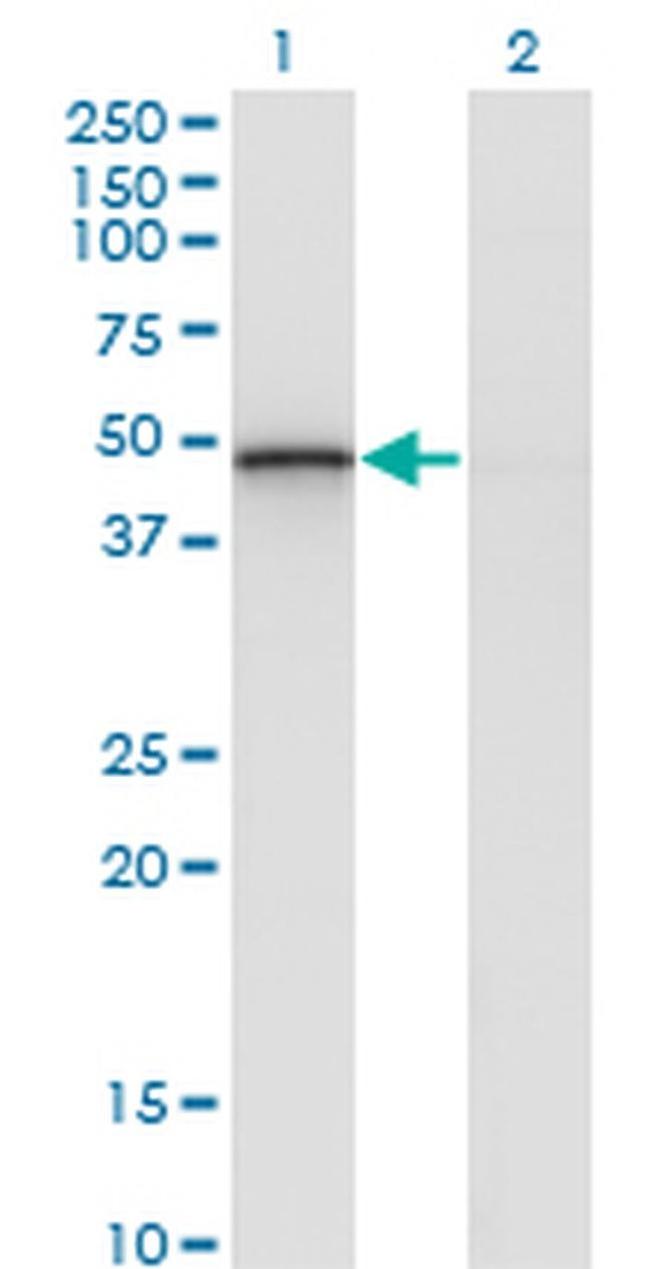
Please note: We are reviewing Western blot images included in the antibody testing data in our catalog, including those provided by third parties. Unless expressly labeled or annotated as “raw-unedited”, Western blot images included in the antibody testing data in our catalog may have been edited, optimized or otherwise adjusted for presentation.

产品信息
MA5-24549
产品规格
种属反应
Human
宿主/亚型
Mouse
/ IgG1, kappa
分类
Monoclonal
类型
Antibody
克隆号
1A9
抗原
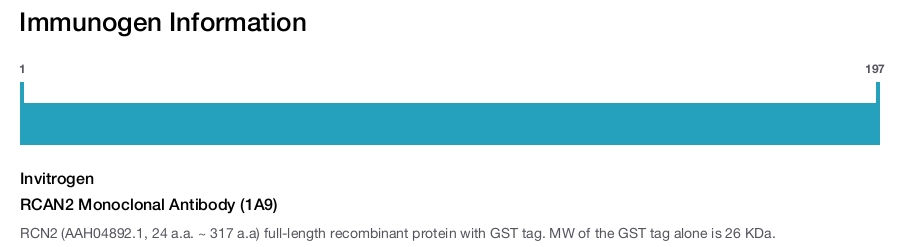
RCN2 (AAH04892.1, 24 a.a. ~ 317 a.a) full-length recombinant protein with GST tag. MW of the GST tag alone is 26 KDa.
偶联物
Unconjugated
Unconjugated
Unconjugated
形式
Liquid
规格
100 µg
纯化类型
Protein A
保存液
PBS, pH 7.4
内含物
no preservative
保存条件
-20°C, Avoid Freeze/Thaw Cycles
运输条件
Ambient (domestic); Wet ice (international)
RRID
产品详细信息
Peptide Sequence: KAEELHYPLG ERRSDYDREA LLGVQEDVDE YVKLGHEEQQ KRLQAIIKKI DLDSDGFLTE SELSSWIQMS FKHYAMQEAK QQFVEYDKNS DDTVTWDEYN IQMYDRVIDF DENTALDDAE EESFRKLHLK DKKRFEKANQ DSGPGLSLEE FIAFEHPEEV DYMTEFVIQE ALEEHDKNGD GFVSLEEFLG DYRWDPTANE DPEWILVEKD RFVNDYDKDN DGRLDPQELL PWVVPNNQGI AQEEALHLID EMDLNGDKKL SEEEILENPD LFLTSEATDY GRQLHDDYFY HDEL
靶标信息
Regulator of calcineurin 2 (RCAN2), also known as ZAKI4 and DSCR1L1, is expressed as two isoforms differing at their N-terminus. The longer of the two (isoform 1) is expressed exclusively in the brain, while isoform 2 is ubiquitously expressed, with highest expression in brain, heart, and muscle. Both isoforms bind to the catalytic subunit of calcineurin, a Ca++-dependent protein phosphatase involved in several neuronal functions, though their C-terminal region and inhibit calcineurin's activity. Unlike isoform 1 of RCAN2, the expression of the second isoform is not induced by the thyroid hormone T3. RCAN2 is a member of a family of three endogenous calcineurin regulators that are located near the minimal supernumerary fragment of chromosome 21 in individuals with Down syndrome, suggesting that they play a role in this syndrome. Multiple isoforms of RCAN2 are known to exist.
仅用于科研。不用于诊断过程。未经明确授权不得转售。
篇参考文献 (0)
您是否在文献中引用过该产品?请点击下方按钮邮件告知我们。
生物信息学
蛋白别名: Down syndrome candidate region 1-like 1; Down syndrome critical region gene 1-like 1; myocyte-enriched calcineurin-interacting protein 2; thyroid hormone-responsive (skin fibroblasts); thyroid hormone-responsive protein ZAKI-4; unnamed protein product; ZAKI-4
基因别名: CSP2; DSCR1L1; MCIP2; ZAKI-4; ZAKI4
UniProt ID: (Human) Q14206
Entrez Gene ID: (Human) 10231
Disclaimer

Clicking the images or links will redirect you to a website hosted by BenchSci that provides third-party scientific content. Neither the content nor the BenchSci technology and processes for selection have been evaluated by us; we are providing them as-is and without warranty of any kind, including for use or application of the Thermo Fisher Scientific products presented.

