Search
Abnova
RUSC1 Polyclonal Antibody, MaxPab™
{{$productOrderCtrl.translations['antibody.pdp.commerceCard.promotion.promotions']}}
{{$productOrderCtrl.translations['antibody.pdp.commerceCard.promotion.promocode']}}: {{promo.promoCode}} {{promo.promoTitle}} {{promo.promoDescription}}. {{$productOrderCtrl.translations['antibody.pdp.commerceCard.promotion.learnmore']}}
{{$ctrl.translations['antibody.pdp.skuNotes.additionalInformation']}}:
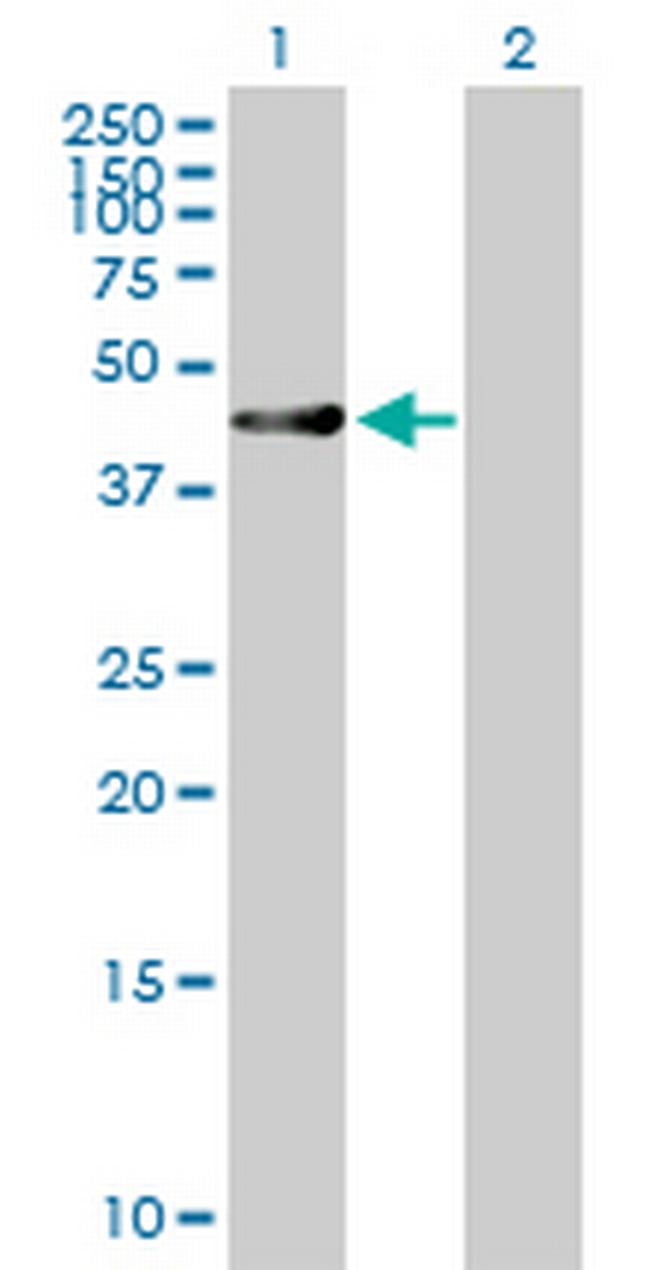
Please note: We are reviewing Western blot images included in the antibody testing data in our catalog, including those provided by third parties. Unless expressly labeled or annotated as “raw-unedited”, Western blot images included in the antibody testing data in our catalog may have been edited, optimized or otherwise adjusted for presentation.

Product Details
H00023623-B01P
Applications
Tested Dilution
Publications
Product Specifications
Species Reactivity
Human
Host/Isotype
Mouse
/ IgG
Class
Polyclonal
Type
Antibody
Immunogen
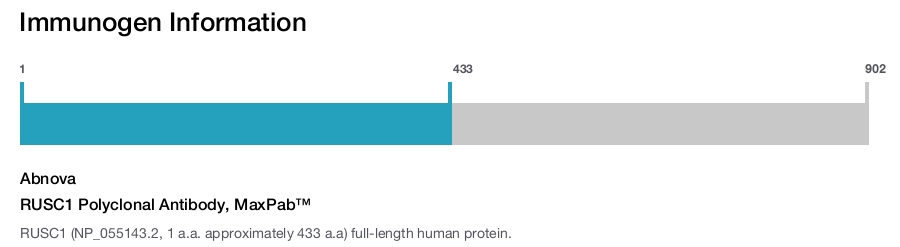
RUSC1 (NP_055143.2, 1 a.a. approximately 433 a.a) full-length human protein.
Conjugate
Unconjugated
Unconjugated
Unconjugated
Form
Liquid
Concentration
0.5 mg/mL
Amount
50 µg
Purification
Protein A
Storage buffer
PBS, pH 7.4
Contains
no preservative
Storage conditions
-20°C, Avoid Freeze/Thaw Cycles
Shipping conditions
Ambient (domestic); Wet ice (international)
Product Specific Information
Product may be used with Western Blot (Transfected lysate).
The Isotype of this product is composed of an IgG Mixture.
Immunogen sequence: MAEAQSGTGQ LQEQKKGLLI AVSVSVDKII SHFGAARNLV QKAQLGDSRL SPDVGHLVLT TLCPALHALV ADGLKPFRKD LITGQRRSSP WSVVEASVKP GSSTRSLGTL YSQVSRLAPL SSSRSRFHAF ILGLLNTKQL ELWFSSLQED AGLLSLLYLP TGFFSLARGG CPSLSTELLL LLQPLSVLTF HLDLLFEHHH HLPLGPPQAP APPGPPPALQ QTMQAMLHFG GRLAQSLRGT SKEAASDPSD SPNLPTPGSW WEQLTQASRV YASGGTEGFP LSRWAPGRHG TAAEEGAQER PLPTDEMAPG RGLWLGRLFG VPGGPAENEN GALKSRRPSS WLPPTVSVLA LVKRGAPPEM PSPQELEASA PRMVQTHRAV RALCDHTAAR PDQLSFRRGE VLRVITTVDE DWLRCGRDGM EGLVPVGYTS LVL
Target Information
RUSC1, also known as NESCA, shares with the related protein RUSC2 a common domain structure of RUN, leucine zipper and SH3 domain in addition to over 30% amino acid identity. RUSC1 is an adapter protein that can bind to the TrkA receptor and is necessary in the NGF-induced neurite growth of PC12 cells. RUSC1 has also been shown to interact with Ikappa-B kinase- (IKK-) -gamma, the regulatory subunit of the IKK complex that is required for NF-kappa-B activation in many signaling pathways such as TNF-R or the TLR pathways. RUSC1 can also bind to the E3 ubiquitin ligase TRAF6, which then catalyzes RUSC1 polyubiquitination. Since overexpression of RUSC1 strongly inhibits TRAF6-mediated polyubiquitination of IKK-gamma, RUSC1 may be a link in the IKK-gamma-mediated NF-kappa-B activation pathway.
For Research Use Only. Not for use in diagnostic procedures. Not for resale without express authorization.
References (0)
Have you cited this product in a publication?
Let us know so we can reference it here.
Bioinformatics
Protein Aliases: new molecule containing SH3 at the carboxy-terminus; RP11-21N7.4; RUN and SH3 domain-containing protein 1; unnamed protein product
Gene Aliases: NESCA
UniProt ID: (Human) Q9BVN2
Entrez Gene ID: (Human) 23623
Disclaimer

Clicking the images or links will redirect you to a website hosted by BenchSci that provides third-party scientific content. Neither the content nor the BenchSci technology and processes for selection have been evaluated by us; we are providing them as-is and without warranty of any kind, including for use or application of the Thermo Fisher Scientific products presented.

Performance Guarantee
If an Invitrogen™ antibody doesn't perform as described on our website or datasheet,we'll replace the product at no cost to you, or provide you with a credit for a future purchase.*
Learn more
We're here to help
Get expert recommendations for common problems or connect directly with an on staff expert for technical assistance related to applications, equipment and general product use.
Contact tech support