Search
Invitrogen
Renilla luciferase Polyclonal Antibody
{{$productOrderCtrl.translations['antibody.pdp.commerceCard.promotion.promotions']}}
{{$productOrderCtrl.translations['antibody.pdp.commerceCard.promotion.promocode']}}: {{promo.promoCode}} {{promo.promoTitle}} {{promo.promoDescription}}. {{$productOrderCtrl.translations['antibody.pdp.commerceCard.promotion.learnmore']}}
{{$ctrl.translations['antibody.pdp.skuNotes.additionalInformation']}}:
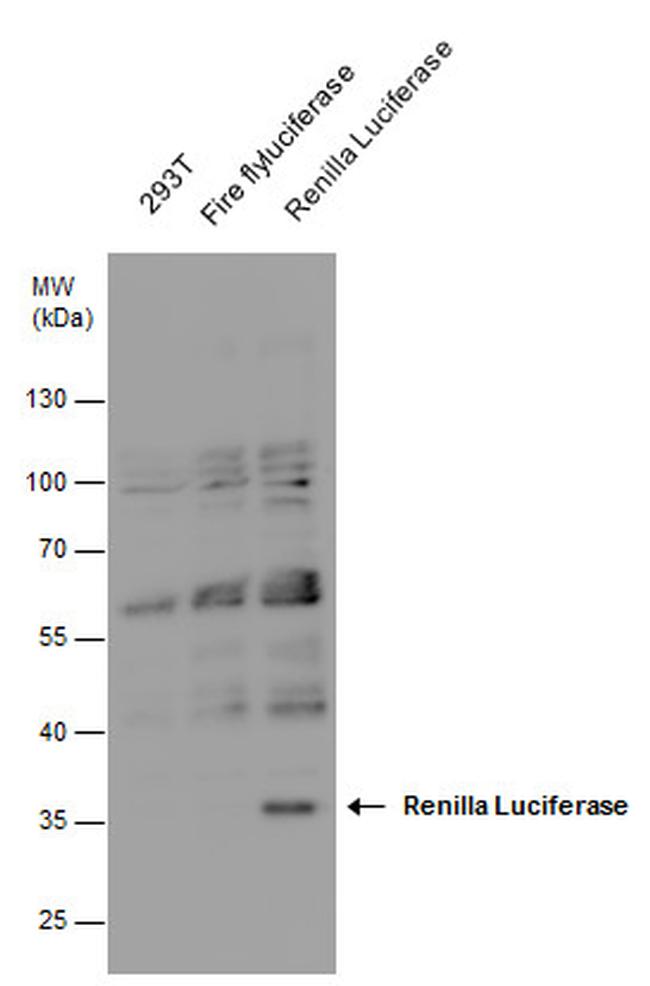
图: 1 / 3
Renilla luciferase Antibody (PA5-32210) in WB
Western Blot analysis of Renilla luciferase was performed by separating 30 µg of non-transfected (-) and Renilla Luciferase -transfected (+) 293T whole cell extracts by 10% SDS-PAGE. Proteins were transferred to a membrane and probed with a Renilla luciferase Polyclonal Antibody (Product # PA5-32210) at a dilution of 1:2000.
Please note: We are reviewing Western blot images included in the antibody testing data in our catalog, including those provided by third parties. Unless expressly labeled or annotated as “raw-unedited”, Western blot images included in the antibody testing data in our catalog may have been edited, optimized or otherwise adjusted for presentation.


产品信息
PA5-32210
产品规格
种属反应
Luciferase
已发表种属
Human,
Luciferase
宿主/亚型
Rabbit
/ IgG
分类
Polyclonal
类型
Antibody
抗原
Full length Renilla Luciferase recombinant protein.
偶联物
Unconjugated
Unconjugated
Unconjugated
形式
Liquid
浓度
1.14 mg/mL
规格
114 µg
纯化类型
Antigen affinity chromatography
保存液
PBS, pH 7, with 20% glycerol
内含物
0.025% ProClin 300
保存条件
Store at 4°C short term. For long term storage, store at -20°C, avoiding freeze/thaw cycles.
运输条件
Ambient (domestic); Wet ice (international)
RRID
产品详细信息
Recommended positive controls: 293T transfected Renilla Luciferase.
Store product as a concentrated solution. Centrifuge briefly prior to opening the vial.
靶标信息
Renilla luciferase (RLuc), derived from the sea pansy Renilla reniformis, is a widely-used reporter gene in molecular biology for in vitro and in vivo assays, including gene expression studies and small animal imaging. The luciferase enzyme, approximately 37 kDa in size, belongs to the alpha/beta hydrolase family and operates via a catalytic mechanism involving the oxidative decarboxylation of its substrate, coelenterazine, in the presence of molecular oxygen, resulting in the emission of blue light. The gene encoding Renilla luciferase has been isolated and characterized, with its cDNA available for various applications. Structurally, RLuc contains a hydrolase fold akin to that of bacterial dehalogenases, suggesting an evolutionary relationship. Despite extensive utilization, the exact details of its active site and catalytic mechanism continue to be explored. The bioluminescent property of RLuc is particularly useful for generating a detectable signal in various biological assays, enhancing its utility as a biosensor.
仅用于科研。不用于诊断过程。未经明确授权不得转售。
生物信息学
蛋白别名: Renilla-luciferin 2-monooxygenase
Disclaimer

Clicking the images or links will redirect you to a website hosted by BenchSci that provides third-party scientific content. Neither the content nor the BenchSci technology and processes for selection have been evaluated by us; we are providing them as-is and without warranty of any kind, including for use or application of the Thermo Fisher Scientific products presented.

