Search
Agrisera
Rubisco/557 kDa hexadecamer Polyclonal Antibody
{{$productOrderCtrl.translations['antibody.pdp.commerceCard.promotion.promotions']}}
{{$productOrderCtrl.translations['antibody.pdp.commerceCard.promotion.viewpromo']}}
{{$productOrderCtrl.translations['antibody.pdp.commerceCard.promotion.promocode']}}: {{promo.promoCode}} {{promo.promoTitle}} {{promo.promoDescription}}. {{$productOrderCtrl.translations['antibody.pdp.commerceCard.promotion.learnmore']}}
Additional Information:
{{banner.description}}
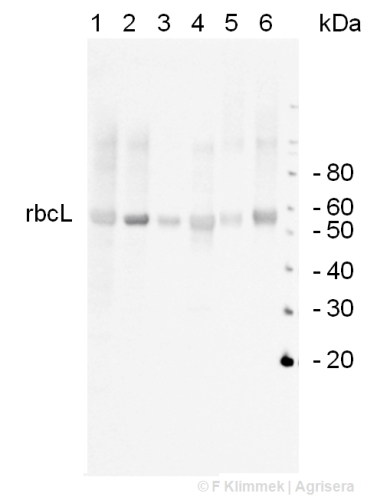
图: 1 / 1
Rubisco/557 kDa hexadecamer Antibody (AS07-218) in WB
0.5 µg of total leaf protein isolated with Agrisera Protein Extraction Buffer AS08 300 from Arabidopsis thaliana (1), Spinacia oleracea (2), Zea mays (3), Hordeum vulgare (4), Solanum tuberosum (5), Pisum sativum (6) were separated on 4-12% Nu PAGE (Invitrogen) LDS-PAGE and blotted 45 min (30 V) to nitrocellulose. Filters where blocked 1 h with 2% low-fat milk powder in TBS-T (0.1% TWEEN 20) and probed with... View More

产品信息
AS07-218
产品规格
种属反应
Bacteria,
Plant
宿主/亚型
Rabbit
分类
Polyclonal
类型
Antibody
抗原
Purified 557 kDa hexadecamer Rubisco protein complex from Spinacia oleracea.
偶联物
形式
Lyophilized
保存液
whole serum
内含物
no preservative
保存条件
-20°C, Avoid Freeze/Thaw Cycles
运输条件
Ambient (domestic); Wet ice (international)
产品详细信息
Store lyophilized/reconstituted at -20°C; once reconstituted make aliquots to avoid repeated freeze-thaw cycles. Please remember to spin the tubes briefly prior to opening them to avoid any losses that might occur from material adhering to the cap or sides of the tube.
For reconstitution add 50 µL of sterile water.
Specific Species Reactivity: Anabaena sp. PCC 7120, Arabidopsis thaliana, Aucuba japonica, Fremyella diplosiphon, Glycine max, Hordeum vulgare, Manihot esculenta Crantz, Oryza sativa, Physcomitrium patens, Pisum sativum, Populus sp., Salsola laricifolia, Solanum tuberosum, Spinacia oleracea, Synechocystis sp. PCC 6803, Synechococcus sp. PCC7942, Zea mays
靶标信息
RuBisCO catalyzes two reactions: the carboxylation of D-ribulose 1,5-bisphosphate, the primary event in carbon dioxide fixation, as well as the oxidative fragmentation of the pentose substrate in the photorespiration process. Both reactions occur simultaneously and in competition at the same active site.Sequence similarities: Belongs to the RuBisCO large chain family. Type I subfamily. Post-translational modifications: The disulfide bond which can form between Cys-247 in the large chain dimeric partners within the hexadecamer appears to be associated with oxidative stress and protein turnover. The disulfide bonds reported in 1RBO may be the result of oxidation during crystallization.
仅用于科研。不用于诊断过程。未经明确授权不得转售。
篇参考文献 (0)
您是否在文献中引用过该产品?请点击下方按钮邮件告知我们。
生物信息学
蛋白别名: rbcA; rbcB; rbcL; rbcS; rubisco
Disclaimer

Clicking the images or links will redirect you to a website hosted by BenchSci that provides third-party scientific content. Neither the content nor the BenchSci technology and processes for selection have been evaluated by us; we are providing them as-is and without warranty of any kind, including for use or application of the Thermo Fisher Scientific products presented.

