Search
Agrisera
SAM1-4/S-adenosylmethionine synthase Polyclonal Antibody
{{$productOrderCtrl.translations['antibody.pdp.commerceCard.promotion.promotions']}}
{{$productOrderCtrl.translations['antibody.pdp.commerceCard.promotion.viewpromo']}}
{{$productOrderCtrl.translations['antibody.pdp.commerceCard.promotion.promocode']}}: {{promo.promoCode}} {{promo.promoTitle}} {{promo.promoDescription}}. {{$productOrderCtrl.translations['antibody.pdp.commerceCard.promotion.learnmore']}}
Additional Information:
{{banner.description}}
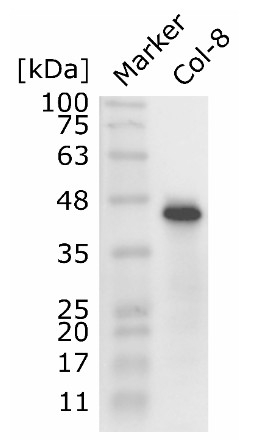
图: 1 / 2
SAM1-4/S-adenosylmethionine synthase Antibody (AS16-3148) in WB
Leaf tissue of Arabidopsis thaliana Col-8 plants was disrupted via mortar and pestle under liquid nitrogen. Leaf protein was extracted by addition of appropriate amounts of extraction buffer (6 M Guanidine-HCl, 100 m M HEPES, 5 m M EDTA and 1 x Halt™ Protease Inhibitor-Cocktail). Extracted protein was chloroform/methanol-precipitated and resolved in 2% SDS, 50 m M Tris (p H 7.4). Protein concentration was d... View More


产品信息
AS16-3148
产品规格
种属反应
Plant
宿主/亚型
Rabbit
分类
Polyclonal
类型
Antibody
抗原
KLH-conjugated peptide derived from protein sequence of Arabidopsis thaliana SAM1-4.
偶联物
形式
Lyophilized
保存液
whole serum
内含物
no preservative
保存条件
-20°C, Avoid Freeze/Thaw Cycles
运输条件
Ambient (domestic); Wet ice (international)
产品详细信息
Store lyophilized/reconstituted at -20°C; once reconstituted make aliquots to avoid repeated freeze-thaw cycles. Please remember to spin the tubes briefly prior to opening them to avoid any losses that might occur from material adhering to the cap or sides of the tube.
For reconstitution add 50 µL of sterile water.
Specific Species Reactivity: Arabidopsis thaliana, Malus domestica
靶标信息
SAM1-4 refers to plant S adenosylmethionine synthetase isoforms that produce S adenosylmethionine from methionine and ATP, supplying the universal methyl donor for DNA, RNA, protein, and metabolite methylation and serving as the propylamine source for polyamine and ethylene biosynthesis. Multiple SAMS genes show tissue and condition specific expression to balance demands for epigenetic regulation, hormone production, and secondary metabolism during development and stress. SAM1 4 maintain cellular methyl cycle flux with folate dependent one carbon metabolism, and their activity influences chromatin state, transcript maturation, membrane lipid composition, and signaling pathways. Perturbation of SAMS levels affects growth, flowering, stress tolerance, and metabolite profiles by altering methylation capacity and ethylene and polyamine outputs.
仅用于科研。不用于诊断过程。未经明确授权不得转售。
篇参考文献 (0)
您是否在文献中引用过该产品?请点击下方按钮邮件告知我们。
生物信息学
蛋白别名: AtSAM1; MAT1; METK1; S-adenosylmethionine synthetase 1; S-ADENOSYLMETHIONINE SYNTHETASE-1; SAM-1
Disclaimer

Clicking the images or links will redirect you to a website hosted by BenchSci that provides third-party scientific content. Neither the content nor the BenchSci technology and processes for selection have been evaluated by us; we are providing them as-is and without warranty of any kind, including for use or application of the Thermo Fisher Scientific products presented.

