Search
Invitrogen
SARM Recombinant Rabbit Monoclonal Antibody (HL1066)
{{$productOrderCtrl.translations['antibody.pdp.commerceCard.promotion.promotions']}}
{{$productOrderCtrl.translations['antibody.pdp.commerceCard.promotion.promocode']}}: {{promo.promoCode}} {{promo.promoTitle}} {{promo.promoDescription}}. {{$productOrderCtrl.translations['antibody.pdp.commerceCard.promotion.learnmore']}}
{{$ctrl.translations['antibody.pdp.skuNotes.additionalInformation']}}:
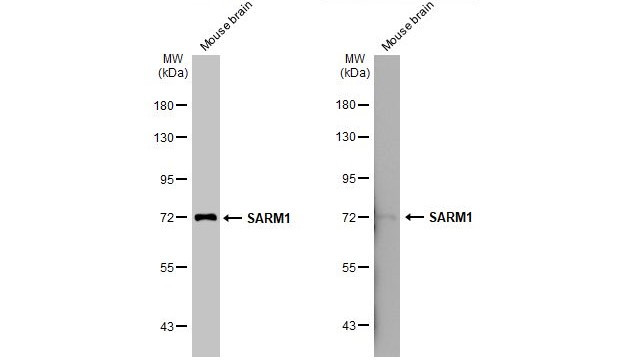
Please note: We are reviewing Western blot images included in the antibody testing data in our catalog, including those provided by third parties. Unless expressly labeled or annotated as “raw-unedited”, Western blot images included in the antibody testing data in our catalog may have been edited, optimized or otherwise adjusted for presentation.


产品信息
MA5-42379
应用
建议稀释比
已发表文章
产品规格
种属反应
Human,
Mouse,
Rat
宿主/亚型
Rabbit
/ IgG
Expression System
HEK293 cells
分类
Recombinant Monoclonal
类型
Antibody
克隆号
HL1066
抗原
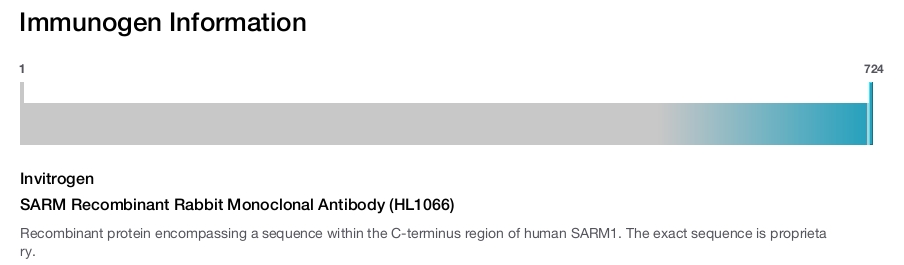
Recombinant protein encompassing a sequence within the C-terminus region of human SARM1. The exact sequence is proprietary.
偶联物
Unconjugated
Unconjugated
Unconjugated
形式
Liquid
浓度
1 mg/mL
规格
100 µg
纯化类型
Protein A
保存液
PBS
内含物
no preservative
保存条件
Store at 4°C short term. For long term storage, store at -20°C, avoiding freeze/thaw cycles.
运输条件
Ambient (domestic); Wet ice (international)
RRID
产品详细信息
Store as concentrated solution. Centrifuge briefly prior to opening vial. For short-term storage (1-2 weeks), store at 4°C. For long-term storage, aliquot and store at -20°C or below. Avoid multiple freeze-thaw cycles.
靶标信息
NAD(+) hydrolase, which plays a key role in axonal degeneration following injury by regulating NAD(+) metabolism (PubMed:25908823, PubMed:27671644, PubMed:28334607). Acts as a negative regulator of MYD88- and TRIF-dependent toll-like receptor signaling pathway by promoting Wallerian degeneration, an injury-induced form of programmed subcellular death which involves degeneration of an axon distal to the injury site (PubMed:15123841, PubMed:16964262, PubMed:20306472, PubMed:25908823). Wallerian degeneration is triggered by NAD(+) depletion: in response to injury, SARM1 is activated and catalyzes cleavage of NAD(+) into ADP-D-ribose (ADPR), cyclic ADPR (cADPR) and nicotinamide; NAD(+) cleavage promoting cytoskeletal degradation and axon destruction (PubMed:25908823, PubMed:28334607, PubMed:30333228, PubMed:31128467, PubMed:31439793, PubMed:31439792). Also able to hydrolyze NADP(+), but not other NAD(+)-related molecules (PubMed:29395922). Can activate neuronal cell death in response to stress (PubMed:20306472). Regulates dendritic arborization through the MAPK4-JNK pathway. Involved in innate immune response: inhibits both TICAM1/TRIF- and MYD88-dependent activation of JUN/AP-1, TRIF-dependent activation of NF-kappa-B and IRF3, and the phosphorylation of MAPK14/p38 (PubMed:16964262). [UniProt]
仅用于科研。不用于诊断过程。未经明确授权不得转售。
篇参考文献 (0)
您是否在文献中引用过该产品?请点击下方按钮邮件告知我们。
生物信息学
蛋白别名: FLJ36296; NADase SARM1; NADP(+) hydrolase SARM1; SAM domain-containing protein 2; SARM1a; SARM1b; sterile alpha and Armadillo repeat protein; sterile alpha and HEAT/Armadillo motif protein, ortholog of Drosophila; sterile alpha and TIR motif containing 1; sterile alpha and TIR motif-containing protein 1; sterile alpha motif domain-containing protein 2; Tir-1 homolog; unnamed protein product
基因别名: A830091I15Rik; hSARM1; HsTIR; MyD88-5; MyD885; SAMD2; SARM
UniProt ID: (Human) Q6SZW1, (Mouse) Q6PDS3, (Rat) D3ZUM2
Entrez Gene ID: (Human) 23098, (Mouse) 237868, (Rat) 287545
signal transduction
response to glucose
NAD catabolic process
negative regulation of MyD88-independent toll-like receptor signaling pathway
regulation of apoptotic process
positive regulation of programmed cell death
response to axon injury
regulation of dendrite morphogenesis
neurological system process
protein localization to mitochondrion
modification of postsynaptic structure
regulation of synapse pruning
Disclaimer

Clicking the images or links will redirect you to a website hosted by BenchSci that provides third-party scientific content. Neither the content nor the BenchSci technology and processes for selection have been evaluated by us; we are providing them as-is and without warranty of any kind, including for use or application of the Thermo Fisher Scientific products presented.

