Search
Abnova
SARS-CoV Nucleoprotein/NP Recombinant Rabbit Monoclonal Antibody
{{$productOrderCtrl.translations['antibody.pdp.commerceCard.promotion.promotions']}}
{{$productOrderCtrl.translations['antibody.pdp.commerceCard.promotion.promocode']}}: {{promo.promoCode}} {{promo.promoTitle}} {{promo.promoDescription}}. {{$productOrderCtrl.translations['antibody.pdp.commerceCard.promotion.learnmore']}}
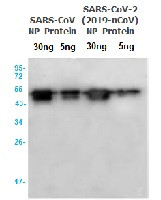
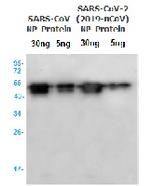
Please note: We are reviewing Western blot images included in the antibody testing data in our catalog, including those provided by third parties. Unless expressly labeled or annotated as “raw-unedited”, Western blot images included in the antibody testing data in our catalog may have been edited, optimized or otherwise adjusted for presentation.

产品信息
RAB01765
应用
建议稀释比
已发表文章
产品规格
种属反应
Virus
宿主/亚型
Rabbit
/ IgG
Expression System
CHO cells
分类
Recombinant Monoclonal
类型
Antibody
抗原
Recombinant protein corresponding to SARS-CoV Nucleoprotein/NP protein.
偶联物
Unconjugated
Unconjugated
Unconjugated
形式
Lyophilized
规格
100 µg
纯化类型
Affinity chromatography
保存液
PBS
内含物
no preservative
保存条件
Maintain refrigerated at 2-8°C for up to 1 month. For long term storage store at -20°C
运输条件
Ambient (domestic); Wet ice (international)
靶标信息
The SARS-CoV Nucleoprotein, or nucleocapsid (N) protein, is a fundamental structural component of the SARS-CoV virus, which belongs to the family of coronaviruses. Like its relative, SARS-CoV-2, the N protein is vital for viral replication and packaging, interacting closely with the viral RNA to form the ribonucleoprotein complex. The N protein is encoded by the positive-sense, single-stranded RNA genome of the virus, which is composed of approximately 30 proteins facilitating various functions such as cell penetration, replication, and transcription. With a molecular weight of approximately 46 kDa, the SARS-CoV N protein shares about 89.1% sequence identity with the nucleocapsid protein of SARS-CoV-2. The protein's structure is characterized by two distinct domains: the N-terminal RNA-binding domain and the C-terminal dimerization domain. These domains work synergistically to provide structural integrity and facilitate critical interactions with other viral and host proteins. Researchers are keen on exploring the N protein as a target for vaccine development, considering its significant role in viral pathogenesis and immune evasion. It plays a crucial role in modulating antiviral responses by interacting with host cell proteins, potentially affecting global gene expression and translation processes in the host.
仅用于科研。不用于诊断过程。未经明确授权不得转售。
篇参考文献 (0)
您是否在文献中引用过该产品?请点击下方按钮邮件告知我们。
Disclaimer

Clicking the images or links will redirect you to a website hosted by BenchSci that provides third-party scientific content. Neither the content nor the BenchSci technology and processes for selection have been evaluated by us; we are providing them as-is and without warranty of any kind, including for use or application of the Thermo Fisher Scientific products presented.

