Search
Disclaimer

Clicking the images or links will redirect you to a website hosted by BenchSci that provides third-party scientific content. Neither the content nor the BenchSci technology and processes for selection have been evaluated by us; we are providing them as-is and without warranty of any kind, including for use or application of the Thermo Fisher Scientific products presented.
NeoBiotechnologies
SATB2 (Colorectal Carcinoma Marker) Recombinant Rabbit Monoclonal Antibody (SATB2/9432R)
{{$productOrderCtrl.translations['antibody.pdp.commerceCard.promotion.promotions']}}
{{$productOrderCtrl.translations['antibody.pdp.commerceCard.promotion.viewpromo']}}
{{$productOrderCtrl.translations['antibody.pdp.commerceCard.promotion.promocode']}}: {{promo.promoCode}} {{promo.promoTitle}} {{promo.promoDescription}}. {{$productOrderCtrl.translations['antibody.pdp.commerceCard.promotion.learnmore']}}


产品信息
23314-RBM27-P1ABX
产品规格
种属反应
Human
宿主/亚型
Rabbit
/ IgG, kappa
Expression System
CHO cells
分类
Recombinant Monoclonal
类型
Antibody
克隆号
SATB2/9432R
抗原
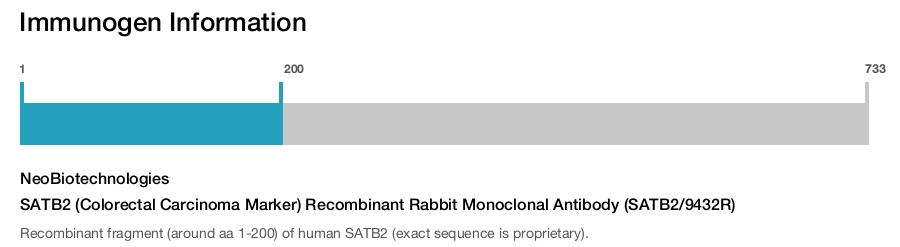
Recombinant fragment (around aa 1-200) of human SATB2 (exact sequence is proprietary).
偶联物
形式
Liquid
浓度
200 µg/mL
纯化类型
Protein A
保存液
PBS
内含物
no preservative
保存条件
-20°C or -80°C if preferred
运输条件
Ambient (domestic); Wet ice (international)
产品详细信息
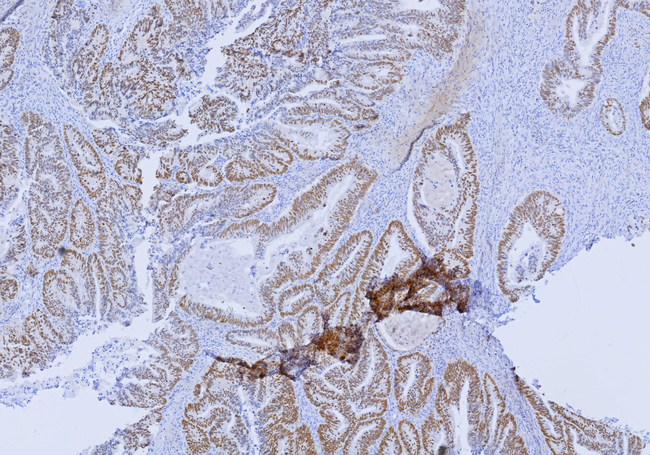
Product cellular localization: Nucleus.
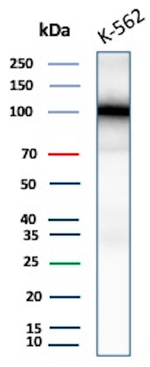
Positive control: Human colon, tonsil or cerebral cortex. K-562 lysate.
Tissue specificity: High expression in adult brain, moderate expression in fetal brain, and weak expression in adult liver, kidney, and spinal cord and in select brain regions, including amygdala, corpus callosum, caudate nucleus, and hippocampus.
靶标信息
DNA-binding protein SATB2 binds to DNA at the nuclear matrix- or scaffold associated regions. It is thought to recognize the sugar-phosphate structure of double-stranded DNA. SATB2 is a transcription factor controlling nuclear gene expression by binding to matrix attachment regions (MARs) of DNA and inducing a local chromatin-loop remodeling. It also acts as a docking site for several chromatin remodeling enzymes by recruiting corepressors (HDACs) or coactivators (HATs) directly to promoters and enhancers. SATB2 is required for the initiation of the upper-layer neurons (UL1) specific genetic program and for the inactivation of deep-layer neurons (DL) and UL2 specific genes - probably by modulating BCL11B expression. It is a repressor of Ctip2 and a regulatory determinant of corticocortical connections in the developing cerebral cortex. Mutations in the gene are associate with cleft palate isolated (CPI).
仅用于科研。不用于诊断过程。未经明确授权不得转售。
篇参考文献 (0)
您是否在文献中引用过该产品?请点击下方按钮邮件告知我们。
生物信息学
蛋白别名: DNA-binding protein SATB2; FLJ21474; FLJ32076; MGC119474; MGC119477; SATB family member 2; Special AT-rich sequence-binding protein 2
基因别名: GLSS; KIAA1034; SATB2
UniProt ID: (Human) Q9UPW6
Entrez Gene ID: (Human) 23314
negative regulation of transcription from RNA polymerase II promoter
neuron migration
osteoblast development
chromatin remodeling
transcription, DNA-templated
regulation of transcription from RNA polymerase II promoter
embryonic pattern specification
covalent chromatin modification
commitment of neuronal cell to specific neuron type in forebrain
positive regulation of transcription from RNA polymerase II promoter
embryonic skeletal system morphogenesis
cartilage development
palate development
cellular response to organic substance

