Search
Osenses
SCAMP5 Polyclonal Antibody
{{$productOrderCtrl.translations['antibody.pdp.commerceCard.promotion.promotions']}}
{{$productOrderCtrl.translations['antibody.pdp.commerceCard.promotion.viewpromo']}}
{{$productOrderCtrl.translations['antibody.pdp.commerceCard.promotion.promocode']}}: {{promo.promoCode}} {{promo.promoTitle}} {{promo.promoDescription}}. {{$productOrderCtrl.translations['antibody.pdp.commerceCard.promotion.learnmore']}}
Additional Information:
{{banner.description}}
产品信息
OSS00095G-500UG
产品规格
种属反应
Human,
Mouse,
Rat
宿主/亚型
Rabbit
/ IgG
分类
Polyclonal
类型
Antibody
抗原
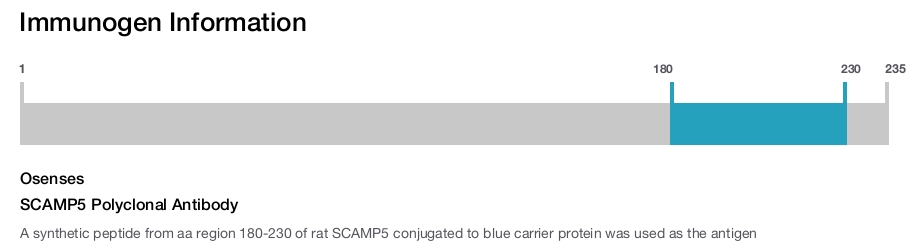
A synthetic peptide from aa region 180-230 of rat SCAMP5 conjugated to blue carrier protein was used as the antigen
偶联物
Unconjugated
Unconjugated
Unconjugated
形式
Lyophilized
浓度
Conc. Not Determined
规格
500 µg
纯化类型
Ammonium sulfate precipitation
保存液
PBS
内含物
no preservative
保存条件
Store at 4°C short term. For long term storage, store at -20°C, avoiding freeze/thaw cycles. Glycerol (1:1) may be added for added stability.
运输条件
Ambient (domestic); Wet ice (international)
产品详细信息
Reconstitute in 500 µL of sterile water. Centrifuge to remove any insoluble material.
The peptide is homologous in mouse and shares 95% identity with human.
Specificity of this antibody: SCAMP5.
靶标信息
Secretory carrier membrane proteins (SCAMPs) are proteins that are components of post-Golgi membranes. These proteins are implicated to function in membrane trafficking. In fibroblasts, SCAMPs are concentrated in compartments that are involved in the recycling of cell surface receptors and endocytosis. In neurons, SCAMPs are associated with synaptic vesicles, secretion granules and transporter vesicles. SCAMPs are composed of four central transmembrane regions and a cytoplasmic tail. Of the five known SCAMPs, SCAMPs 1-3 contain cytoplasmic N-terminal regions with NPF repeats. NPF repeats are found to interact with EH domain proteins that function in budding of transport vesicles from the plasma membrane or the Golgi complex. SCAMPs 4 and 5 lack the N-terminal NPF repeats. SCAMPs 1-4 are all ubiquitously coexpressed while SCAMP 5 is only detectable in the brain. Studies show that SCAMP 5 is expressed late in development which is coincident with expansion of mature synapses.
仅用于科研。不用于诊断过程。未经明确授权不得转售。
生物信息学
蛋白别名: hSCAMP5; SCAMP5; unnamed protein product
基因别名: Sc5
UniProt ID: (Human) Q8TAC9, (Rat) Q9JKE3, (Mouse) Q9JKD3
Entrez Gene ID: (Human) 192683, (Rat) 65171, (Mouse) 56807
Disclaimer

Clicking the images or links will redirect you to a website hosted by BenchSci that provides third-party scientific content. Neither the content nor the BenchSci technology and processes for selection have been evaluated by us; we are providing them as-is and without warranty of any kind, including for use or application of the Thermo Fisher Scientific products presented.

