Search
Invitrogen
SLC7A5 Polyclonal Antibody
{{$productOrderCtrl.translations['antibody.pdp.commerceCard.promotion.promotions']}}
{{$productOrderCtrl.translations['antibody.pdp.commerceCard.promotion.promocode']}}: {{promo.promoCode}} {{promo.promoTitle}} {{promo.promoDescription}}. {{$productOrderCtrl.translations['antibody.pdp.commerceCard.promotion.learnmore']}}
{{$ctrl.translations['antibody.pdp.skuNotes.additionalInformation']}}:
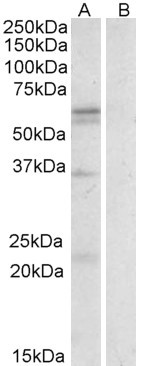
图: 1 / 1
SLC7A5 Antibody (PA5-19101) in WB
Western blot analysis of SLC7A5 using SLC7A5 Polyclonal Antibody (Product # PA5-19101) (0.3 µg/mL) in staining of Human Spleen lysate (35 µg protein in RIPA buffer) with (B) and without (A) blocking with the immunising peptide. Primary incubation was 1 hour. Detected by chemiluminescence.
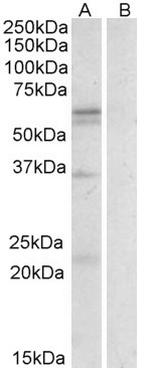
Please note: We are reviewing Western blot images included in the antibody testing data in our catalog, including those provided by third parties. Unless expressly labeled or annotated as “raw-unedited”, Western blot images included in the antibody testing data in our catalog may have been edited, optimized or otherwise adjusted for presentation.

产品信息
PA5-19101
产品规格
种属反应
Human
宿主/亚型
Goat
/ IgG
分类
Polyclonal
类型
Antibody
抗原
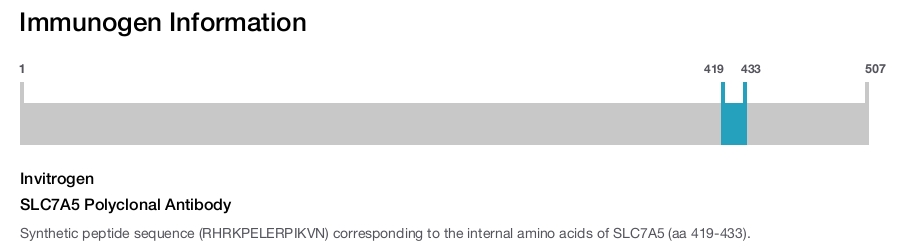
Synthetic peptide sequence (RHRKPELERPIKVN) corresponding to the internal amino acids of SLC7A5 (aa 419-433).
偶联物
Unconjugated
Unconjugated
Unconjugated
形式
Liquid
浓度
0.5 mg/mL
规格
100 µg
纯化类型
Ammonium sulfate precipitation
保存液
TBS, pH 7.3, with 0.5% BSA
内含物
0.02% sodium azide
保存条件
-20°C, Avoid Freeze/Thaw Cycles
运输条件
Ambient (domestic); Wet ice (international)
RRID
产品详细信息
This antibody is predicted to react with canine based on sequence homology.
This antibody is tested in Peptide ELISA: antibody detection limit dilution 64,000.
靶标信息
Solute carrier family 7 member 5 also known as large neutral amino acids transporter small subunit 1 is a protein that in humans is encoded by the SLC7A5 gene.It is sodium-independent, high-affinity transport of large neutral amino acids such as phenylalanine, tyrosine, leucine, arginine and tryptophan, when associated with SLC3A2/4F2hc.It involved in cellular amino acid uptake and the transport of L-DOPA across the blood-brain barrier, and that of thyroid hormones triiodothyronine (T3) and thyroxine (T4) across the cell membrane in tissues such as placenta.Acts as an amino acid exchanger and plays a role in neuronal cell proliferation (neurogenesis) in brain.
仅用于科研。不用于诊断过程。未经明确授权不得转售。
篇参考文献 (0)
您是否在文献中引用过该产品?请点击下方按钮邮件告知我们。
生物信息学
蛋白别名: 4F2; 4F2 light chain; 4F2HC; 4T2HC; CD98 light chain; CD98HC; E16; integral membrane protein E16; L-type amino acid transporter 1; LAT1; MDU1; MP hLAT1; NACAE; sodium-independent neutral amino acid transporter LAT1; solute carrier family 7 (amino acid transporter light chain, L system), member 5; solute carrier family 7 (cationic amino acid transporter, y+ system), member 5
基因别名: 4F2LC; CD98; D16S469E; E16; LAT1; MPE16
UniProt ID: (Human) Q01650
Entrez Gene ID: (Human) 8140
protein binding
amino acid transmembrane transporter activity
aromatic amino acid transmembrane transporter activity
neutral amino acid transmembrane transporter activity
L-amino acid transmembrane transporter activity
L-leucine transmembrane transporter activity
L-tryptophan transmembrane transporter activity
antiporter activity
thyroid hormone transmembrane transporter activity
transmembrane transporter activity
peptide antigen binding
positive regulation of cytokine production involved in immune response
amino acid transmembrane transport
amino acid transport
negative regulation of autophagy
negative regulation of gene expression
response to muscle activity
neutral amino acid transport
L-amino acid transport
isoleucine transport
leucine transport
methionine transport
phenylalanine transport
proline transport
tryptophan transport
tyrosine transport
valine transport
alanine transport
positive regulation of interferon-gamma production
positive regulation of interleukin-17 production
positive regulation of interleukin-4 production
cellular response to glucose starvation
xenobiotic transport
transmembrane transport
response to hyperoxia
positive regulation of glial cell proliferation
thyroid hormone transport
cellular response to lipopolysaccharide
cellular response to amino acid stimulus
amino acid import across plasma membrane
liver regeneration
transport across blood-brain barrier
L-histidine transport
L-alpha-amino acid transmembrane transport
cellular response to L-arginine
L-leucine import across plasma membrane
L-tryptophan transmembrane transport
negative regulation of vascular associated smooth muscle cell apoptotic process
positive regulation of leucine import across plasma membrane
Disclaimer

Clicking the images or links will redirect you to a website hosted by BenchSci that provides third-party scientific content. Neither the content nor the BenchSci technology and processes for selection have been evaluated by us; we are providing them as-is and without warranty of any kind, including for use or application of the Thermo Fisher Scientific products presented.

