Search
Invitrogen
SMAD3 Polyclonal Antibody
{{$productOrderCtrl.translations['antibody.pdp.commerceCard.promotion.promotions']}}
{{$productOrderCtrl.translations['antibody.pdp.commerceCard.promotion.promocode']}}: {{promo.promoCode}} {{promo.promoTitle}} {{promo.promoDescription}}. {{$productOrderCtrl.translations['antibody.pdp.commerceCard.promotion.learnmore']}}
{{$ctrl.translations['antibody.pdp.skuNotes.additionalInformation']}}:
Please note: We are reviewing Western blot images included in the antibody testing data in our catalog, including those provided by third parties. Unless expressly labeled or annotated as “raw-unedited”, Western blot images included in the antibody testing data in our catalog may have been edited, optimized or otherwise adjusted for presentation.


产品信息
PA5-17378
产品规格
种属反应
Human,
Mouse,
Rat
已发表种属
Mouse
宿主/亚型
Rabbit
/ IgG
分类
Polyclonal
类型
Antibody
抗原
Synthetic peptide corresponding to a central region unique to Smad3
偶联物
Unconjugated
Unconjugated
Unconjugated
形式
Liquid
浓度
1.2 µg/mL
规格
0.12 µg
纯化类型
Antigen affinity chromatography
保存液
0.01M HEPES, pH 7.5, with 0.15M NaCl, 100µg/mL BSA, 50% glycerol
内含物
no preservative
保存条件
-20°C
运输条件
Ambient (domestic); Wet ice (international)
RRID
产品详细信息
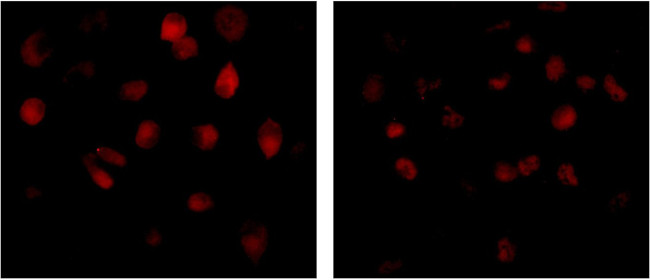
Antibodies to this protein (and modification) were previously sold as part of a Thermo Scientific Cellomics High Content Screening Kit. This replacement antibody is now recommended for researchers who need an antibody for high content cell based assays. It has been thoroughly tested and validated for cellular immunofluorescence (IF) applications. Further optimization including the selection of the most appropriate fluorescent Dylight conjugated secondary antibody may have to be performed for your high content assay.
It is not recommended to aliquot this antibody.
靶标信息
SMAD3 belongs to the SMAD family of proteins. They are similar to the gene products of the Drosophila gene 'mothers against decapentaplegic' (Mad) and the C. elegans gene Sma. SMAD proteins are signal transducers and transcriptional modulators that mediate multiple signaling pathways. This protein functions as a transcriptional modulator activated by transforming growth factor-beta and is thought to play a role in the regulation of carcinogenesis.
仅用于科研。不用于诊断过程。未经明确授权不得转售。
生物信息学
蛋白别名: DKFZP586N0721; DKFZp686J10186; MAD (mothers against decapentaplegic, Drosophila) homolog 3; MAD homolog 3; mad homolog JV15-2; mad protein homolog; MAD, mothers against decapentaplegic homolog 3; MAD-3; mad3; MGC60396; mMad3; mothers against decapentaplegic homolog 3; mothers against DPP homolog 3; SMA- and MAD-related protein 3; SMAD; Smad 3; SMAD, mothers against DPP homolog 3; unnamed protein product
基因别名: hMAD-3; hSMAD3; HSPC193; HsT17436; JV15-2; LDS1C; LDS3; mad3; MADH3; Smad 3
UniProt ID: (Human) P84022, (Mouse) Q8BUN5, (Rat) P84025
Entrez Gene ID: (Human) 4088, (Mouse) 17127, (Rat) 25631
transcription regulatory region sequence-specific DNA binding
RNA polymerase II regulatory region sequence-specific DNA binding
RNA polymerase II core promoter proximal region sequence-specific DNA binding
RNA polymerase II transcription factor activity, sequence-specific DNA binding
core promoter proximal region sequence-specific DNA binding
bacterial-type RNA polymerase transcriptional repressor activity, sequence-specific DNA binding
transcription corepressor binding
transcription coactivator binding
transcriptional activator activity, RNA polymerase II transcription regulatory region sequence-specific binding
DNA binding
chromatin binding
double-stranded DNA binding
transcription factor activity, sequence-specific DNA binding
transforming growth factor beta receptor binding
protein binding
collagen binding
beta-catenin binding
zinc ion binding
ligand-dependent nuclear receptor binding
DEAD/H-box RNA helicase binding
enzyme binding
protein kinase binding
phosphatase binding
chromatin DNA binding
ubiquitin protein ligase binding
mineralocorticoid receptor binding
sterol response element binding
glucocorticoid receptor binding
identical protein binding
protein homodimerization activity
ubiquitin binding
bHLH transcription factor binding
sequence-specific DNA binding
RNA polymerase II sequence-specific DNA binding transcription factor binding
co-SMAD binding
I-SMAD binding
R-SMAD binding
DNA-binding transcription factor binding
promoter-specific chromatin binding
negative regulation of transcription from RNA polymerase II promoter
MAPK cascade
skeletal system development
osteoblast differentiation
ureteric bud development
response to hypoxia
in utero embryonic development
mesoderm formation
somitogenesis
release of cytochrome c from mitochondria
liver development
heart looping
osteoblast development
immune system development
regulation of transcription, DNA-templated
regulation of transcription from RNA polymerase II promoter
apoptotic process
immune response
transforming growth factor beta receptor signaling pathway
JNK cascade
gastrulation
endoderm development
cell proliferation
negative regulation of cell proliferation
anatomical structure morphogenesis
embryonic pattern specification
response to gamma radiation
gene expression
positive regulation of gene expression
negative regulation of gene expression
positive regulation of alkaline phosphatase activity
positive regulation of epithelial to mesenchymal transition
regulation of striated muscle tissue development
regulation of transforming growth factor beta receptor signaling pathway
signal transduction involved in regulation of gene expression
cell differentiation
negative regulation of ossification
negative regulation of cell growth
adrenal gland development
positive regulation of cell migration
positive regulation of bone mineralization
thyroid gland development
positive regulation of chondrocyte differentiation
positive regulation of interleukin-1 beta production
regulation of transforming growth factor beta2 production
positive regulation of transforming growth factor beta3 production
activin receptor signaling pathway
negative regulation of osteoblast proliferation
cellular response to platelet-derived growth factor stimulus
nodal signaling pathway
T cell activation
negative regulation of protein catabolic process
response to cocaine
negative regulation of apoptotic process
proteasome-mediated ubiquitin-dependent protein catabolic process
cell-cell junction organization
positive regulation of nitric oxide biosynthetic process
negative regulation of fat cell differentiation
negative regulation of osteoblast differentiation
positive regulation of transcription, DNA-templated
positive regulation of transcription from RNA polymerase II promoter
paraxial mesoderm morphogenesis
developmental growth
embryonic foregut morphogenesis
embryonic cranial skeleton morphogenesis
regulation of epithelial cell proliferation
negative regulation of inflammatory response
regulation of immune response
protein stabilization
positive regulation of positive chemotaxis
negative regulation of cytosolic calcium ion concentration
positive regulation of stress fiber assembly
regulation of mitochondrial membrane potential
positive regulation of focal adhesion assembly
pericardium development
transdifferentiation
positive regulation of SMAD protein import into nucleus
SMAD protein signal transduction
regulation of dendritic spine morphogenesis
negative regulation of wound healing
trophoblast cell migration
negative regulation of lung blood pressure
lens fiber cell differentiation
cellular response to glucose stimulus
cellular response to growth factor stimulus
response to transforming growth factor beta
cellular response to transforming growth factor beta stimulus
positive regulation of canonical Wnt signaling pathway
apoptotic signaling pathway
extrinsic apoptotic signaling pathway
response to alcohol
cellular response to virus
transforming growth factor beta receptor superfamily signaling pathway
positive regulation of extracellular matrix assembly
negative regulation of pri-miRNA transcription from RNA polymerase II promoter
positive regulation of pri-miRNA transcription from RNA polymerase II promoter
negative regulation of cardiac muscle hypertrophy in response to stress
response to angiotensin
primary miRNA processing
negative regulation of lipopolysaccharide-mediated signaling pathway
developmental process
wound healing
positive regulation of protein import into nucleus
negative regulation of cell differentiation
negative regulation of transforming growth factor beta production
regulation of miRNA transcription
Disclaimer

Clicking the images or links will redirect you to a website hosted by BenchSci that provides third-party scientific content. Neither the content nor the BenchSci technology and processes for selection have been evaluated by us; we are providing them as-is and without warranty of any kind, including for use or application of the Thermo Fisher Scientific products presented.

