Search
Invitrogen
SPINK1 Polyclonal Antibody
{{$productOrderCtrl.translations['antibody.pdp.commerceCard.promotion.promotions']}}
{{$productOrderCtrl.translations['antibody.pdp.commerceCard.promotion.promocode']}}: {{promo.promoCode}} {{promo.promoTitle}} {{promo.promoDescription}}. {{$productOrderCtrl.translations['antibody.pdp.commerceCard.promotion.learnmore']}}
{{$ctrl.translations['antibody.pdp.skuNotes.additionalInformation']}}:
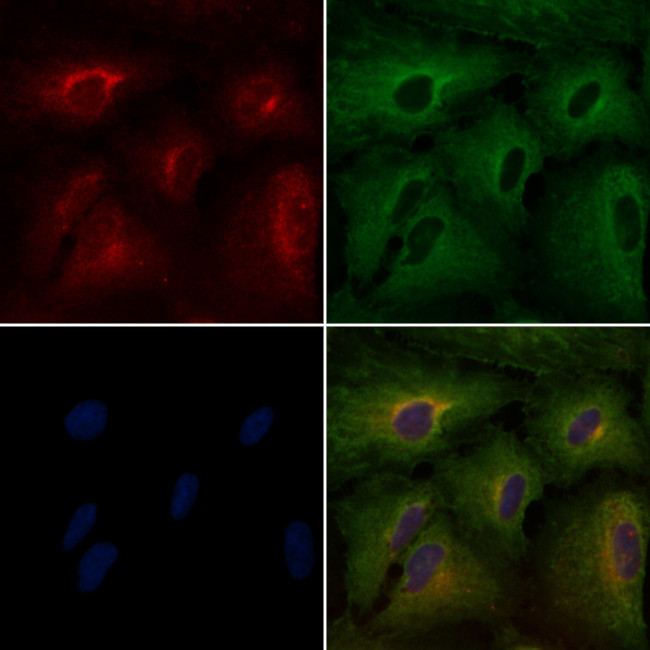
图: 1 / 2
SPINK1 Antibody (PA5-102353) in ICC/IF
Immunocytochemistry analysis of SPINK1 in A549 cells. The samples were fixed with PFA and permeabilized in 0.1% Triton X-100, then blocked in 10% serum for 45 minutes at 25°C. Samples were incubated with SPINK1 polyclonal antibody (Product # PA5-102353) and mouse anti-beta tubulin antibody for 1 hour at 37°C. An AlexaFluor594 conjugated goat anti-rabbit IgG(H+L) (Red) and an AlexaFluor488 conjugated goat anti-mouse IgG(H+L) (Green) were used as the secondary antibodies. The nuclear counter stain is DAPI (blue).
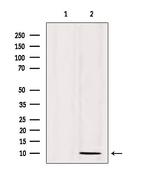
Please note: We are reviewing Western blot images included in the antibody testing data in our catalog, including those provided by third parties. Unless expressly labeled or annotated as “raw-unedited”, Western blot images included in the antibody testing data in our catalog may have been edited, optimized or otherwise adjusted for presentation.


产品信息
PA5-102353
应用
建议稀释比
已发表文章
产品规格
种属反应
Human,
Mouse,
Rat
宿主/亚型
Rabbit
/ IgG
分类
Polyclonal
类型
Antibody
抗原
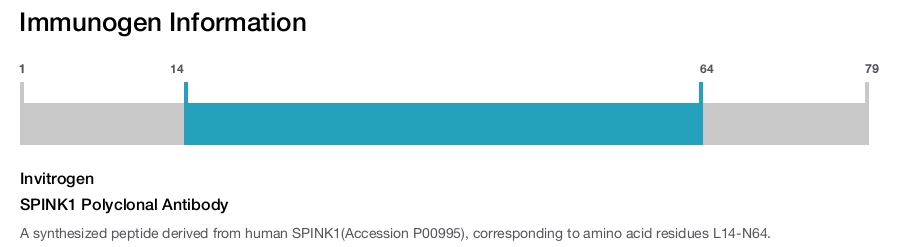
A synthesized peptide derived from human SPINK1(Accession P00995), corresponding to amino acid residues L14-N64.
偶联物
Unconjugated
Unconjugated
Unconjugated
形式
Liquid
浓度
1 mg/mL
规格
100 µg
纯化类型
Affinity chromatography
保存液
PBS, pH 7.4, with 50% glycerol
内含物
0.02% sodium azide
保存条件
-20°C
运输条件
Ambient (domestic); Wet ice (international)
RRID
产品详细信息
Antibody detects endogenous levels of total SPINK1.
靶标信息
This is a trypsin inhibitor, its physiological function is to prevent the trypsin-catalyzed premature activation of zymogens within the pancreas. Defects in SPINK1 are a cause of pancreatitis (PCTT) [MIM:167800]. A disease characterized by the presence of calculi in pancreatic ducts. It causes severe abdominal pain attacks. Defects in SPINK1 are the cause of susceptibility to tropical calcific pancreatitis (TCP) [MIM:608189]. TCP is an idiopathic, juvenile, nonalcoholic form of chronic pancreatitis widely prevalent in several tropical countries. It can be associated with fibrocalculous pancreatic diabetes (FCPD) depending on both environmental and genetic factors. TCP differs from alcoholic pancreatitis by a much younger age of onset, pancreatic calcification, a high incidence of insulin dependent but ketosis resistant diabetes mellitus, and an exceptionally high incidence of pancreatic cancer.
仅用于科研。不用于诊断过程。未经明确授权不得转售。
篇参考文献 (0)
您是否在文献中引用过该产品?请点击下方按钮邮件告知我们。
生物信息学
蛋白别名: calcium transport inhibitor; caltrin; cholecystokinin-releasing peptide; ISK1; monitor peptide; monitor peptide precursor; pancreatic cholecystokinin(CCK) releasing peptide; pancreatic secretory trypsin inhibitor; pancreatic secretory trypsin inhibitor I; pancreatic secretory trypsin inhibitor II; pancreatic secretory trypsin inhibitor type I precursor; pancreatic secretory trypsin inhibitor type II (PSTI-II); pancreatic secretory trypsin inhibitor type II precursor; pancreatic secretory trypsin inhibitor-56; pancreatic secretory trypsin inhibitor-61; pancreatic secretory trypsin inhibitor-like protein precursor; prostatic secretory glycoprotein; PSTI-I; PSTI-II; serine peptidase inhibitor, Kazal type 1; serine peptidase inhibitor, Kazal type 3; serine protease inhibitor Kazal-type 3; serine protease inhibitor Kazal-type 3-like; Serine protease inhibitor, kanzal type 1/ Trypsin inhibitor-like protein, pancreatic; serine protease inhibitor, Kazal type 1; trypsin inhibitor-like protein, pancreatic; tumor-associated trypsin inhibitor; unnamed protein product
基因别名: p12; PCTT; PSTI; Psti-1; PSTI-56; PSTI-61; Spink1; Spink3; TATI; TCP; Tilp
UniProt ID: (Human) P00995, (Rat) P09655, (Mouse) P09036, (Rat) P09656
Entrez Gene ID: (Human) 6690, (Rat) 24833, (Mouse) 20730, (Rat) 266602
positive regulation of cytosolic calcium ion concentration
negative regulation of peptidase activity
response to nutrient levels
response to ethanol
sperm capacitation
positive regulation of epithelial cell proliferation
negative regulation of peptidyl-tyrosine phosphorylation
regulation of acrosome reaction
cellular response to peptide hormone stimulus
positive regulation of pancreatic juice secretion
positive regulation of peptide hormone secretion
negative regulation of calcium ion import
negative regulation of serine-type endopeptidase activity
regulation of store-operated calcium entry
spermatid development
negative regulation of nitric oxide-cGMP mediated signal transduction
Disclaimer

Clicking the images or links will redirect you to a website hosted by BenchSci that provides third-party scientific content. Neither the content nor the BenchSci technology and processes for selection have been evaluated by us; we are providing them as-is and without warranty of any kind, including for use or application of the Thermo Fisher Scientific products presented.

