Search
Abnova
SS18 Polyclonal Antibody, MaxPab™
{{$productOrderCtrl.translations['antibody.pdp.commerceCard.promotion.promotions']}}
{{$productOrderCtrl.translations['antibody.pdp.commerceCard.promotion.promocode']}}: {{promo.promoCode}} {{promo.promoTitle}} {{promo.promoDescription}}. {{$productOrderCtrl.translations['antibody.pdp.commerceCard.promotion.learnmore']}}
{{$ctrl.translations['antibody.pdp.skuNotes.additionalInformation']}}:
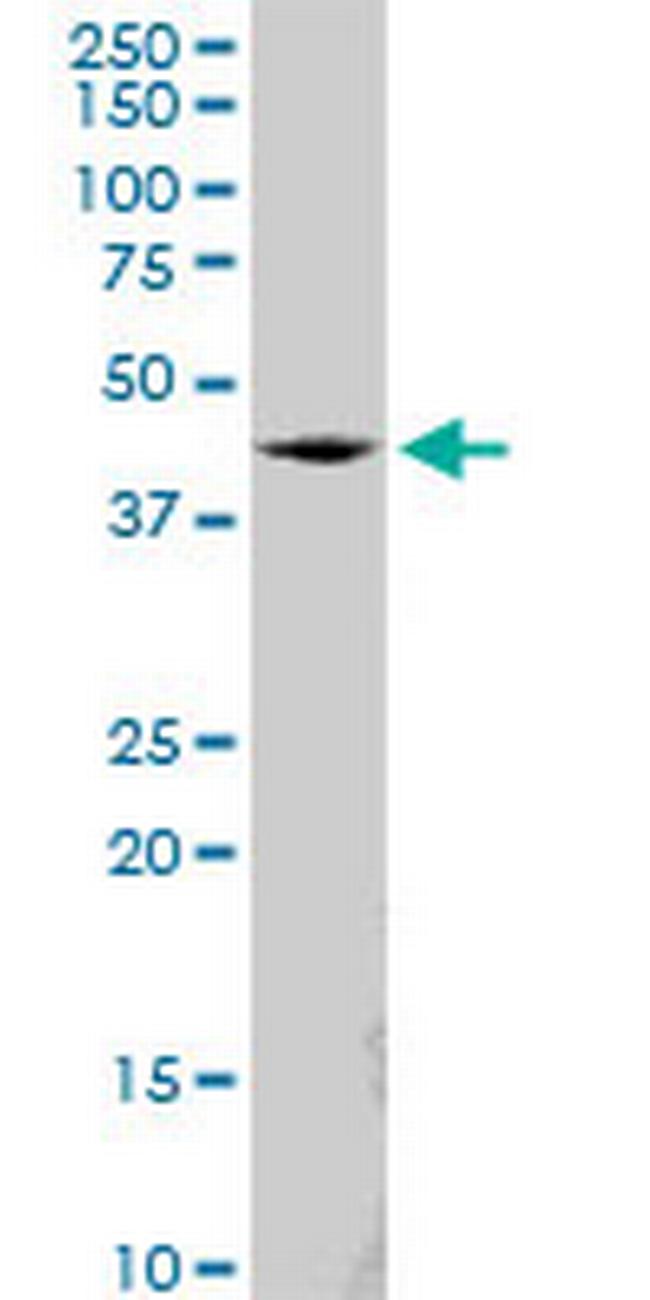
Please note: We are reviewing Western blot images included in the antibody testing data in our catalog, including those provided by third parties. Unless expressly labeled or annotated as “raw-unedited”, Western blot images included in the antibody testing data in our catalog may have been edited, optimized or otherwise adjusted for presentation.

产品信息
H00006760-B01P
产品规格
种属反应
Human
宿主/亚型
Mouse
/ IgG
分类
Polyclonal
类型
Antibody
抗原
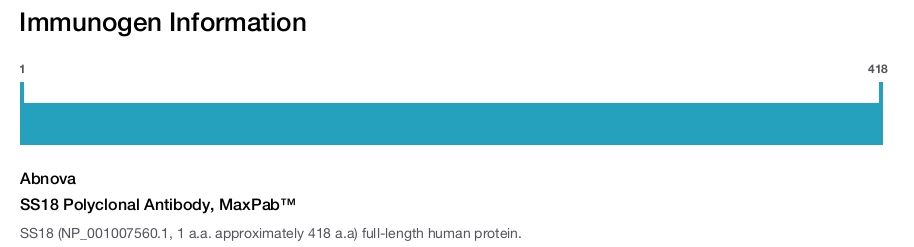
SS18 (NP_001007560.1, 1 a.a. approximately 418 a.a) full-length human protein.
偶联物
Unconjugated
Unconjugated
Unconjugated
形式
Liquid
浓度
1 mg/mL
规格
50 µg
纯化类型
Protein A
保存液
PBS, pH 7.4
内含物
no preservative
保存条件
-20°C, Avoid Freeze/Thaw Cycles
运输条件
Ambient (domestic); Wet ice (international)
产品详细信息
Product may be used with Western Blot (Cell lysate).
The Isotype of this product is composed of an IgG Mixture.
Immunogen sequence: MSVAFAAPRQ RGKGEITPAA IQKMLDDNNH LIQCIMDSQN KGKTSECSQY QQMLHTNLVY LATIADSNQN MQSLLPAPPT QNMPMGPGGM NQSGPPPPPR SHNMPSDGMV GGGPPAPHMQ NQMNGQMPGP NHMPMQGPGP NQLNMTNSSM NMPSSSHGSM GGYNHSVPSS QSMPVQNQMT MSQGQPMGNY GPRPNMSMQP NQGPMMHQQP PSQQYNMPQG GGQHYQGQQP PMGMMGQVNQ GNHMMGQRQI PPYRPPQQGP PQQYSGQEDY YGDQYSHGGQ GPPEGMNQQY YPDGHNDYGY QQPSYPEQGY DRPYEDSSQH YYEGGNSQYG QQQDAYQGPP PQQGYPPQQQ QYPGQQGYPG QQQGYGPSQG GPGPQYPNYP QGQGQQYGGY RPTQPGPPQP PQQRPYGYDQ GQYGNYQQ
靶标信息
The transcriptional coactivator SYT (synovial translocation protein) contains a conserved amino terminal SNH domain and a carboxy terminal QPGY domain, which is a functioning transcriptional activating sequence. Synovial sarcoma translocation (SSX) proteins, including SSX1-5, are transcriptional repressors that contain a repressor domain in their carboxy termini. SSX proteins are localized to the nucleus and expressed in testis and several types of cancers and, therefore, they are classified as C/T (cancer/testis) antigens. The t(x;18) translocation results in the fusion of the amino terminus of SYT to the carboxy terminus of either SSX1 or SSX2; both fusions result in the production of transcriptional activators.
仅用于科研。不用于诊断过程。未经明确授权不得转售。
篇参考文献 (0)
您是否在文献中引用过该产品?请点击下方按钮邮件告知我们。
生物信息学
蛋白别名: MGC116875; SS18; SS18, nBAF chromatin remodeling complex subunit; synovial sarcoma translocated to X chromosome protein; synovial sarcoma translocation; synovial sarcoma translocation, chromosome 18; synovial sarcoma, translocated to X chromosome; SYT; SYTins; unnamed protein product
基因别名: SMARCL1; SSXT; SYT
UniProt ID: (Human) Q15532
Entrez Gene ID: (Human) 6760
Disclaimer

Clicking the images or links will redirect you to a website hosted by BenchSci that provides third-party scientific content. Neither the content nor the BenchSci technology and processes for selection have been evaluated by us; we are providing them as-is and without warranty of any kind, including for use or application of the Thermo Fisher Scientific products presented.

