Search
Rockland
STIM2 Polyclonal Antibody
{{$productOrderCtrl.translations['antibody.pdp.commerceCard.promotion.promotions']}}
{{$productOrderCtrl.translations['antibody.pdp.commerceCard.promotion.promocode']}}: {{promo.promoCode}} {{promo.promoTitle}} {{promo.promoDescription}}. {{$productOrderCtrl.translations['antibody.pdp.commerceCard.promotion.learnmore']}}
{{$ctrl.translations['antibody.pdp.skuNotes.additionalInformation']}}:
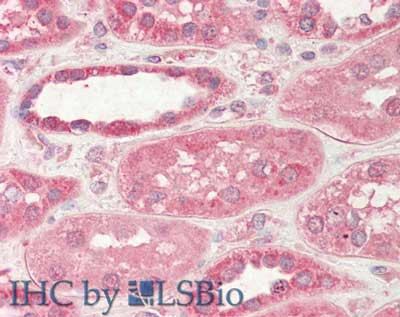
图: 1 / 1
STIM2 Antibody (600-601-J51) in IHC (P)
Immunohistochemistry of Sheep anti-STIM2 antibody. Tissue: Kidney. Fixation: formalin fixed paraffin embedded. Antigen retrieval: not required. Primary antibody: STIM2 antibody at 5 µg/mL for 1 h at RT. Secondary antibody: Peroxidase sheep secondary antibody at 1:10,000 for 45 min at RT. Staining: STIM2 as precipitated red signal with hematoxylin purple nuclear counterstain.
Please note: We are reviewing Western blot images included in the antibody testing data in our catalog, including those provided by third parties. Unless expressly labeled or annotated as “raw-unedited”, Western blot images included in the antibody testing data in our catalog may have been edited, optimized or otherwise adjusted for presentation.

产品信息
600-601-J51
应用
建议稀释比
已发表文章
产品规格
种属反应
Human
宿主/亚型
Sheep
/ IgG
分类
Polyclonal
类型
Antibody
抗原
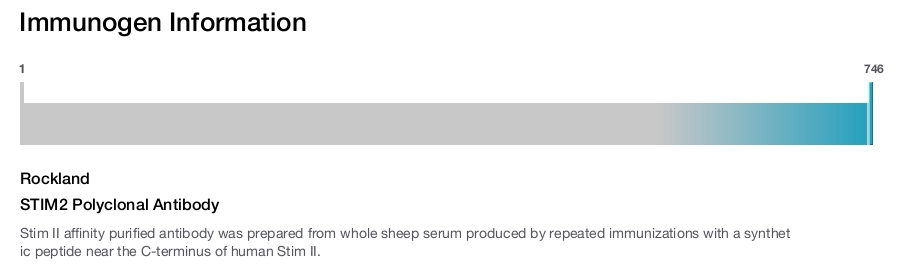
Stim II affinity purified antibody was prepared from whole sheep serum produced by repeated immunizations with a synthetic peptide near the C-terminus of human Stim II.
偶联物
Unconjugated
Unconjugated
Unconjugated
形式
Liquid
浓度
1.1 mg/mL
规格
100 µg
纯化类型
Affinity chromatography
保存液
0.02M potassium phosphate, pH 7.2, with 30% glycerol, 0.15M NaCl
内含物
no preservative
保存条件
-20°C, Avoid Freeze/Thaw Cycles
运输条件
Ambient (domestic); Wet ice (international)
产品详细信息
Store vial at -20° C prior to opening. Aliquot contents and freeze at -20° C or below for extended storage. Avoid cycles of freezing and thawing. Centrifuge product if not completely clear after standing at room temperature. This product is stable for several weeks at 4° C as an undiluted liquid. Dilute only prior to immediate use.
A BLAST analysis was used to suggest cross-reactivity with mouse and human based on 100% sequence homology. Cross-reactivity with Stim II from other sources has not been determined.
靶标信息
In T lymphocytes, the sole pathway for Ca++ entry following antigen-receptor binding is through store-operated Ca++-release-activated Ca++ (CRAC) channels. These channels are made up of the pore-forming subunit ORAI1 and the stromal interaction molecule 1 (STIM1), a protein that functions as a Ca++ sensor and activates the CRAC channels, migrating to the plasma membrane from endoplasmic reticulum (ER)-like sites which act as the Ca++ store. A related molecule, STIM2, acts to inhibit the STIM1-mediated store-operated Ca++ entry, and can form complexes with STIM1, suggesting they may play a coordinated role in controlling Ca++ entry. At least three isoforms of STIM2 are known to exist.
仅用于科研。不用于诊断过程。未经明确授权不得转售。
篇参考文献 (0)
您是否在文献中引用过该产品?请点击下方按钮邮件告知我们。
生物信息学
蛋白别名: OTTHUMP00000123457; OTTHUMP00000123458; OTTHUMP00000216198; transmembrane protein; unnamed protein product
UniProt ID: (Human) Q9P246
Entrez Gene ID: (Human) 57620
Disclaimer

Clicking the images or links will redirect you to a website hosted by BenchSci that provides third-party scientific content. Neither the content nor the BenchSci technology and processes for selection have been evaluated by us; we are providing them as-is and without warranty of any kind, including for use or application of the Thermo Fisher Scientific products presented.

