Search
Invitrogen
TADA3L Polyclonal Antibody
{{$productOrderCtrl.translations['antibody.pdp.commerceCard.promotion.promotions']}}
{{$productOrderCtrl.translations['antibody.pdp.commerceCard.promotion.promocode']}}: {{promo.promoCode}} {{promo.promoTitle}} {{promo.promoDescription}}. {{$productOrderCtrl.translations['antibody.pdp.commerceCard.promotion.learnmore']}}
{{$ctrl.translations['antibody.pdp.skuNotes.additionalInformation']}}:
Please note: We are reviewing Western blot images included in the antibody testing data in our catalog, including those provided by third parties. Unless expressly labeled or annotated as “raw-unedited”, Western blot images included in the antibody testing data in our catalog may have been edited, optimized or otherwise adjusted for presentation.


产品信息
PA5-96535
产品规格
种属反应
Human,
Mouse,
Rat
宿主/亚型
Rabbit
/ IgG
分类
Polyclonal
类型
Antibody
抗原
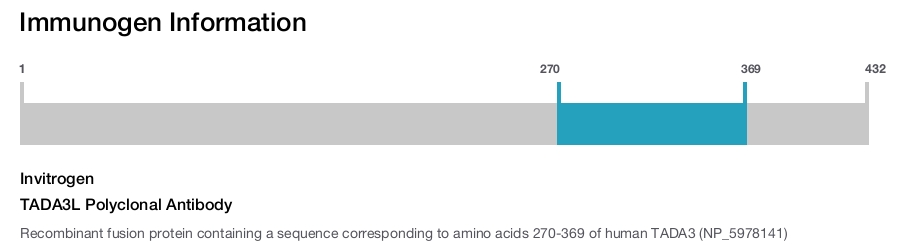
Recombinant fusion protein containing a sequence corresponding to amino acids 270-369 of human TADA3 (NP_5978141)
偶联物
Unconjugated
Unconjugated
Unconjugated
形式
Liquid
浓度
1.09 mg/mL
规格
109 µg
纯化类型
Affinity Chromatography
保存液
PBS, pH 7.3, with 50% glycerol
内含物
0.09% sodium azide
保存条件
-20°C, Avoid Freeze/Thaw Cycles
运输条件
Ambient (domestic); Wet ice (international)
RRID
产品详细信息
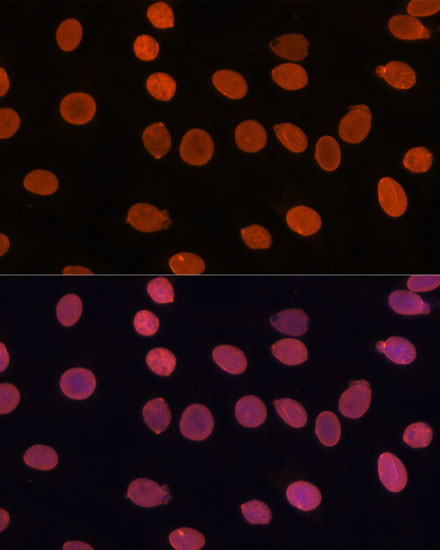
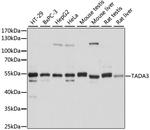
Immunogen sequence: EENIISPMED SPIPDMSGKE SGADGASTSP RNQNKPFSVP HTKSLESRIK EELIAQGLLE SEDRPAEDSE DEVLAELRKR QAELKALSAH NRTKKHDLLR; Positive Samples: HT-29, BxPC-3, HepG2, HeLa, Mouse testis, Mouse liver, Rat testis, Rat liver; Cellular Location: Nucleus
靶标信息
Many DNA-binding transcriptional activator proteins enhance the initiation rate of RNA polymerase II-mediated gene transcription by interacting functionally with the general transcription machinery bound at the basal promoter. Adaptor proteins are usually required for this activation, possibly to acetylate and destabilize nucleosomes, thereby relieving chromatin constraints at the promoter. The protein encoded by this gene is a transcriptional activator adaptor and has been found to be part of the PCAF histone acetylase complex. In addition, it associates with the tumor suppressor protein p53 and is required for full activity of p53 and p53-mediated apoptosis. At least four alternatively spliced variants have been found for this gene, but the full-length nature of some variants has not been determined.
仅用于科研。不用于诊断过程。未经明确授权不得转售。
篇参考文献 (0)
您是否在文献中引用过该产品?请点击下方按钮邮件告知我们。
生物信息学
蛋白别名: ADA3 homolog; ADA3-like protein; alteration/deficiency in activation 3; epididymis secretory sperm binding protein; FLJ20221; FLJ21329; mADA3; TADA3L; transcriptional cofactor; unnamed protein product
基因别名: 1110004B19Rik; ADA3; hADA3; NGG1; STAF54; TADA3L
UniProt ID: (Human) O75528, (Mouse) Q8R0L9, (Rat) Q4V8F5
Entrez Gene ID: (Human) 10474, (Mouse) 101206, (Rat) 362414
negative regulation of transcription from RNA polymerase II promoter
regulation of DNA repair
regulation of transcription, DNA-templated
regulation of transcription from RNA polymerase II promoter
positive regulation of gene expression
intracellular estrogen receptor signaling pathway
regulation of RNA splicing
positive regulation of transcription, DNA-templated
regulation of embryonic development
regulation of cell division
regulation of cell cycle
regulation of tubulin deacetylation
mitotic cell cycle
regulation of protein phosphorylation
chromatin organization
regulation of protein stability
biological_process
Disclaimer

Clicking the images or links will redirect you to a website hosted by BenchSci that provides third-party scientific content. Neither the content nor the BenchSci technology and processes for selection have been evaluated by us; we are providing them as-is and without warranty of any kind, including for use or application of the Thermo Fisher Scientific products presented.

