Search
Invitrogen
TEAD4 Recombinant Rabbit Monoclonal Antibody (25GB4515)
{{$productOrderCtrl.translations['antibody.pdp.commerceCard.promotion.promotions']}}
{{$productOrderCtrl.translations['antibody.pdp.commerceCard.promotion.promocode']}}: {{promo.promoCode}} {{promo.promoTitle}} {{promo.promoDescription}}. {{$productOrderCtrl.translations['antibody.pdp.commerceCard.promotion.learnmore']}}
{{$ctrl.translations['antibody.pdp.skuNotes.additionalInformation']}}:
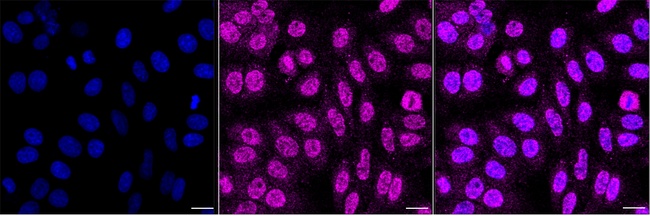
图: 1 / 4
TEAD4 Antibody (MA570551) in ICC/IF
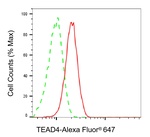
Immunocytochemistry analysis of TEAD4 in HepG2 cells. Sample was incubated with TEAD4 monoclonal antibody (Product # MA570551) at a dilution of 1:1,000. Nuclei were stained blue with DAPI and Alexa Fluor 647. Images were taken using Leica stellaris 5. Protein abundance based on laser Intensity and smart gain: Low. Scale bar, 20 μm.
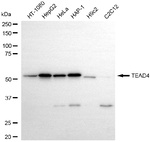
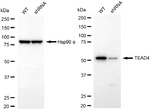
Please note: We are reviewing Western blot images included in the antibody testing data in our catalog, including those provided by third parties. Unless expressly labeled or annotated as “raw-unedited”, Western blot images included in the antibody testing data in our catalog may have been edited, optimized or otherwise adjusted for presentation.


产品信息
MA570551
应用
建议稀释比
已发表文章
产品规格
种属反应
Human,
Mouse,
Rat
宿主/亚型
Rabbit
/ IgG
Expression System
HEK293F
分类
Recombinant Monoclonal
类型
Antibody
克隆号
25GB4515
抗原
Recombinant protein of human TEAD4. The antigenic range is proprietary.
偶联物
Unconjugated
Unconjugated
Unconjugated
形式
Liquid
浓度
2 mg/mL
规格
200 µg
纯化类型
Antigen affinity chromatography
保存液
PBS, pH 7.4, with 50% glycerol
内含物
0.02% sodium azide
保存条件
-20°C
运输条件
Ambient (domestic); Dry ice (international)
靶标信息
This gene product is a member of the transcriptional enhancer factor (TEF) family of transcription factors, which contain the TEA/ATTS DNA-binding domain. It is preferentially expressed in the skeletal muscle, and binds to the M-CAT regulatory element found in promoters of muscle-specific genes to direct their gene expression. Alternatively spliced transcripts encoding distinct isoforms, some of which are translated through the use of a non-AUG (UUG) initiation codon, have been described for this gene.
仅用于科研。不用于诊断过程。未经明确授权不得转售。
篇参考文献 (0)
您是否在文献中引用过该产品?请点击下方按钮邮件告知我们。
生物信息学
蛋白别名: ETF-related factor-2; FGF-regulated 19; hRTEF-1B; related transcription enhancer factor 1B; RTEF-1; TEA domain family member 4; TEF-1-related factor 1; TEF-1-related factor FR-19; TEF-1-related factor; the first amino acid was determined to be isoleucine rather than methionine by comparison to mTEF1 (ascess; the first amino acid was determined to be isoleucine rather than methionine by comparison to mTEF1 (ascession # L13853); TEF-1-related factor; transcription factor 13-like 1; transcription factor RTEF-1; transcriptional enhancer factor 1-related; transcriptional enhancer factor 3
基因别名: EFTR-2; ETFR-2; Etfr2; FR-19; hRTEF-1B; RTEF1; TCF13L1; Tcf13r1; TEAD-4; TEF-3; TEF3; Tefr; TEFR-1; Tefr1; Tefr1a
UniProt ID: (Human) Q15561, (Mouse) Q62296
Entrez Gene ID: (Human) 7004, (Mouse) 21679, (Rat) 683522
RNA polymerase II core promoter proximal region sequence-specific DNA binding
RNA polymerase II transcription factor activity, sequence-specific DNA binding
transcriptional activator activity, RNA polymerase II transcription regulatory region sequence-specific binding
DNA binding
transcription factor activity, sequence-specific DNA binding
protein binding
sequence-specific DNA binding
in utero embryonic development
cell fate specification
blastocyst formation
trophectodermal cell fate commitment
transcription, DNA-templated
regulation of transcription, DNA-templated
regulation of transcription from RNA polymerase II promoter
embryo implantation
hippo signaling
cell fate commitment
positive regulation of transcription, DNA-templated
positive regulation of transcription from RNA polymerase II promoter
embryonic organ development
positive regulation of stem cell population maintenance
skeletal system development
muscle organ development
Disclaimer

Clicking the images or links will redirect you to a website hosted by BenchSci that provides third-party scientific content. Neither the content nor the BenchSci technology and processes for selection have been evaluated by us; we are providing them as-is and without warranty of any kind, including for use or application of the Thermo Fisher Scientific products presented.

