Search
Invitrogen
TIM-1 Polyclonal Antibody
{{$productOrderCtrl.translations['antibody.pdp.commerceCard.promotion.promotions']}}
{{$productOrderCtrl.translations['antibody.pdp.commerceCard.promotion.promocode']}}: {{promo.promoCode}} {{promo.promoTitle}} {{promo.promoDescription}}. {{$productOrderCtrl.translations['antibody.pdp.commerceCard.promotion.learnmore']}}
{{$ctrl.translations['antibody.pdp.skuNotes.additionalInformation']}}:
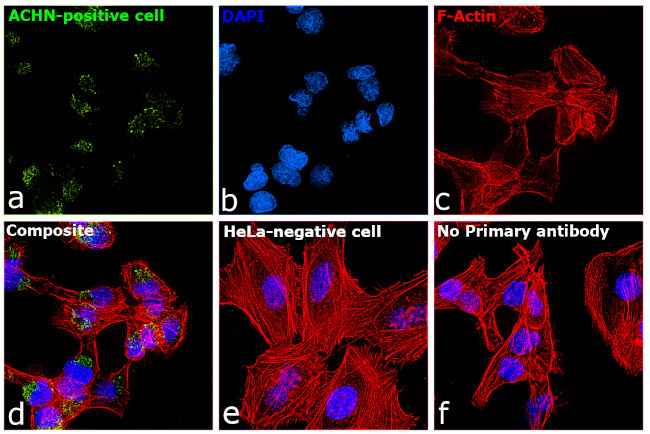
图: 1 / 9
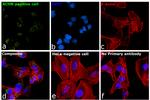
TIM-1 Antibody (PA5-20244) in ICC/IF
Immunofluorescence analysis of TIM-1 was performed using 70% confluent log phase ACHN cells. The cells were fixed with 4% paraformaldehyde for 10 minutes, permeabilized with 0.1% Triton™ X-100 for 10 minutes, and blocked with 2% BSA for 45 minutes at room temperature. The cells were labeled with TIM-1 Polyclonal Antibody (Product # PA5-20244) at 1:200 dilution in 0.1% BSA, incubated at 4 degree celsius overnight and then labeled with Donkey anti-Rabbit IgG (H+L) Highly Cross-Adsorbed Secondary Antibody, Alexa Fluor Plus 488 (Product # A327... View More
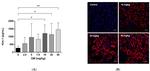
Please note: We are reviewing Western blot images included in the antibody testing data in our catalog, including those provided by third parties. Unless expressly labeled or annotated as “raw-unedited”, Western blot images included in the antibody testing data in our catalog may have been edited, optimized or otherwise adjusted for presentation.


产品信息
PA5-20244
应用
建议稀释比
已发表文章
产品规格
种属反应
Human
已发表种属
Human,
Mouse
宿主/亚型
Rabbit
/ IgG
分类
Polyclonal
类型
Antibody
抗原
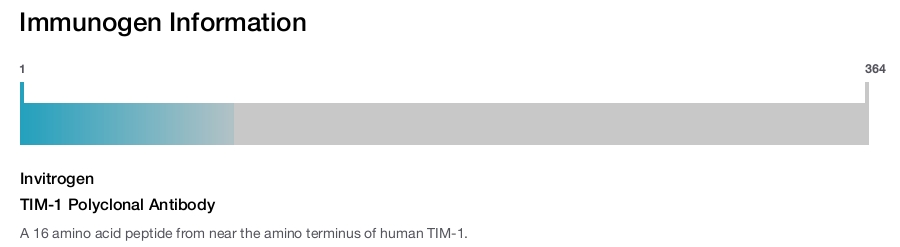
A 16 amino acid peptide from near the amino terminus of human TIM-1.
偶联物
Unconjugated
Unconjugated
Unconjugated
形式
Liquid
浓度
1 mg/mL
规格
100 µg
纯化类型
Antigen affinity chromatography
保存液
PBS
内含物
0.02% sodium azide
保存条件
4°C
运输条件
Ambient (domestic); Wet ice (international)
RRID
产品详细信息
A suggested positive control is human uterus tissue lysate.
PA5-20244 can be used with blocking peptide PEP-0363.
The PA5-20244 immunogen is located within amino acids 50 - 100 of TIM-1.
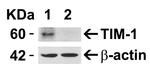
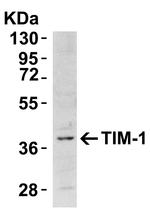
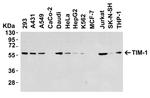
Predicted molecular ~ 44kD. In Western blot applications, this antibody has been observed to detect a band at: 60kD (Post-modification: 4 N-linked glycosylation)
Predicted species reactivity based on immunogen sequence: Mouse: (63%), Rat: (56%)
靶标信息
CD365 also known as T-cell immunoglobulin and mucin domain 1 (Tim-1) is a type 1 surface glycoprotein that consists of extracellular N-terminal immunoglobulin V-like domain and a mucin domain, and a short cytoplasmic tail. The endogenous ligand for CD365 is Tim-4. In addition, CD365 is known to be a cellular receptor or co-receptor for a number of viruses including hepatitis A and C viruses, Ebola virus, Marburg virus, Dengue virus, Zika virus, West Nile virus, and Japanese encephalitis virus. The direct binding of the viruses by CD365 occurs via phosphatildyl-serine exposed on viral envelopes. Polymorphisms within human CD365 gene (HAVCR1) are associated with susceptibility to infection and the disease severity. CD365 has also been implicated in the T cell co-stimulation. CD365 is primarily expressed in epithelial cells. It is also highly expressed in A549, 769-P and Caco-2 and cell lines. CD365 exists also as a soluble protein generated by metalloproteinase mediated proteolytic cleavage of the surface protein.
仅用于科研。不用于诊断过程。未经明确授权不得转售。
生物信息学
蛋白别名: HAVCR1; kidney injury molecule 1; T cell immunoglobin domain and mucin domain protein 1; T-cell immunoglobulin mucin family member 1; T-cell immunoglobulin mucin receptor 1; T-cell membrane protein 1; unnamed protein product
基因别名: CD365; HAVCR; HAVCR-1; KIM-1; KIM1; TIM; TIM-1; TIM1; TIMD-1; TIMD1
UniProt ID: (Human) Q96D42
Entrez Gene ID: (Human) 26762
Disclaimer

Clicking the images or links will redirect you to a website hosted by BenchSci that provides third-party scientific content. Neither the content nor the BenchSci technology and processes for selection have been evaluated by us; we are providing them as-is and without warranty of any kind, including for use or application of the Thermo Fisher Scientific products presented.

