Search
Antibodies Inc
TRAAK Potassium Channel Monoclonal Antibody (N445/27)
{{$productOrderCtrl.translations['antibody.pdp.commerceCard.promotion.promotions']}}
{{$productOrderCtrl.translations['antibody.pdp.commerceCard.promotion.promocode']}}: {{promo.promoCode}} {{promo.promoTitle}} {{promo.promoDescription}}. {{$productOrderCtrl.translations['antibody.pdp.commerceCard.promotion.learnmore']}}
{{$ctrl.translations['antibody.pdp.skuNotes.additionalInformation']}}:
产品信息
75-433
应用
建议稀释比
已发表文章
产品规格
种属反应
Mouse,
Rat
宿主/亚型
Mouse
/ IgG2a
分类
Monoclonal
类型
Antibody
克隆号
N445/27
抗原
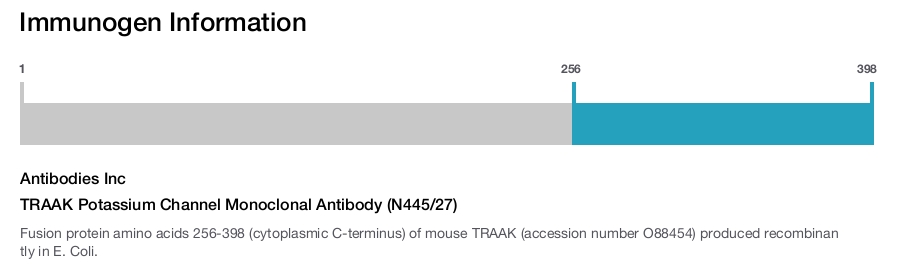
Fusion protein amino acids 256-398 (cytoplasmic C-terminus) of mouse TRAAK (accession number O88454) produced recombinantly in E. Coli.
偶联物
Unconjugated
Unconjugated
Unconjugated
形式
Liquid
浓度
1 mg/mL
规格
100 µg
纯化类型
Protein A
保存液
TBS, pH 7.4
内含物
0.065% sodium azide
保存条件
Store at 4°C short term. For long term storage, store at -20°C, avoiding freeze/thaw cycles.
运输条件
Ambient (domestic); Dry ice (international)
产品详细信息
For maximum recovery of product, centrifuge the vial prior to removing the cap.
靶标信息
Potassium channels play a role in many cellular processes including maintenance of the action potential, muscle contraction, hormone secretion, osmotic regulation, and ion flow. This gene encodes one of the members of the superfamily of potassium channel proteins containing two pore-forming P domains. The encoded protein homodimerizes and functions as an outwardly rectifying channel. It is expressed primarily in neural tissues and is stimulated by membrane stretch and polyunsaturated fatty acids.
仅用于科研。不用于诊断过程。未经明确授权不得转售。
篇参考文献 (0)
您是否在文献中引用过该产品?请点击下方按钮邮件告知我们。
生物信息学
蛋白别名: KCNK4; KT4.1b; pore-forming K+ channel subunit; potassium channel, two pore domain subfamily K, member 4; potassium inwardly-rectifying channel, subfamily K, member 4; protein expressed in male leptotene and zygotene spermatocytes 622; TWIK-related arachidonic acid-stimulated potassium channel protein
基因别名: KT4.1; TRAAK; TRAAKt
UniProt ID: (Rat) G3V8V5, (Mouse) O88454
Entrez Gene ID: (Rat) 116489, (Mouse) 16528
memory
neuronal action potential
sensory perception of pain
sensory perception of temperature stimulus
detection of mechanical stimulus involved in sensory perception of touch
cellular response to mechanical stimulus
cellular response to fatty acid
cellular response to acidic pH
cellular response to alkaline pH
cellular response to temperature stimulus
potassium ion transmembrane transport
cellular response to arachidonate
response to ultrasound
Disclaimer

Clicking the images or links will redirect you to a website hosted by BenchSci that provides third-party scientific content. Neither the content nor the BenchSci technology and processes for selection have been evaluated by us; we are providing them as-is and without warranty of any kind, including for use or application of the Thermo Fisher Scientific products presented.

