Search
NeoBiotechnologies
TRPS1 (Transcriptional repressor GATA binding 1) Recombinant Rabbit Monoclonal Antibody (MSVA-512R)
{{$productOrderCtrl.translations['antibody.pdp.commerceCard.promotion.promotions']}}
{{$productOrderCtrl.translations['antibody.pdp.commerceCard.promotion.promocode']}}: {{promo.promoCode}} {{promo.promoTitle}} {{promo.promoDescription}}. {{$productOrderCtrl.translations['antibody.pdp.commerceCard.promotion.learnmore']}}
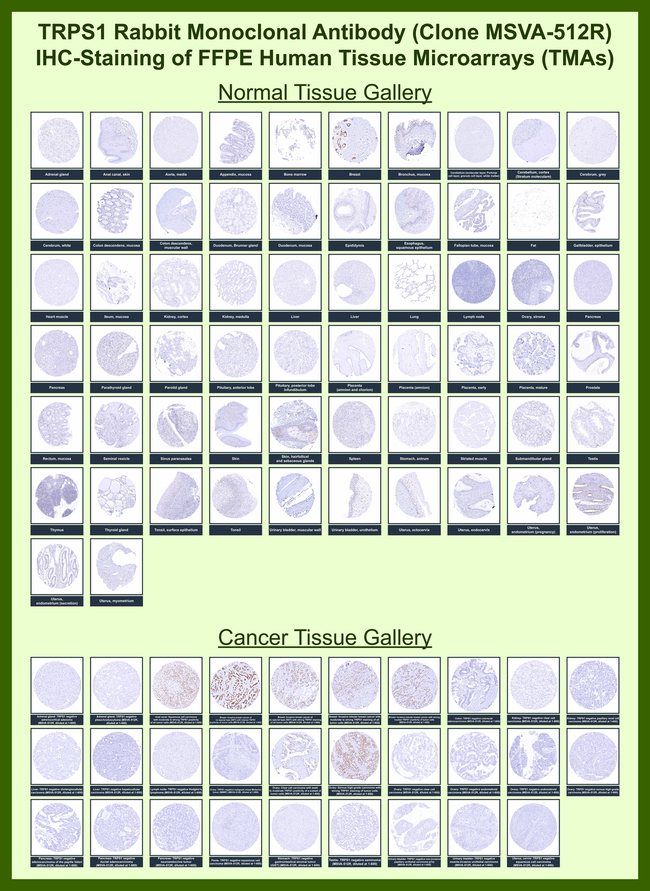
图: 1 / 1
TRPS1 (Transcriptional repressor GATA binding 1) Antibody (7227-RBM13-P1) in IHC (P)
Zinc finger transcription factor Trps1 Rabbit Recombinant Monoclonal Antibody (MSVA-512R) tested on many normal and cancer tissues. The immunohistochemistry staining in these tissues aligns with the expression data in Human Protein Atlas.
Please note: We are reviewing Western blot images included in the antibody testing data in our catalog, including those provided by third parties. Unless expressly labeled or annotated as “raw-unedited”, Western blot images included in the antibody testing data in our catalog may have been edited, optimized or otherwise adjusted for presentation.


产品信息
7227-RBM13-P1
产品规格
种属反应
Human
宿主/亚型
Rabbit
/ IgG, kappa
Expression System
CHO cells
分类
Recombinant Monoclonal
类型
Antibody
克隆号
MSVA-512R
抗原
Recombinant fragment (around aa 900-1100) of human TRPS1 protein (exact sequence is proprietary).
偶联物
Unconjugated
Unconjugated
Unconjugated
形式
Liquid
浓度
200 µg/mL
规格
100 µg
纯化类型
Protein A
保存液
PBS with 0.05% BSA
内含物
0.05% sodium azide
保存条件
4°C
运输条件
Ambient (domestic); Wet ice (international)
产品详细信息
Product cellular localization: Centrosome, Cytoplasm, Cytoskeleton, Endoplasmic reticulum, Microtubule organizing center, Mitochondrion matrix, Nucleus, PML body.
Positive control: Tonsil: More than 20 % of germinal centre B-cells must show a weak to moderate nuclear staining.
Tissue specificity: Ubiquitous. Isoforms are expressed in a wide range of normal tissues but in a tissue-dependent manner. Isoform 2 is expressed in most normal tissues but is not detected in brain, lung, prostate, muscle, fetal brain, spinal cord and fetal liver. Isoform 3 is expressed in most normal tissues but is not detected in lung, spleen, testis, fetal brain, spinal cord and fetal liver. Isoform 7 is expressed in most normal tissues but is not detected in prostate, uterus, skeletal muscle and breast. Isoform 8 is detected only in colon, bone marrow, testis, fetal brain and intestine. Isoform 9 is expressed in most normal tissues but is not detected in brain, heart, lung, fetal liver, salivary gland, breast or intestine.
靶标信息
This gene encodes a transcription factor that represses GATA-regulated genes and binds to a dynein light chain protein. Binding of the encoded protein to the dynein light chain protein affects binding to GATA consensus sequences and suppresses its transcriptional activity. Defects in this gene are a cause of tricho-rhino-phalangeal syndrome (TRPS) types I-III. [provided by RefSeq].
仅用于科研。不用于诊断过程。未经明确授权不得转售。
篇参考文献 (0)
您是否在文献中引用过该产品?请点击下方按钮邮件告知我们。
生物信息学
蛋白别名: prostate cancer gene product; tricho-rhino-phalangeal syndrome type I protein; trichorhinophalangeal syndrome I; unnamed protein product; zinc finger protein GC79
基因别名: GC79; LGCR
UniProt ID: (Human) Q9UHF7
Entrez Gene ID: (Human) 7227
RNA polymerase II regulatory region sequence-specific DNA binding
transcriptional repressor activity, RNA polymerase II transcription regulatory region sequence-specific binding
transcription factor activity, sequence-specific DNA binding
protein binding
zinc ion binding
protein domain specific binding
sequence-specific DNA binding
Disclaimer

Clicking the images or links will redirect you to a website hosted by BenchSci that provides third-party scientific content. Neither the content nor the BenchSci technology and processes for selection have been evaluated by us; we are providing them as-is and without warranty of any kind, including for use or application of the Thermo Fisher Scientific products presented.

