Search
Invitrogen
Thiamphenicols Recombinant Mouse Monoclonal Antibody (2D6)
{{$productOrderCtrl.translations['antibody.pdp.commerceCard.promotion.promotions']}}
{{$productOrderCtrl.translations['antibody.pdp.commerceCard.promotion.promocode']}}: {{promo.promoCode}} {{promo.promoTitle}} {{promo.promoDescription}}. {{$productOrderCtrl.translations['antibody.pdp.commerceCard.promotion.learnmore']}}
{{$ctrl.translations['antibody.pdp.skuNotes.additionalInformation']}}:
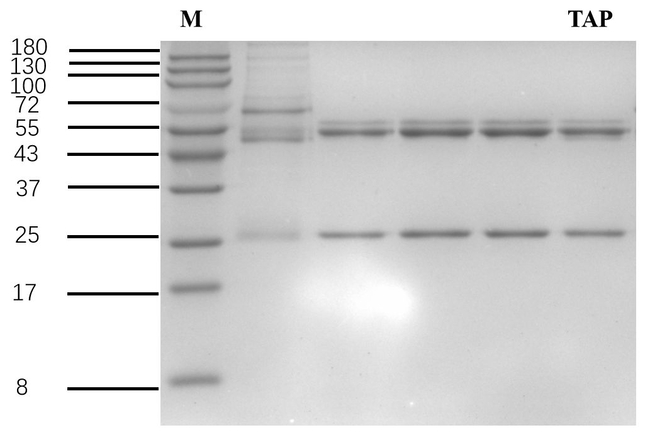
图: 1 / 1
Thiamphenicols Antibody (MA566282) in SDS-PAGE
SDS-PAGE characterization of Thiamphenicols under reducing conditions. Lane M: Protein marker (kDa); Lane TAP: Purified Thiamphenicols Recombinant Monoclonal (Product # MA566282). Thiamphenicols showing heavy chain (~50 kDa) and light chain (~25 kDa). Gels were stained with Coomassie Brilliant Blue R-396.
Please note: We are reviewing Western blot images included in the antibody testing data in our catalog, including those provided by third parties. Unless expressly labeled or annotated as “raw-unedited”, Western blot images included in the antibody testing data in our catalog may have been edited, optimized or otherwise adjusted for presentation.

产品信息
MA566282
产品规格
种属反应
Chemical
宿主/亚型
Mouse
/ IgG
Expression System
CHO cells
分类
Recombinant Monoclonal
类型
Antibody
克隆号
2D6
抗原
Conjugate of TAP hapten and KLH.
偶联物
Unconjugated
Unconjugated
Unconjugated
形式
Liquid
浓度
2.7 mg/mL
规格
200 µg
纯化类型
Protein G
保存液
PBS
内含物
0.09% sodium azide
保存条件
-20°C
运输条件
Ambient (domestic); Wet ice (international)
RRID
靶标信息
Thiamphenicol, a derivative of chloramphenicol, is a broad-spectrum antibiotic predominantly used in veterinary medicine to treat bacterial infections due to its enhanced safety profile. Structurally, thiamphenicol is similar to chloramphenicol but lacks the nitro group, replaced by a methyl-sulfonyl group, which reduces its toxicity and potential for causing aplastic anemia, a rare but serious side effect associated with chloramphenicol. Thiamphenicol functions by inhibiting bacterial protein synthesis through binding to the 50S ribosomal subunit, thus preventing peptide bond formation and halting microbial growth. It is effective against a wide range of Gram-positive and Gram-negative bacteria, making it valuable in treating respiratory, gastrointestinal, and urogenital infections in animals. The pharmacokinetics of thiamphenicol allow for diverse therapeutic applications, though careful monitoring of dosage and potential resistance is necessary. Research into thiamphenicol focuses on optimizing its use while expanding its applications in both animal and potentially human medicine.
仅用于科研。不用于诊断过程。未经明确授权不得转售。
篇参考文献 (0)
您是否在文献中引用过该产品?请点击下方按钮邮件告知我们。
Disclaimer

Clicking the images or links will redirect you to a website hosted by BenchSci that provides third-party scientific content. Neither the content nor the BenchSci technology and processes for selection have been evaluated by us; we are providing them as-is and without warranty of any kind, including for use or application of the Thermo Fisher Scientific products presented.

